Thank you for visiting SNEWPapers!
Sign up free
Editorial
September 15, 1790
Gazette Of The United States
New York, New York County, New York
What is this article about?
The editorial contends that societal vices and idleness arise from flawed institutions rather than human nature, advocating for laws that foster industry, knowledge, and virtue to prevent moral decay, citing recent urban improvements as evidence.
Merged-components note: These two sequential components form a single continuous editorial discussing societal evils, institutions, and principles for reform.
Clipping
OCR Quality
98%
Excellent
Full Text
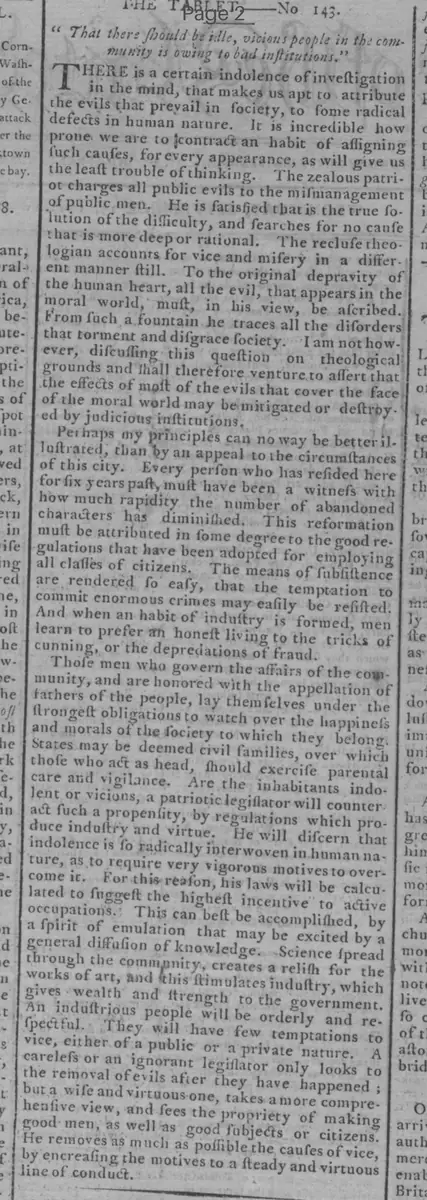
"That there should be idle, vicious people in the community is owing to bad institutions.
There is nothing more common in the mind, that makes us apt to attribute the evils that prevail in society, to some radical defects in human nature. It is incredible how prone we are to contract an habit of assigning such causes, for every appearance, as will give us the least trouble of thinking. The zealous patriot charges all public evils to the mismanagement of public men. He is satisfied that is the true solution of the difficulty, and searches for no cause that is more deep or rational. The recluse theologian accounts for vice and misery in a different manner still. To the original depravity of the human heart, all the evil, that appears in the moral world, must, in his view, be ascribed. From such a fountain he traces all the disorders that torment and disgrace society. I am not, however, discussing this question on theological grounds and shall therefore venture to assert that the effects of most of the evils that cover the face of the moral world may be mitigated or destroyed by judicious institutions.
Perhaps my principles can no way be better illustrated, than by an appeal to the circumstances of this city. Every person who has resided here for six years past must have been a witness with how much rapidity the number of abandoned characters has diminished. This reformation must be attributed in some degree to the good regulations that have been adopted for employing all classes of citizens. The means of subsistence are rendered so easy, that the temptation to commit enormous crimes may easily be resisted. And when an habit of industry is formed, men learn to prefer an honest living to the tricks of cunning, or the depredations of fraud. Those men who govern the affairs of the community, and are honored with the appellation of fathers of the people, lay themselves under the strongest obligations to watch over the happiness and morals of the society to which they belong. States may be deemed civil families, over which those who act as head, should exercise care and vigilance. Are the inhabitants indolent or vicious, a patriotic legislator will counteract such a propensity, by regulations which produce industry and virtue. He will discern that indolence is so radically interwoven in human nature, as to require very vigorous motives to overcome it. For this reason, his laws will be calculated to suggest the highest incentive to active occupations. This can best be accomplished, by a spirit of emulation that may be excited by a general diffusion of knowledge. Science spread through the community, creates a relish for the works of art, and this stimulates industry, which gives wealth and strength to the government. An industrious people will be orderly and respectful. They will have few temptations to vice, either of a public or a private nature. A careless or an ignorant legislator only looks to the removal of evils after they have happened; but a wise and virtuous one, takes a more comprehensive view, and sees the propriety of making good men, as well as good subjects or citizens. He removes as much as possible the causes of vice, by increasing the motives to a steady and virtuous line of conduct."
There is nothing more common in the mind, that makes us apt to attribute the evils that prevail in society, to some radical defects in human nature. It is incredible how prone we are to contract an habit of assigning such causes, for every appearance, as will give us the least trouble of thinking. The zealous patriot charges all public evils to the mismanagement of public men. He is satisfied that is the true solution of the difficulty, and searches for no cause that is more deep or rational. The recluse theologian accounts for vice and misery in a different manner still. To the original depravity of the human heart, all the evil, that appears in the moral world, must, in his view, be ascribed. From such a fountain he traces all the disorders that torment and disgrace society. I am not, however, discussing this question on theological grounds and shall therefore venture to assert that the effects of most of the evils that cover the face of the moral world may be mitigated or destroyed by judicious institutions.
Perhaps my principles can no way be better illustrated, than by an appeal to the circumstances of this city. Every person who has resided here for six years past must have been a witness with how much rapidity the number of abandoned characters has diminished. This reformation must be attributed in some degree to the good regulations that have been adopted for employing all classes of citizens. The means of subsistence are rendered so easy, that the temptation to commit enormous crimes may easily be resisted. And when an habit of industry is formed, men learn to prefer an honest living to the tricks of cunning, or the depredations of fraud. Those men who govern the affairs of the community, and are honored with the appellation of fathers of the people, lay themselves under the strongest obligations to watch over the happiness and morals of the society to which they belong. States may be deemed civil families, over which those who act as head, should exercise care and vigilance. Are the inhabitants indolent or vicious, a patriotic legislator will counteract such a propensity, by regulations which produce industry and virtue. He will discern that indolence is so radically interwoven in human nature, as to require very vigorous motives to overcome it. For this reason, his laws will be calculated to suggest the highest incentive to active occupations. This can best be accomplished, by a spirit of emulation that may be excited by a general diffusion of knowledge. Science spread through the community, creates a relish for the works of art, and this stimulates industry, which gives wealth and strength to the government. An industrious people will be orderly and respectful. They will have few temptations to vice, either of a public or a private nature. A careless or an ignorant legislator only looks to the removal of evils after they have happened; but a wise and virtuous one, takes a more comprehensive view, and sees the propriety of making good men, as well as good subjects or citizens. He removes as much as possible the causes of vice, by increasing the motives to a steady and virtuous line of conduct."
What sub-type of article is it?
Social Reform
Moral Or Religious
Education
What keywords are associated?
Social Evils
Bad Institutions
Industry Promotion
Virtue Cultivation
Knowledge Diffusion
Moral Reform
Legislative Duty
Human Indolence
What entities or persons were involved?
Patriotic Legislator
Fathers Of The People
Editorial Details
Primary Topic
Institutions Mitigating Social Evils Through Industry And Knowledge
Stance / Tone
Advocacy For Legislative Promotion Of Virtue And Industry
Key Figures
Patriotic Legislator
Fathers Of The People
Key Arguments
Social Evils Like Idleness And Vice Result From Bad Institutions, Not Inherent Human Defects
Judicious Institutions Can Mitigate Or Eliminate Most Moral Evils
Recent City Reforms Reduced Abandoned Characters Via Employment Regulations
Easy Subsistence Reduces Crime Temptation And Fosters Honest Industry
Legislators Must Promote Industry And Virtue To Counteract Indolence
Diffusion Of Knowledge Excites Emulation, Stimulates Industry, And Strengthens Government
Industrious People Are Orderly, Respectful, And Less Tempted By Vice
Wise Legislators Prevent Evils By Increasing Motives For Virtuous Conduct