Thank you for visiting SNEWPapers!
Sign up free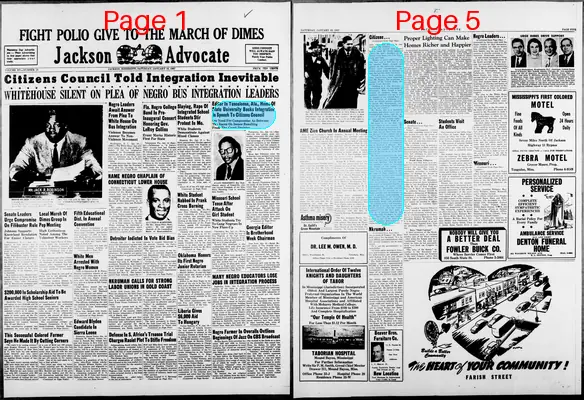
Jackson Advocate
Jackson, Hinds County, Mississippi
What is this article about?
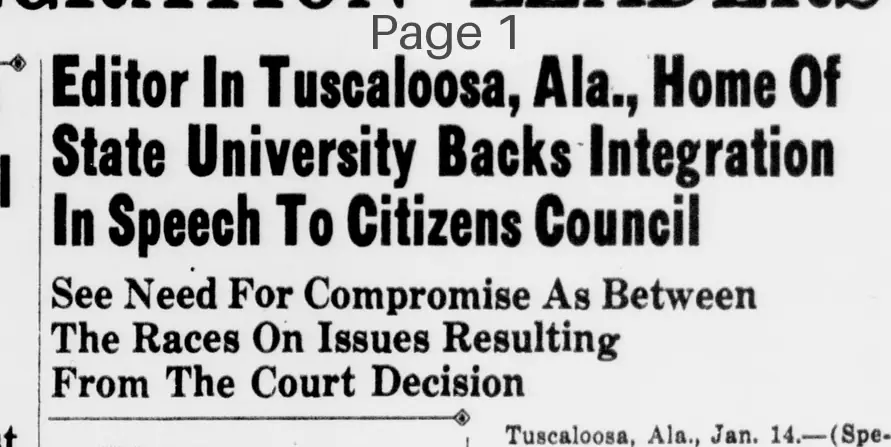
In Tuscaloosa, Alabama, editor Mr. Boone addresses the Citizens Council on January 4, backing the Supreme Court's school integration ruling, urging racial compromise, and highlighting the need for Southern acceptance to avoid national backlash. (187 characters)
Merged-components note: Wait, correction: this is for Editor in Tuscaloosa; merged page 1 ro28 and page 5 ro98 (text matches continuation about condemning violence).
Clippings
1 of 2
OCR Quality
Full Text
See Need For Compromise As Between The Races On Issues Resulting From The Court Decision
were reasonably prompt in condemning the violence.
After the council had invited him to speak Mr. Boone appeared before the unit's members at the county court house Jan. 4 in Tuscaloosa and said:
"Sooner or later, and I have no idea how soon or how late it will be, another Negro student will appear on the university campus.
Under such circumstances are whites again going to attempt to take the law into their own hands?"
Though it was a basic question, what seemed even more important was Mr. Boone's flat assertions in support of the United States Supreme Court decision:
"Nothing in it (the decision) is inconsistent with my conception of democracy. Even though a background of southern living and southern tradition tells me it will be strange to see colored faces at the University of Alabama. I believe we should prepare ourselves to accept this development, since it has been ordered as rightful and just by our courts."
Mr. Boone, who is a university graduate, and whose son is now an undergraduate there, said the decision of the Supreme Court "had to come and was morally right."
"Can't Get Away With It"
He went on to say that "this United States is one country. We in the South are outnumbered. We don't like what the Supreme Court has said, but we have been ignoring the rest of the country, and we can't do that and get away with it.
"They're going to do like you and I would if one of our communities told us it meant to violate the law as much as it pleased. We'd control them lawfully. So will the rest of the country use the full force of the law on us, if we drive them to it."
Mr. Boone emphasized the need for compromise, as between the races, on the issues resulting from the court decision. But he made this emphasis clear in accepting the weight of the ruling: "for whites the contribution," he said, "must be in a willingness to give up some of their traditions and customs so as to share more equally the blessings of education.
"For the Negro, the contribution must be acceptance of less speed than could be demanded legally in implementation of newly established rights. Meanwhile, time and attention can be directed by our Negro groups and institutions toward a greater understanding of the responsibilities of first-class citizenship. For there is much responsibility along with privilege."
In making such a bold utterance, Mr. Boone is certain to win additional criticism. But his record especially over the past year, is such as to indicate that he will continue, with his paper, to stand firm. Thus far he has marked himself as one of the most courageous southern newspapermen in connection with the racial issues.
What sub-type of article is it?
What themes does it cover?
What keywords are associated?
What entities or persons were involved?
Where did it happen?
Story Details
Key Persons
Location
Tuscaloosa, Ala., County Courthouse
Event Date
Jan. 4
Story Details
Editor Mr. Boone speaks to the Citizens Council in Tuscaloosa, supporting the U.S. Supreme Court decision on integration at the University of Alabama, calling for compromise between races, and emphasizing acceptance of the ruling despite Southern traditions.