Thank you for visiting SNEWPapers!
Sign up free
Jeffersonian Republican
Stroudsburg, East Stroudsburg, Milford, Monroe County, Pike County, Pennsylvania
What is this article about?
Two key compromise plans on slavery in U.S. territories: President Taylor's proposal for military governments allowing territories to decide slavery upon statehood, and Mr. Clay's for territorial governments without slavery restrictions. Objections noted for each, with Slave States preferring 36°30' or Clayton's Supreme Court reference.
Clipping
OCR Quality
Full Text
Mr. Clay proposes territorial governments, with no Slavery restrictions on either side, thus flinging the responsibility on the territories themselves. The principal objection urged to this plan is that neither the North nor the South will accept it. The Slave States feel inclined to compromise only on 36,30, or on Clayton's proposition of a reference of the whole subject to the Supreme Court.--Miners' Journal.
What sub-type of article is it?
What keywords are associated?
What entities or persons were involved?
Domestic News Details
Key Persons
Event Details
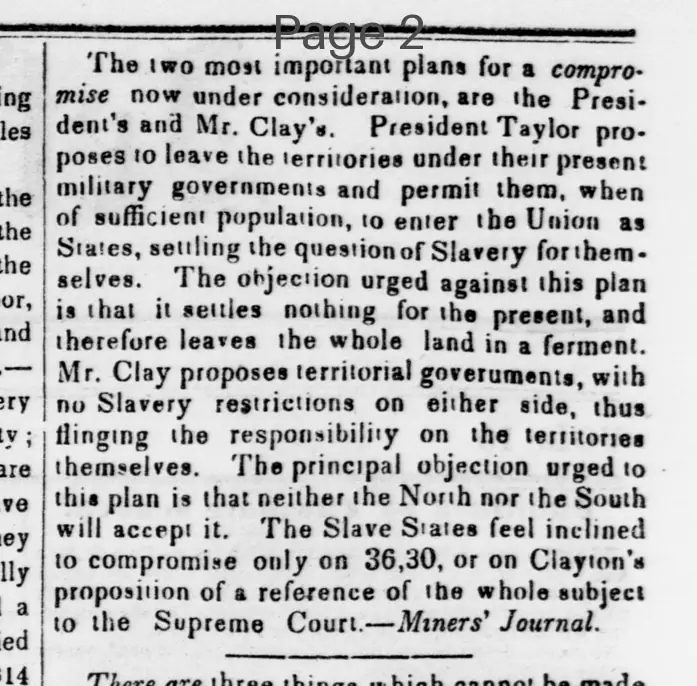
The two most important plans for a compromise now under consideration are the President's and Mr. Clay's. President Taylor proposes to leave the territories under their present military governments and permit them, when of sufficient population, to enter the Union as States, settling the question of Slavery for themselves. The objection urged against this plan is that it settles nothing for the present, and therefore leaves the whole land in a ferment. Mr. Clay proposes territorial governments, with no Slavery restrictions on either side, thus flinging the responsibility on the territories themselves. The principal objection urged to this plan is that neither the North nor the South will accept it. The Slave States feel inclined to compromise only on 36,30, or on Clayton's proposition of a reference of the whole subject to the Supreme Court.