Thank you for visiting SNEWPapers!
Sign up free
Story
October 4, 1939
Imperial Valley Press
El Centro, Imperial County, California
What is this article about?
Bruce Catton examines 529 letters to a senator, finding 492 oppose changes to the neutrality law, with over half spontaneous, indicating genuine public sentiment against altering it amid pressure from organizations.
Clipping
OCR Quality
98%
Excellent
Full Text
Bruce Catton in Washington
Dissects the News
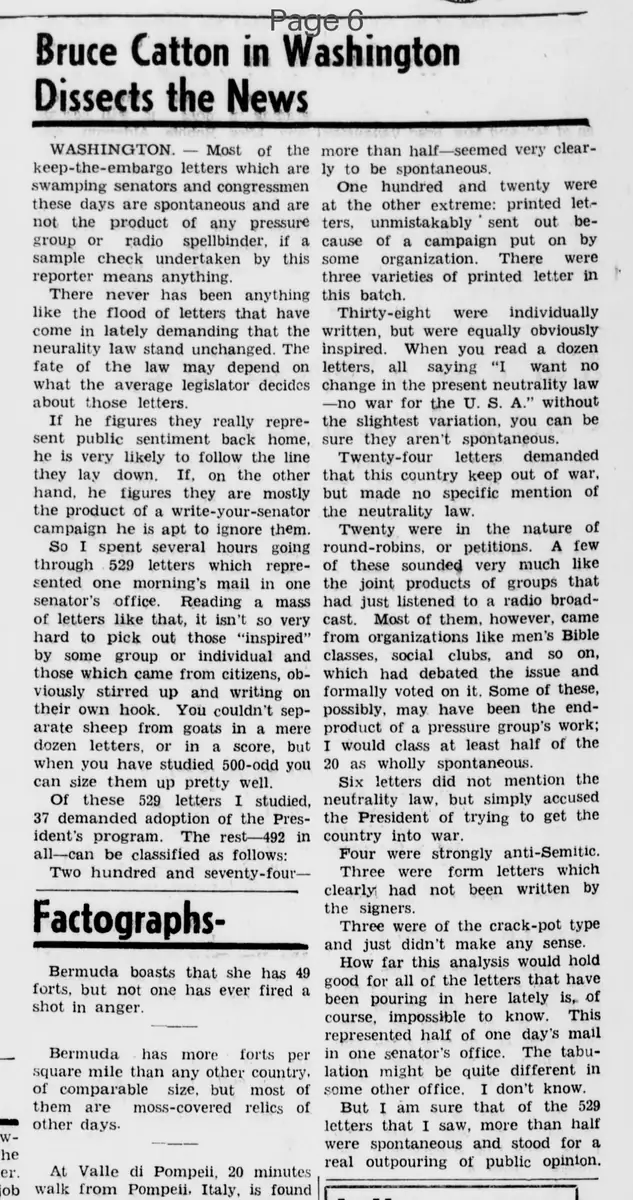
WASHINGTON. - Most of the keep-the-embargo letters which are swamping senators and congressmen these days are spontaneous and are not the product of any pressure group or radio spellbinder, if a sample check undertaken by this reporter means anything.
There never has been anything like the flood of letters that have come in lately demanding that the neutrality law stand unchanged. The fate of the law may depend on what the average legislator decides about those letters.
If he figures they really represent public sentiment back home, he is very likely to follow the line they lay down. If, on the other hand, he figures they are mostly the product of a write-your-senator campaign he is apt to ignore them.
So I spent several hours going through 529 letters which represented one morning's mail in one senator's office. Reading a mass of letters like that, it isn't so very hard to pick out those "inspired" by some group or individual and those which came from citizens, obviously stirred up and writing on their own hook. You couldn't separate sheep from goats in a mere dozen letters, or in a score, but when you have studied 500-odd you can size them up pretty well.
Of these 529 letters I studied, 37 demanded adoption of the President's program. The rest--492 in all--can be classified as follows:
Two hundred and seventy-four--more than half--seemed very clearly to be spontaneous.
One hundred and twenty were at the other extreme: printed letters, unmistakably 'sent out because of a campaign put on by some organization.' There were three varieties of printed letter in this batch.
Thirty-eight were individually written, but were equally obviously inspired. When you read a dozen letters, all saying "I want no change in the present neutrality law --no war for the U. S. A." without the slightest variation, you can be sure they aren't spontaneous.
Twenty-four letters demanded that this country keep out of war, but made no specific mention of the neutrality law.
Twenty were in the nature of round-robins, or petitions. A few of these sounded very much like the joint products of groups that had just listened to a radio broadcast. Most of them, however, came from organizations like men's Bible classes, social clubs, and so on, which had debated the issue and formally voted on it. Some of these, possibly, may have been the end-product of a pressure group's work; I would class at least half of the 20 as wholly spontaneous.
Six letters did not mention the neutrality law, but simply accused the President of trying to get the country into war.
Four were strongly anti-Semitic.
Three were form letters which clearly had not been written by the signers.
Three were of the crack-pot type and just didn't make any sense.
How far this analysis would hold good for all of the letters that have been pouring in here lately is, of course, impossible to know. This represented half of one day's mail in one senator's office. The tabulation might be quite different in some other office. I don't know.
But I am sure that of the 529 letters that I saw, more than half were spontaneous and stood for a real outpouring of public opinion.
Dissects the News
WASHINGTON. - Most of the keep-the-embargo letters which are swamping senators and congressmen these days are spontaneous and are not the product of any pressure group or radio spellbinder, if a sample check undertaken by this reporter means anything.
There never has been anything like the flood of letters that have come in lately demanding that the neutrality law stand unchanged. The fate of the law may depend on what the average legislator decides about those letters.
If he figures they really represent public sentiment back home, he is very likely to follow the line they lay down. If, on the other hand, he figures they are mostly the product of a write-your-senator campaign he is apt to ignore them.
So I spent several hours going through 529 letters which represented one morning's mail in one senator's office. Reading a mass of letters like that, it isn't so very hard to pick out those "inspired" by some group or individual and those which came from citizens, obviously stirred up and writing on their own hook. You couldn't separate sheep from goats in a mere dozen letters, or in a score, but when you have studied 500-odd you can size them up pretty well.
Of these 529 letters I studied, 37 demanded adoption of the President's program. The rest--492 in all--can be classified as follows:
Two hundred and seventy-four--more than half--seemed very clearly to be spontaneous.
One hundred and twenty were at the other extreme: printed letters, unmistakably 'sent out because of a campaign put on by some organization.' There were three varieties of printed letter in this batch.
Thirty-eight were individually written, but were equally obviously inspired. When you read a dozen letters, all saying "I want no change in the present neutrality law --no war for the U. S. A." without the slightest variation, you can be sure they aren't spontaneous.
Twenty-four letters demanded that this country keep out of war, but made no specific mention of the neutrality law.
Twenty were in the nature of round-robins, or petitions. A few of these sounded very much like the joint products of groups that had just listened to a radio broadcast. Most of them, however, came from organizations like men's Bible classes, social clubs, and so on, which had debated the issue and formally voted on it. Some of these, possibly, may have been the end-product of a pressure group's work; I would class at least half of the 20 as wholly spontaneous.
Six letters did not mention the neutrality law, but simply accused the President of trying to get the country into war.
Four were strongly anti-Semitic.
Three were form letters which clearly had not been written by the signers.
Three were of the crack-pot type and just didn't make any sense.
How far this analysis would hold good for all of the letters that have been pouring in here lately is, of course, impossible to know. This represented half of one day's mail in one senator's office. The tabulation might be quite different in some other office. I don't know.
But I am sure that of the 529 letters that I saw, more than half were spontaneous and stood for a real outpouring of public opinion.
What sub-type of article is it?
Historical Event
Curiosity
What themes does it cover?
Social Manners
Justice
What keywords are associated?
Neutrality Law
Public Opinion
Spontaneous Letters
Pressure Groups
Senator Mail
Anti War Sentiment
What entities or persons were involved?
Bruce Catton
President
Where did it happen?
Washington
Story Details
Key Persons
Bruce Catton
President
Location
Washington
Story Details
Bruce Catton analyzes 529 letters to a senator, classifying most as spontaneous opposition to changing the neutrality law, with some from organized campaigns, reflecting public sentiment against U.S. involvement in war.