Thank you for visiting SNEWPapers!
Sign up free
Editorial
November 13, 1832
Constitutional Whig
Richmond, Virginia
What is this article about?
This editorial contrasts the torment of constant amusement and recreation with the enduring pleasure and virtue found in diligent industry and work as a profession. It argues that providence enables useful labors to be pursued without satiety, promoting happiness and morality, and cites Samuel Johnson and Robert Burton in support.
Clipping
OCR Quality
98%
Excellent
Full Text
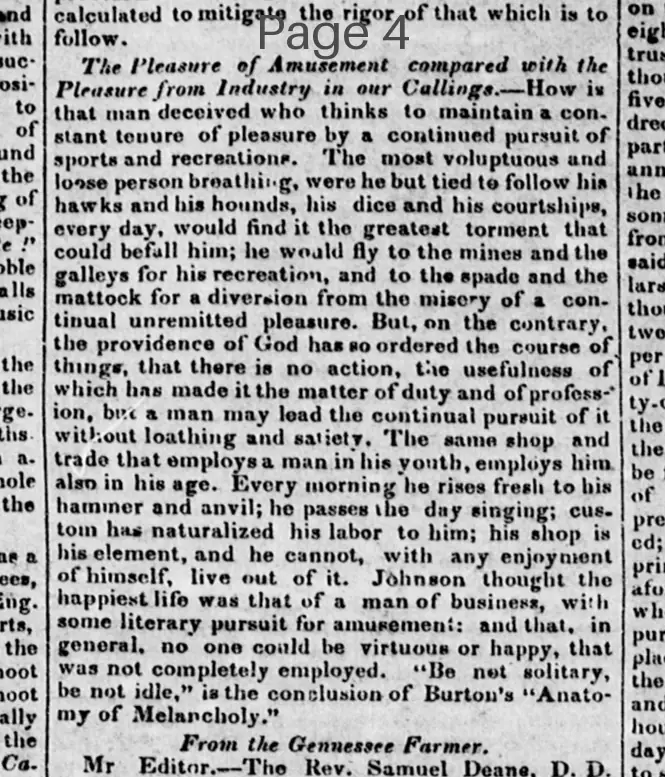
The Pleasure of Amusement compared with the Pleasure from Industry in our Callings.—How is that man deceived who thinks to maintain a constant tenure of pleasure by a continued pursuit of sports and recreations. The most voluptuous and loose person breathing, were he but tied to follow his hawks and his hounds, his dice and his courtships, every day, would find it the greatest torment that could befall him; he would fly to the mines and the galleys for his recreation, and to the spade and the mattock for a diversion from the misery of a continual unremitted pleasure. But, on the contrary, the providence of God has so ordered the course of things, that there is no action, the usefulness of which has made it the matter of duty and of profession, but a man may load the continual pursuit of it without loathing and satiety. The same shop and trade that employs a man in his youth, employs him also in his age. Every morning he rises fresh to his hammer and anvil; he passes the day singing; custom has naturalized his labor to him; his shop is his element, and he cannot, with any enjoyment of himself, live out of it. Johnson thought the happiest life was that of a man of business, with some literary pursuit for amusement: and that, in general, no one could be virtuous or happy, that was not completely employed. "Be not solitary, be not idle," is the conclusion of Burton's "Anatomy of Melancholy."
What sub-type of article is it?
Moral Or Religious
Social Reform
What keywords are associated?
Pleasure From Industry
Virtue In Work
Against Idleness
Moral Happiness
Providence In Labor
What entities or persons were involved?
Johnson
Burton
Anatomy Of Melancholy
Editorial Details
Primary Topic
Pleasure From Industry Versus Amusement
Stance / Tone
Advocacy For Virtue And Happiness Through Diligent Work
Key Figures
Johnson
Burton
Anatomy Of Melancholy
Key Arguments
Constant Pursuit Of Amusements Leads To Torment And Satiety
Providence Orders Useful Duties To Be Pursued Without Loathing
Labor Becomes Enjoyable Through Custom And Routine
Happiest Life Is Business With Literary Amusement
Virtue And Happiness Require Complete Employment
Be Not Solitary, Be Not Idle