Thank you for visiting SNEWPapers!
Sign up free
Literary
July 15, 1789
Gazette Of The United States
New York, New York County, New York
What is this article about?
An essay reflecting on friendship, arguing that adversity distinguishes true friends from pretenders who flock to prosperity. It regrets mistaking misfortunes for crimes and notes pretended friends' utility in social settings, signed E. C.
Clipping
OCR Quality
98%
Excellent
Full Text
ON FRIENDSHIP.
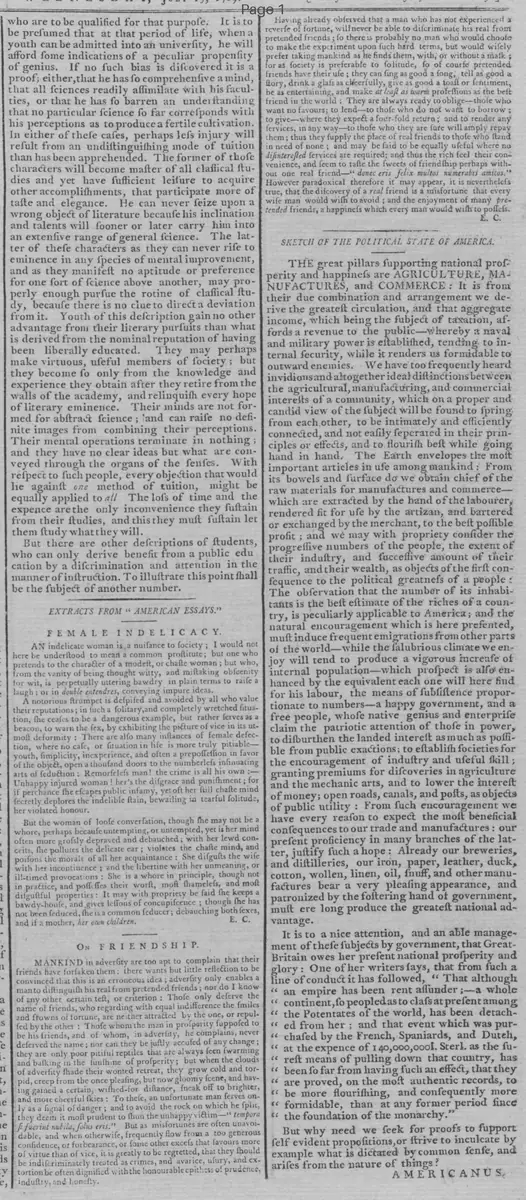
MANKIND in adversity are too apt to complain that their friends have forsaken them: there wants but little reflection to be convinced that this is an erroneous idea; adversity only enables a man to distinguish his real from pretended friends; nor do I know of any other certain test, or criterion: Those only deserve the name of friends, who regarding with equal indifference the smiles and frowns of fortune, are neither attracted by the one, or repulsed by the other: Those whom the man in prosperity supposed to be his friends, and of whom, in adversity, he complains, never deserved the name; nor can they be justly accused of any change; they are only poor pitiful reptiles that are always seen swarming and basking in the sunshine of prosperity; but when the clouds of adversity shade their wonted retreat, they grow cold and torpid, creep from the once pleasing, but now gloomy scene, and having gained a certain, wished-for distance, sneak off to brighter, and more cheerful skies: To these, an unfortunate man serves only as a signal of danger; and to avoid the rock on which he split, they deem it most prudent to shun the unhappy victim—"tempora fuerint nulla, Solus eris." But as misfortunes are often unavoidable, and when otherwise, frequently flow from a too generous confidence, or forbearance, or some other excess that favours more of virtue than of vice, it is greatly to be regretted, that they should be indiscriminately treated as crimes, and avarice, usury, and extortion be often dignified with the honourable epithets of prudence, industry, and honesty.
Having already observed that a man who has not experienced a reverse of fortune, will never be able to discriminate his real from pretended friends; so there is probably no man who would choose to make the experiment upon such hard terms, but would wisely prefer taking mankind as he finds them, with, or without a mask; for as society is preferable to solitude, so of course pretended friends have their use; they can sing as good a song, tell as good a story, drink a glass as cheerfully, give as good a toast or sentiment, be as entertaining, and make at least as warm professions as the best friend in the world: They are always ready to oblige—those who want no favours; to lend to those who do not want to borrow; to give—where they expect a four-fold return; and to render any services, in any way—to those who they are sure will amply repay them; thus they supply the place of real friends to those who stand in need of none; and may be said to be equally useful where no disinterested services are required; and thus the rich feel their convenience, and seem to taste the sweets of friendship perhaps without one real friend—"donec eris felix multos numerabis amicos."
However paradoxical therefore it may appear, it is nevertheless true, that the discovery of a real friend is a misfortune that every wise man would wish to avoid; and the enjoyment of many pretended friends, a happiness which every man would wish to possess.
E. C.
MANKIND in adversity are too apt to complain that their friends have forsaken them: there wants but little reflection to be convinced that this is an erroneous idea; adversity only enables a man to distinguish his real from pretended friends; nor do I know of any other certain test, or criterion: Those only deserve the name of friends, who regarding with equal indifference the smiles and frowns of fortune, are neither attracted by the one, or repulsed by the other: Those whom the man in prosperity supposed to be his friends, and of whom, in adversity, he complains, never deserved the name; nor can they be justly accused of any change; they are only poor pitiful reptiles that are always seen swarming and basking in the sunshine of prosperity; but when the clouds of adversity shade their wonted retreat, they grow cold and torpid, creep from the once pleasing, but now gloomy scene, and having gained a certain, wished-for distance, sneak off to brighter, and more cheerful skies: To these, an unfortunate man serves only as a signal of danger; and to avoid the rock on which he split, they deem it most prudent to shun the unhappy victim—"tempora fuerint nulla, Solus eris." But as misfortunes are often unavoidable, and when otherwise, frequently flow from a too generous confidence, or forbearance, or some other excess that favours more of virtue than of vice, it is greatly to be regretted, that they should be indiscriminately treated as crimes, and avarice, usury, and extortion be often dignified with the honourable epithets of prudence, industry, and honesty.
Having already observed that a man who has not experienced a reverse of fortune, will never be able to discriminate his real from pretended friends; so there is probably no man who would choose to make the experiment upon such hard terms, but would wisely prefer taking mankind as he finds them, with, or without a mask; for as society is preferable to solitude, so of course pretended friends have their use; they can sing as good a song, tell as good a story, drink a glass as cheerfully, give as good a toast or sentiment, be as entertaining, and make at least as warm professions as the best friend in the world: They are always ready to oblige—those who want no favours; to lend to those who do not want to borrow; to give—where they expect a four-fold return; and to render any services, in any way—to those who they are sure will amply repay them; thus they supply the place of real friends to those who stand in need of none; and may be said to be equally useful where no disinterested services are required; and thus the rich feel their convenience, and seem to taste the sweets of friendship perhaps without one real friend—"donec eris felix multos numerabis amicos."
However paradoxical therefore it may appear, it is nevertheless true, that the discovery of a real friend is a misfortune that every wise man would wish to avoid; and the enjoyment of many pretended friends, a happiness which every man would wish to possess.
E. C.
What sub-type of article is it?
Essay
What themes does it cover?
Friendship
Moral Virtue
Social Manners
What keywords are associated?
Friendship
Adversity
True Friends
Pretended Friends
Fortune
Society
Misfortune
What entities or persons were involved?
E. C.
Literary Details
Title
On Friendship.
Author
E. C.
Key Lines
Those Only Deserve The Name Of Friends, Who Regarding With Equal Indifference The Smiles And Frowns Of Fortune, Are Neither Attracted By The One, Or Repulsed By The Other:
They Are Only Poor Pitiful Reptiles That Are Always Seen Swarming And Basking In The Sunshine Of Prosperity;
Pretended Friends Have Their Use; They Can Sing As Good A Song, Tell As Good A Story, Drink A Glass As Cheerfully,
The Discovery Of A Real Friend Is A Misfortune That Every Wise Man Would Wish To Avoid; And The Enjoyment Of Many Pretended Friends, A Happiness Which Every Man Would Wish To Possess.