Thank you for visiting SNEWPapers!
Sign up free
The National Intelligencer And Washington Advertiser
Washington, District Of Columbia
What is this article about?
A Paris publication, 'An Essay upon the Modes of rendering Revolutions useful,' possibly sanctioned by Chief Consul Bonaparte, argues for hereditary executive power in France and praises Bonaparte's role in restoring order without violence or proscriptions.
Merged-components note: Continuation of the article on the Chief Consul of France and Bonaparte's government across pages 1 and 2, based on sequential reading order and matching content flow.
Clippings
1 of 2
OCR Quality
Full Text
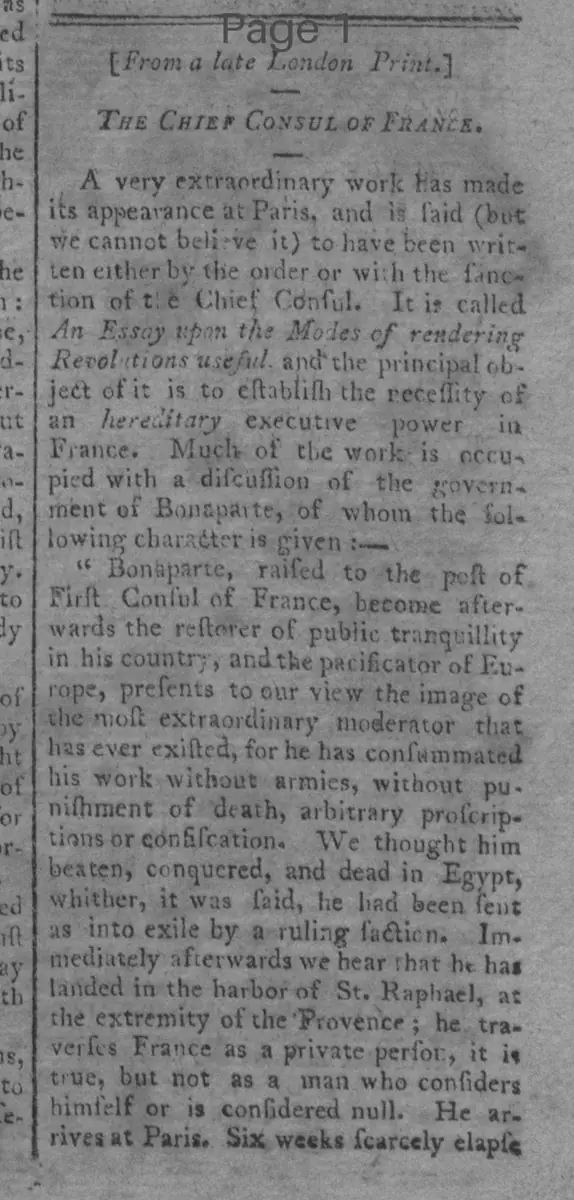
The Chief Consul of France.
A very extraordinary work has made its appearance at Paris, and is said (but we cannot believe it) to have been written either by the order or with the sanction of the Chief Consul. It is called An Essay upon the Modes of rendering Revolutions useful. and the principal object of it is to establish the necessity of an hereditary executive power in France. Much of the work is occupied with a discussion of the government of Bonaparte, of whom the following character is given :-
" Bonaparte, raised to the post of First Consul of France, becomes afterwards the restorer of public tranquillity in his country, and the pacificator of Europe, presents to our view the image of the most extraordinary moderator that has ever existed, for he has consummated his work without armies, without punishment of death, arbitrary proscriptions or confiscation. We thought him beaten, conquered, and dead in Egypt, whither, it was said, he had been sent as into exile by a ruling faction. Immediately afterwards we hear that he has landed in the harbor of St. Raphael, at the extremity of the Provence; he traverses France as a private person, it is true, but not as a man who considers himself or is considered null. He arrives at Paris. Six weeks scarcely elapse
Before he overthrows the Directory, the Councils and the Constitution that had vexed and disturbed France for five years; he raises himself above all, he replaces the government called a representative one by a simple commission, and he orders a constitutional act, the parts of which he previously puts into execution.
"All acts till that time were anti-revolutionary ones, emanating from his own will, without the appearance of the concurrence of the people. He addresses a constitution to the French; it is accepted in the form which it prescribes, and the consular government, immediately upon its adoption, gives birth to ideas of happiness in the minds of a numerous people. Prosperity seems anew to be willing to occupy a vast and too long ravaged territory.
"Bonaparte, strong in the spirit that he has created in France, has been able to show the same opposition and the same impartiality towards all parties; more powerful than them all together, it has not been necessary for him to proscribe any one either en masse or in detail. This power broke the revolutionary principle that had been tottering so long and engendered that anti-revolutionary principle which for twenty months has been immovable.
"He applies himself to every thing; he compresses all factions; but he destroys nothing--he approximates without danger the most contradictory elements--the Jacobins and the Emigrants--the moderate and the furious, the tolerating and the fanatics--he makes the presumptuous silent, and recalls the banished. In his position he had no need of punishing any past political offence: and if he were ever severe in Fructidor in the year 5, by the penalty of death and transportation, it was for offences posterior to his elevation, and against the existing order of things.
"The incessant and undisturbed activity of Bonaparte is alarmed at nothing. He increased the strength of the armies out of France at the time that the necessity of military force ceased to be more pressing in France. He promised peace on the day of his accession; he has always shown himself true to his word, but he has never thought himself obliged to hurry himself, in order to fulfil his promise; he calculated that a brilliant and dictated peace would be the most solid support of the new government. He has happily attained his object, in spite of all the hazards that might have swayed him from his purpose, and checked him in his career.
"Of all the Frenchmen who have distinguished themselves in the revolution, Bonaparte is the man who has united the fittest qualities for the part he occupies.
"To fix the revolution, it was necessary to have the action of a military government. Bonaparte is the general who has most excited the confidence of the army.
"To destroy all factions, it was necessary to have had no share in them. Bonaparte was never of any national representation.
"Not to displease the nation, it was necessary not to be sullied with the blood of any of the victims of the revolution. Bonaparte never figured in the clubs or popular assemblies; he was neither named to the 14th July, the 5th of October, nor the 20th Jan. In the operation of the elections he was only a military man.
"If Bonaparte does not please all Frenchmen, it is because colors must be seen from afar; it is because, obliged to compare him to a crowd of great men, who have preceded him, taken collectively, one thinks one's-self permitted to require that he should concentrate also all their qualities and all their indifferent forms; but one does not recollect that he is neither Caesar nor Augustus, nor Medicis, but in certain points; and that if he were them in every thing, it would be necessary that he should have no morals to be Julius Caesar; that he should have confiscated and arbitrarily decreed the penalty of death to be Augustus; and that he should have been a merchant to be Medicis.
"When so many great men shine in a single one, can one have any difficulty in passing over the details which he may unite, in favour of the absence of those vices which it would be dangerous for him to possess?
All hazards have served Bonaparte, and in so marked a manner, that it is exclaiming against Providence, to say that he is not in his natural post; but would there be no difference between the hazards that have served him, and the chances of birth? This is precisely the difference that exists between him and the pretender of France."
What sub-type of article is it?
What keywords are associated?
What entities or persons were involved?
Where did it happen?
Foreign News Details
Primary Location
Paris
Key Persons
Event Details
A work titled 'An Essay upon the Modes of rendering Revolutions useful' has appeared in Paris, possibly sanctioned by the Chief Consul, advocating for hereditary executive power. It praises Bonaparte as the restorer of tranquility, overthrowing the Directory without violence, reconciling factions, and achieving peace.