Thank you for visiting SNEWPapers!
Sign up free
Sacramento Daily Record Union
Sacramento, Sacramento County, California
What is this article about?
Senator Leland Stanford, aged 66, announces retirement as President of the Southern Pacific Company after 27 years, citing demands of his university and U.S. Senate duties. Collis P. Huntington will succeed him. Stanford discusses company leadership changes, university construction delays due to rains, and his ideas on farm mortgage legislation to promote business.
Clipping
OCR Quality
Full Text
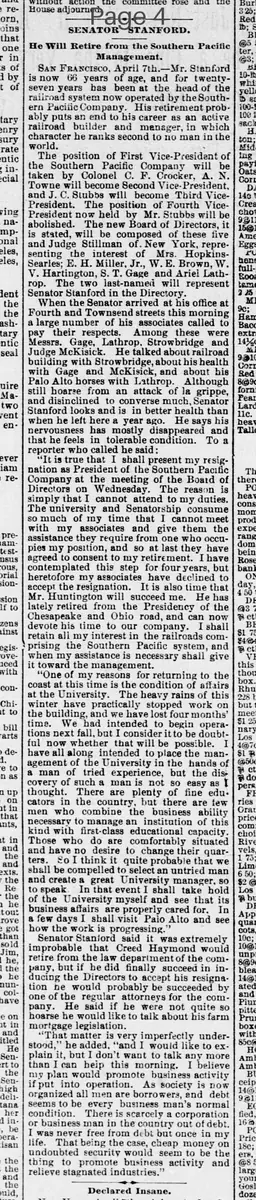
He Will Retire from the Southern Pacific Management.
San Francisco, April 7th.—Mr. Stanford is now 66 years of age, and for twenty-seven years has been at the head of the railroad system now operated by the Southern Pacific Company. His retirement probably puts an end to his career as an active railroad builder and manager, in which character he ranks second to no man in the world.
The position of First Vice-President of the Southern Pacific Company will be taken by Colonel C. F. Crocker, A. N. Towne will become Second Vice-President, and J. C. Stubbs will become Third Vice-President. The position of Fourth Vice-President now held by Mr. Stubbs will be abolished. The new Board of Directors, it is stated, will be composed of these five and Judge Stillman of New York, representing the interest of Mrs. Hopkins Searles; E. H. Miller, Jr., W. E. Brown, W. V. Harrington, S. T. Gage and Ariel Lathrop. The two last-named will represent Senator Stanford in the Directory.
When the Senator arrived at his office at Fourth and Townsend streets this morning a large number of his associates called to pay their respects. Among these were Messrs. Gage, Lathrop, Strowbridge and Judge McKisick. He talked about railroad building with Strowbridge, about his health with Gage and McKisick, and about his Palo Alto horses with Lathrop. Although still hoarse from an attack of la grippe, and disinclined to converse much, Senator Stanford looks and is in better health than when he left here a year ago. He says his nervousness has mostly disappeared and that he feels in tolerable condition. To a reporter who called he said:
"It is true that I shall present my resignation as President of the Southern Pacific Company at the meeting of the Board of Directors on Wednesday. The reason is simply that I cannot attend to my duties. The university and Senatorship consume so much of my time that I cannot meet with my associates and give them the assistance they require from one who occupies my position, and so at last they have agreed to consent to my retirement. I have contemplated this step for four years, but heretofore my associates have declined to accept the resignation. It is also time that Mr. Huntington will succeed me. He has lately retired from the Presidency of the Chesapeake and Ohio road, and can now devote his time to our company. I shall retain all my interest in the railroads comprising the Southern Pacific system, and when my assistance is necessary shall give it toward the management.
"One of my reasons for returning to the coast at this time is the condition of affairs at the University. The heavy rains of this winter have practically stopped work on the building, and we have lost four months time. We had intended to begin operations next fall, but I consider it to be doubtful now whether that will be possible. I have all along intended to place the management of the University in the hands of a man of tried experience, but the discovery of such a man is not so easy as I thought. There are plenty of fine educators in the country, but there are few men who combine the business ability necessary to manage an institution of this kind with first-class educational capacity. Those who do are comfortably situated and have no desire to change their quarters. So I think it quite probable that we shall be compelled to select an untried man and create a great University manager, so to speak. In that event I shall take hold of the University myself and see that its business affairs are properly cared for. In a few days I shall visit Palo Alto and see how the work is progressing.
Senator Stanford said it was extremely improbable that Creed Haymond would retire from the law department of the company, but if he did finally succeed in inducing the Directors to accept his resignation he would probably be succeeded by one of the regular attorneys for the company. He said if he were not quite so hoarse he would like to talk about his farm mortgage legislation.
"That matter is very imperfectly understood," he added, "and I would like to explain it, but I don't want to talk any more than I can help this morning. I believe my plan would promote business activity if put into operation. As society is now organized all men are borrowers, and debt seems to be every business man's normal condition. There is scarcely a corporation or business man in the country out of debt. I was never free from debt but once in my life. That being the case, cheap money on undoubted security would seem to be the thing to promote business activity and relieve stagnated industries."
What sub-type of article is it?
What themes does it cover?
What keywords are associated?
What entities or persons were involved?
Where did it happen?
Story Details
Key Persons
Location
San Francisco
Event Date
April 7th
Story Details
Senator Stanford resigns as President of the Southern Pacific Company after 27 years due to university and Senate commitments; Mr. Huntington succeeds him. He addresses leadership changes, university construction delays from rains, challenges in finding a manager, and his farm mortgage legislation ideas to ease debt and boost business.