Thank you for visiting SNEWPapers!
Sign up free
Springfield Weekly Republican
Springfield, Hampden County, Massachusetts
What is this article about?
New Ashford's 34 voters in Massachusetts plan to lead the nation by voting first in the 1932 presidential election on November 8, a tradition since 1916. Electric lights will illuminate the schoolhouse polls for the first time, with full turnout expected amid strong community spirit.
Clipping
OCR Quality
Full Text
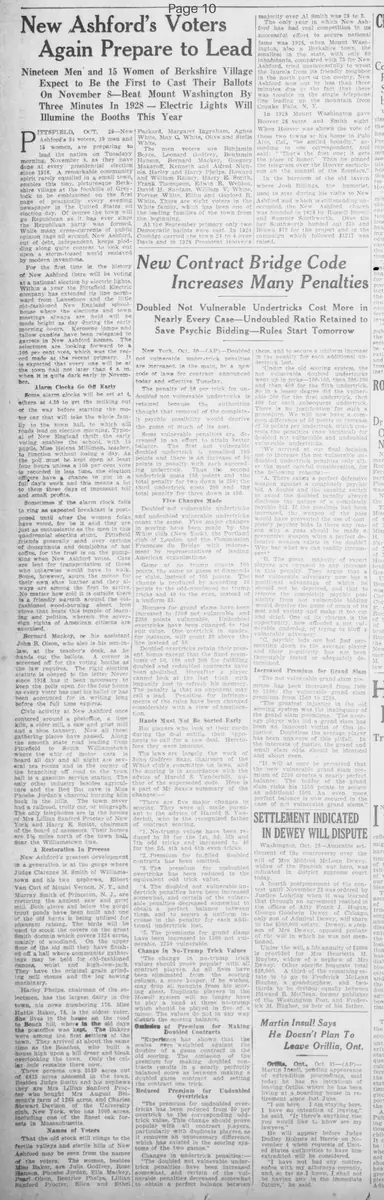
Nineteen Men and 15 Women of Berkshire Village Expect to Be the First to Cast Their Ballots On November 8—Beat Mount Washington By Three Minutes In 1928—Electric Lights Will Illumine the Booths This Year
New Ashford's 34 voters, 19 men and 15 women, are preparing to lead the nation on Tuesday morning, November 8, as they have done at every presidential election since 1916. A remarkable community spirit rarely equalled in a small town, enables this tiny, picturesque Berkshire village at the foothills of Greylock to be emblazoned on the first page of practically every evening newspaper in the United States on election day. Of course the town will go Republican as it has ever since the Republican party was formed.
While many cross-currents of public opinion rage all around, New Ashford, out of debt, independent, keeps plodding along quite content to look out upon a storm-tossed world enslaved by modern inventions.
For the first time in the history of New Ashford there will be voting at a national election by electric lights. Within a year the Pittsfield Electric company has extended its line northward from Lanesboro and the little old-fashioned New England schoolhouse where the elections and town meetings always are held will be made bright as day during the early morning hours. Kerosene lamps and tallow candles have been relegated to garrets in New Ashford homes. The selectmen are looking forward to a 100 per cent vote, which was the record made at the recent primary. It is expected that every one will be at the town hall not later than 6 a. m. when it is quite dark early in November.
Alarm Clocks Go Off Early
Some alarm clocks will be set at 4, others at 4:30 to get the milking out of the way before starting the motor car that will take the whole family to the town hall, to which all roads lead on election morning. Typical of New England thrift the early voting enables the school, with 15 pupils, Miss Helena Millman, teacher, to function without losing a day. As the poll must be kept open at least four hours unless a 100 per cent vote is recorded in less time, the election officers have a chance to put in a full day's work and this means a lot to them these days of incessant toil and small profits.
Sometimes the alarm clock fails to ring as expected breakfast is postponed until after the women folks have voted, for be it said they are just as enthusiastic as the men in this quadrennial election stunt. Pittsfield friends generally send over cartons of doughnuts and demijohns of hot coffee, for the frost is on the pumpkins when New Ashford votes. Cars are lent for transportation of those who otherwise would have to walk. Some, however, spurn the motor for their own shoe leather and they always are among the first to arrive.
No matter how cold it is outside there is a friendly warmth around the old-fashioned wood-burning sheet iron stove that heats this temple of learning and politics, wherein the sovereign rights of American citizens are exercised.
Bernard Mackey, or his assistant John B. Olson, who also is his son-in-law, at the teacher's desk, as he hands out the ballots. A corner is screened off for the voting booths as the law requires. The rigid election statute is obeyed to the letter. Never since 1916 has it been necessary to keep the polls open for the four hours as every voter has cast his ballot or has been accounted for in writing long before the full time expires.
Civic activity at New Ashford once centered around a postoffice, a lime kiln, a cider mill, a saw and grist mill and a shoe tannery. Now all these gathering places have passed. Along the smooth state road leading from Pittsfield to South Williamstown where the whir of motor cars is heard all day and all night are several tea rooms and in the corner of the branching off road to the town hall is a gasoline service station. The only other industry besides agriculture and the Red Bat cave is Miss Phoebe Jordan's charcoal burning kiln back in the hills. The town never had a railroad, trolley car, or telegraph. The only telephones are in the homes of Mrs. Lillian Sanford Procter of New York and Harry E. Smith, chairman of the board of assessors. Their homes are 2½ miles north of the town hall near the Williamstown line.
A Restoration In Process
New Ashford's greatest development in a generation is at the gorge where Judge Clarence M. Smith of Williamstown and his two nephews, Elbert Van Cott of Mount Vernon, N. Y., and Murray Smith of Princeton, N. J. are restoring the ancient saw and grist mill. Both above and below the gorge trout ponds have been built and one of the old barns is being utilized for pheasant raising. The birds will be used to stock the covers on the great Smith domain which covers 1324 acres, mainly of woodland. On the upper floor of the old mill they have finished off a hall where community gatherings may be held for old-fashioned dances, whist and high-low-jack.
They have the original grain grinding mill stones and the log sawing machinery.
Harley Phelps, chairman of the selectmen, has the largest dairy in the town, his cows numbering 170. Miss Hattie Baker, 78, is the oldest voter. She lives in the house on the road to Beach hill, where in the old days the postoffice was kept. The Bakers were among the first settlers of the town. They arrived at about the same time as the Beaches, who built a house high upon a hill drear and bleak overlooking the town. Only the cellar hole remains there now.
Three persons own 3539 acres out of 6815 acres assessed in the town. Besides Judge Smith and his nephews they are Mrs. Lillian Sanford Procter who bought Mrs. August Belmont's farm of 1265 acres, and Charles Stewart Davison of the University club, New York, who has 1000 acres, including one of the finest oak forests in Massachusetts.
Names of Voters
That the old stock still clings to the fertile valleys and sterile hills of New Ashford may be seen from the names of the voters. The women, besides Miss Baker, are Julia Godfrey, Rose Hanson, Phoebe Jordan, Ella Mackey, Pearl Olson, Beatrice Phelps, Lillian Sanford Procter, Ellen and Ethel Packard, Margaret Ingraham, Agnes White, May C. White, Olive and Stella White.
The men voters are Benjamin Boyce, Leonard Godfrey, Benjamin Hanson, Bernard Mackey, Gregory Makaroff, Kenneth and Alfred Nichols, Harley and Harry Phelps, Howard and William Rainey, Harry E. Smith, Frank Thompson, Edwin R. Weldon, David H. Surdam, William V. White, Forrest White, Elihu and Gaylord R. White. There are eight voters in the White family, which has been one of the leading families of the town from the beginning.
At the September primary only two Democratic ballots were cast. In 1924 Coolidge carried the town 24 to 4 over Davis and in 1928 President Hoover's majority over Al Smith was 28 to 3.
The only year in which New Ashford has had real competition in its successful effort to secure national fame was 1928, when Mount Washington, also a Berkshire town, the smallest in the state, with only 60 inhabitants, compared with 75 for New Ashford, tried unsuccessfully to wrest the laurels from its friendly neighbor in the north part of the county. New Ashford won out by less than three minutes due to the fact that there was trouble on the single telephone line leading up the mountain from Copake Falls, N. Y.
In 1928 Mount Washington gave Hoover 28 votes and Smith eight.
When Hoover was shown the vote of these two towns at his home in Palo Alto, Cal., "he smiled broadly," according to one correspondent, and said: "That's the first one; it gets the place of honor." Then he pinned the telegram over the Hoover escutcheon on the mantel of the fireplace.
In the barroom of the old tavern where Josh Billings, the humorist, used to stay during his visits to New Ashford and which is still standing unoccupied, the New Ashford church was founded in 1828 by Russell Brown and Sumner Southworth. Over the bar Southworth handed out $50 and Brown $10 for the project and in the campaign which followed $127 was raised.
What sub-type of article is it?
What themes does it cover?
What keywords are associated?
What entities or persons were involved?
Where did it happen?
Story Details
Key Persons
Location
New Ashford, Berkshire County, Massachusetts
Event Date
November 8, 1932
Story Details
The 34 voters of New Ashford, a small Berkshire village, prepare to cast the first ballots in the nation for the presidential election on November 8, 1932, continuing their tradition since 1916. They will vote by electric light for the first time, expecting 100% turnout starting at 6 a.m. The town, Republican-leaning, maintains strong community spirit amid modernization, with details on local history, industries, and voters.