Thank you for visiting SNEWPapers!
Sign up free
The Evening Argus
Rock Island, Rock Island County County, Illinois
What is this article about?
Washington correspondence from March 15, 1862, details the Union Army of the Potomac's bloodless capture of Manassas, McDowell's command restoration, Fremont's return, naval responses to Merrimac, congressional ironclad and tax bills, emancipation debates, and Southern recruitment.
Merged-components note: The second component is a direct continuation of the Washington correspondence in the first component, forming a single letter to the editor.
Clipping
OCR Quality
Full Text
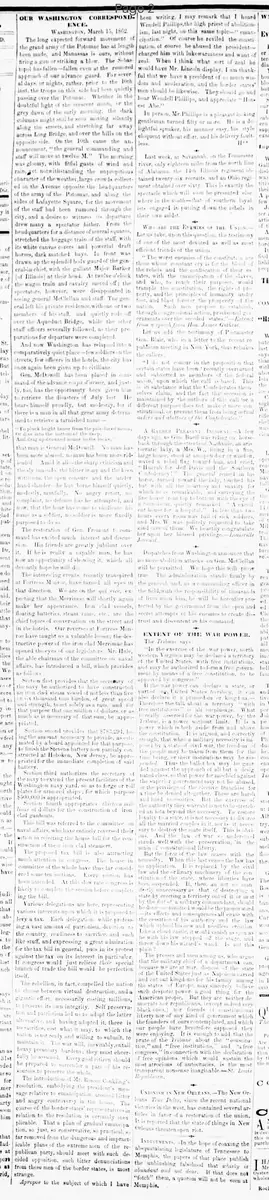
WASHINGTON, March 15, 1862.
The long expected forward movement of the grand army of the Potomac has at length been made, and Manassas is ours, without firing a gun or striking a blow. The Sebastopol has fallen-fallen even at the rumored approach of our advance guard. For several days, or nights, rather, prior to the 10th inst, the troops on this side had been quietly passing over the Potomac. Whether in the doubtful light of the crescent moon, or the grey dawn of the early morning, the dark columns might still be seen moving silently along the streets, and stretching far away across Long Bridge, and over the hills on the opposite side. On the 10th came the announcement, "the general commanding and staff will move at twelve M." The morning was gloomy, with fitful gusts of wind and rain, yet notwithstanding the unpropitious character of the weather, large crowds collected on the Avenue opposite the headquarters of the army of the Potomac, and along the sides of Lafayette Square, for the movement of the staff had been rumored through the city, and a desire to witness its departure drew many a spectator hither. From the headquarters for a distance of several squares, stretched the baggage train of the staff, with its white canvas covers and powerful draft horses, dark matched bays. In front was drawn up the splendid body guard of the general-in-chief, with the gallant Major Barker [of Illinois] at their head. At twelve o'clock the wagon train and cavalry moved off: the spectators, however, were disappointed in seeing General McClellan and staff. The general left his private residence, with one or two members of his staff, and quietly rode off over the Aqueduct Bridge, while the other staff officers severally followed, as their preparations for departure were completed.
And now Washington has relapsed into a comparatively quiet place-few soldiers in the streets, few officers in the hotels, the city has once again been given up to civilians.
Gen. McDowell has been placed in command of the advance corps d'armee, and justly, too, has the opportunity been given him to retrieve the disasters of July last. He bears himself proudly, but modestly, for if there is a man in all that great army determined to retrieve a tarnished name-
To pluck bright honor from the pale-faced moon,
Or dive sho the bottom of the deep,
And drag up drowned honor by the locks.
that man is General McDowell. No man has been more abused, no man has been more ridiculed. Amid all-the sharp criticism and the sly innuendo, the bitter irony and the keen witticism, the open censure and the underhanded slander -he has borne himself quietly, modestly, manfully. No angry retort, no complaint, no defense has he attempted, and now, that the hour has come to vindicate his name as a soldier, no soldier is more fixedly purposed to do so.
The restoration of Gen. Fremont to command has excited much interest and discussion. His friends are greatly jubilant over it. If he is really a capable man, he has now an opportunity of showing it, which all devoutly hope he will do.
The interesting events recently transpired at Fortress Monroe, have turned all eyes in that direction. We are on the qui vive, expecting that the Merrimac will shortly again make her appearance. Iron clad vessels, floating batteries, steam rams, etc., are the chief topics of conversation on the street and in the hotels. Our reverses at Fortress Monroe have taught us a valuable lesson: the destructive power of the iron clad Merrimac has opened the eyes of our legislators. Mr. Hale, the able chairman of the committee on naval affairs, has introduced a bill, which provides as follows:
Section first provides that the secretary of the navy be authorized to have constructed an iron clad steam vessel of not less than five or six thousand tons burden, of great speed and strength, to act solely as a ram, and for that purpose that one million of dollars, or as much as is necessary of that sum, be appropriated.
Section second provides that $753,294, being the amount necessary to provide, as estimated by a board appointed for that purpose, to finish the Stevens battery now partially constructed at Hoboken, New Jersey, be appropriated for the immediate completion of said battery.
Section third authorizes the secretary of the navy to extend the present facilities of the Washington navy yard, so as to forge or roll plates for armored ships; for which purpose $500,000 is appropriated.
Section fourth appropriates thirteen millions of dollars for the construction of iron clad gunboats.
This bill was referred to the committee on naval affairs, who have entirely reversed their action in rejecting the house bill for the construction of these iron clad steamers.
The proposed tax bill is also attracting much attention in congress. The house in committee of the whole have thus far considered some ten sections. Every section has been amended. At this slow rate congress is likely to complete the session before completing the bill.
Various delegations are here, representing various interests upon which it is proposed to levy a tax. Each delegation, while professing a vast amount of patriotism, devotion to the country, readiness to sacrifice, and such like stuff, and expressing a great admiration for the tax bill in general, puts in its protest against the tax on its interest in particular. If congress would just relieve their special branch of trade the bill would be perfection itself.
The rebellion, in fact, compelled the nation to choose between virtual destruction, and a gigantic effort, necessarily costing millions, to preserve its own integrity. Self preservation and patriotism led us to adopt the latter alternative, and having adopted it, there is no sacrifice, cost what it may, to which the nation is not ready and willing to submit, to maintain it. The war will, inevitably, entail heavy pecuniary burdens; they must cheerfully be assumed. Every good citizen should be prepared to surrender a part of his resources to preserve the whole.
The introduction of Mr. Roscoe Conkling's resolution, embodying the president's message relative to emancipation, aroused bitter and angry controversy in the house. The course of the border states' representatives in relation to the resolution is certainly inexplicable. That a plan of gradual emancipation, so just, so conservative, so practical, so far removed from the dangerous and impracticable plans of the extreme men of the republican party, should meet with such decided opposition, such bitter denunciations from these men of the border states, is most strange.
Apropos to the subject of which I have been writing, I may remark that I heard Wendell Phillips, the high priest of abolitionism, last night, on this same topic-" emancipation." Of course he reviled the constitution, of course he abused the president—charged him with lukewarmness and want of zeal. When I think what sort of zeal he would have Mr. Lincoln display, I am thankful that we have a president of so much wisdom and moderation, and the border states' men should be likewise. They should go and hear Wendell Phillips, and appreciate " Honest Abe."
In person, Mr. Phillips is a pleasant looking gentleman turned fifty or more. He is a delightful speaker, his manner easy, his style eloquent without effort, and his delivery faultless.
II**
Last week, at Savannah on the Tennessee river, only eighteen miles from the north line of Alabama, the 14th Illinois regiment obtained twenty six recruits and an Ohio regiment obtained over sixty. This is exactly the spectacle which will soon be presented elsewhere in the south-that of southern loyalists engaged in putting down the rebels in their own midst.
What sub-type of article is it?
What themes does it cover?
What keywords are associated?
Letter to Editor Details
Main Argument
reports the union army's unopposed advance to manassas, updates on military commands for mcdowell and fremont, naval ironclad developments in response to merrimac, congressional tax and emancipation debates, and recruitment in the south.
Notable Details