Thank you for visiting SNEWPapers!
Sign up free
Story
July 21, 1795
The New Hampshire Gazette
Portsmouth, Rockingham County, New Hampshire
What is this article about?
On July 13, 1795, Boston inhabitants at Faneuil Hall unanimously adopted a committee report with 19 objections to the Jay Treaty, viewing it as harmful to US commercial interests, national honor, and peace. They thanked Sen. S.T. Mason for publishing the treaty.
Clipping
OCR Quality
98%
Excellent
Full Text
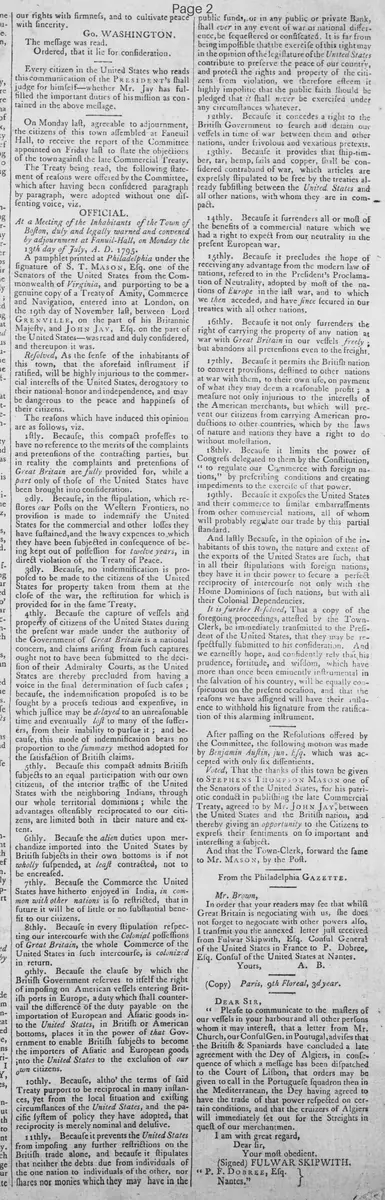
On Monday last, agreeable to adjournment, the citizens of this town assembled at Faneuil Hall, to receive the report of the Committee appointed on Friday last to state the objections of the town against the late Commercial Treaty.
The Treaty being read, the following statement of reasons were offered by the Committee, which after having been considered paragraph by paragraph, were adopted without one dissenting voice, viz.
OFFICIAL.
At a Meeting of the Inhabitants of the Town of Boston, duly and legally warned and convened by adjournment at Faneuil-Hall, on Monday the 13th day of July, A. D. 1795.
A pamphlet printed at Philadelphia under the signature of S. T. MASON, Esq. one of the Senators of the United States from the Commonwealth of Virginia, and purporting to be a genuine copy of a Treaty of Amity, Commerce and Navigation, entered into at London, on the 10th day of November last, between Lord GRENVILLE, on the part of his Britannic Majesty, and John Jay, Esq. on the part of the United States-was read and duly considered, and thereupon it was
Resolved, As the sense of the inhabitants of this town, that the aforesaid instrument if ratified, will be highly injurious to the commercial interests of the United States, derogatory to their national honor and independence, and may be dangerous to the peace and happiness of their citizens.
The reasons which have induced this opinion are as follows, viz.
1stly. Because, this compact professes to have no reference to the merits of the complaints and pretensions of the contracting parties, but in reality the complaints and pretensions of Great Britain are fully provided for, while a part only of those of the United States have been brought into consideration.
2dly. Because, in the stipulation, which restores our Posts on the Western Frontiers, no provision is made to indemnify the United States for the commercial and other losses they have sustained, and the heavy expenses to which they have been subjected in consequence of being kept out of possession for twelve years, in direct violation of the Treaty of Peace.
3dly. Because, no indemnification is proposed to be made to the citizens of the United States for property taken from them at the close of the war, the restitution for which is provided for in the same Treaty.
4thly. Because the capture of vessels and property of citizens of the United States during the present war made under the authority of the Government of Great Britain is a national concern, and claims arising from such captures ought not to have been submitted to the decision of their Admiralty Courts, as the United States are thereby precluded from having a voice in the final determination of such cases; because, the indemnification proposed is to be sought by a process tedious and expensive, in which justice may be delayed to an unreasonable time and eventually lost to many of the sufferers, from their inability to pursue it; and because, this mode of indemnification bears no proportion to the summary method adopted for the satisfaction of British claims.
5thly. Because this compact admits British subjects to an equal participation with our own citizens, of the interior traffic of the United States with the neighboring Indians, through our whole territorial dominions; while the advantages ostensibly reciprocated to our citizens, are limited both in their nature and extent.
6thly. Because the alien duties upon merchandise imported into the United States by British subjects in their own bottoms is if not wholly suspended, at least contracted, not to be increased.
7thly. Because the Commerce the United States have hitherto enjoyed in India, in common with other nations is so restricted, that in future it will be of little or no substantial benefit to our citizens.
8thly. Because in every stipulation respecting our intercourse with the Colonial possessions of Great Britain, the whole Commerce of the United States in such intercourse, is colonized in return.
9thly. Because the clause by which the British Government reserves to itself the right of imposing on American vessels entering British ports in Europe, a duty which shall countervail the difference of the duty payable on the importation of European and Asiatic goods into the United States, in British or American bottoms, places it in the power of that Government to enable British subjects to become the importers of Asiatic and European goods into the United States to the exclusion of our own citizens.
10thly. Because, altho' the terms of said Treaty purport to be reciprocal in many instances, yet from the local situation and existing circumstances of the United States, and the pacific system of policy they have adopted, that reciprocity is merely nominal and delusive.
11thly. Because it prevents the United States from imposing any further restrictions on the British trade alone, and because it stipulates that neither the debts due from individuals of the one nation to individuals of the other, nor shares nor monies which they may have in the public funds, or in any public or private Bank, shall ever in any event of war or national difference, be sequestered or confiscated. It is far from being impossible that the exercise of this right may in the opinion of the legislature of the United States contribute to preserve the peace of our country, and protect the rights and property of the citizens from violation, we therefore esteem it highly impolitic that the public faith should be pledged that it shall never be exercised under any circumstances whatever.
12thly. Because it concedes a right to the British Government to search and detain our vessels in time of war between them and other nations, under frivolous and vexatious pretexts.
13thly. Because it provides that ship-timber, tar, hemp, sails and copper, shall be considered contraband of war, which articles are expressly stipulated to be free by the treaties already subsisting between the United States and all other nations, with whom they are in compact.
14thly. Because it surrenders all or most of the benefits of a commercial nature which we had a right to expect from our neutrality in the present European war.
15thly. Because it precludes the hope of receiving any advantage from the modern law of nations, referred to in the President's Proclamation of Neutrality, adopted by most of the nations of Europe in the last war, and to which we then acceded, and have since secured in our treaties with all other nations.
16thly. Because it not only surrenders the right of carrying the property of any nation at war with Great Britain in our vessels freely: but abandons all pretensions even to the freight,
17thly. Because it permits the British nation to convert provisions, destined to other nations at war with them, to their own use, on payment of what they may deem a reasonable profit; a measure not only injurious to the interests of the American merchants, but which will prevent our citizens from carrying American productions to other countries, which by the laws of nature and nations they have a right to do without molestation.
18thly. Because it limits the power of Congress delegated to them by the Constitution, "to regulate our Commerce with foreign nations," by prescribing conditions and creating impediments to the exercise of that power.
19thly. Because it exposes the United States and their commerce to similar embarrassments from other commercial nations, all of whom will probably regulate our trade by this partial standard.
And lastly Because, in the opinion of the inhabitants of this town, the nature and extent of the exports of the United States are such, that in all their stipulations with foreign nations, they have it in their power to secure a perfect reciprocity of intercourse not only with the Home Dominions of such nations, but with all their Colonial Dependencies.
It is further Resolved, That a copy of the foregoing proceedings, attested by the Town-Clerk, be immediately transmitted to the President of the United States, that they may be respectfully submitted to his consideration. And we earnestly hope, and confidently rely that his prudence, fortitude, and wisdom, which have more than once been eminently instrumental in the salvation of his country, will be equally conspicuous on the present occasion, and that the reasons we have assigned will have their influence to withhold his signature from the ratification of this alarming instrument.
After passing on the Resolutions offered by the Committee, the following motion was made by Benjamin Austin, jun. Esq. which was accepted with only six dissentients.
Voted, That the thanks of this town be given to Stephen T. Thompson Mason one of the Senators of the United States, for his patriotic conduct in publishing the late Commercial Treaty, agreed to by Mr. John Jay, between the United States and the British nation, and thereby giving an opportunity to the Citizens to express their sentiments on so important and interesting a subject.
And that the Town-Clerk, forward the same to Mr. MASON, by the Post.
The Treaty being read, the following statement of reasons were offered by the Committee, which after having been considered paragraph by paragraph, were adopted without one dissenting voice, viz.
OFFICIAL.
At a Meeting of the Inhabitants of the Town of Boston, duly and legally warned and convened by adjournment at Faneuil-Hall, on Monday the 13th day of July, A. D. 1795.
A pamphlet printed at Philadelphia under the signature of S. T. MASON, Esq. one of the Senators of the United States from the Commonwealth of Virginia, and purporting to be a genuine copy of a Treaty of Amity, Commerce and Navigation, entered into at London, on the 10th day of November last, between Lord GRENVILLE, on the part of his Britannic Majesty, and John Jay, Esq. on the part of the United States-was read and duly considered, and thereupon it was
Resolved, As the sense of the inhabitants of this town, that the aforesaid instrument if ratified, will be highly injurious to the commercial interests of the United States, derogatory to their national honor and independence, and may be dangerous to the peace and happiness of their citizens.
The reasons which have induced this opinion are as follows, viz.
1stly. Because, this compact professes to have no reference to the merits of the complaints and pretensions of the contracting parties, but in reality the complaints and pretensions of Great Britain are fully provided for, while a part only of those of the United States have been brought into consideration.
2dly. Because, in the stipulation, which restores our Posts on the Western Frontiers, no provision is made to indemnify the United States for the commercial and other losses they have sustained, and the heavy expenses to which they have been subjected in consequence of being kept out of possession for twelve years, in direct violation of the Treaty of Peace.
3dly. Because, no indemnification is proposed to be made to the citizens of the United States for property taken from them at the close of the war, the restitution for which is provided for in the same Treaty.
4thly. Because the capture of vessels and property of citizens of the United States during the present war made under the authority of the Government of Great Britain is a national concern, and claims arising from such captures ought not to have been submitted to the decision of their Admiralty Courts, as the United States are thereby precluded from having a voice in the final determination of such cases; because, the indemnification proposed is to be sought by a process tedious and expensive, in which justice may be delayed to an unreasonable time and eventually lost to many of the sufferers, from their inability to pursue it; and because, this mode of indemnification bears no proportion to the summary method adopted for the satisfaction of British claims.
5thly. Because this compact admits British subjects to an equal participation with our own citizens, of the interior traffic of the United States with the neighboring Indians, through our whole territorial dominions; while the advantages ostensibly reciprocated to our citizens, are limited both in their nature and extent.
6thly. Because the alien duties upon merchandise imported into the United States by British subjects in their own bottoms is if not wholly suspended, at least contracted, not to be increased.
7thly. Because the Commerce the United States have hitherto enjoyed in India, in common with other nations is so restricted, that in future it will be of little or no substantial benefit to our citizens.
8thly. Because in every stipulation respecting our intercourse with the Colonial possessions of Great Britain, the whole Commerce of the United States in such intercourse, is colonized in return.
9thly. Because the clause by which the British Government reserves to itself the right of imposing on American vessels entering British ports in Europe, a duty which shall countervail the difference of the duty payable on the importation of European and Asiatic goods into the United States, in British or American bottoms, places it in the power of that Government to enable British subjects to become the importers of Asiatic and European goods into the United States to the exclusion of our own citizens.
10thly. Because, altho' the terms of said Treaty purport to be reciprocal in many instances, yet from the local situation and existing circumstances of the United States, and the pacific system of policy they have adopted, that reciprocity is merely nominal and delusive.
11thly. Because it prevents the United States from imposing any further restrictions on the British trade alone, and because it stipulates that neither the debts due from individuals of the one nation to individuals of the other, nor shares nor monies which they may have in the public funds, or in any public or private Bank, shall ever in any event of war or national difference, be sequestered or confiscated. It is far from being impossible that the exercise of this right may in the opinion of the legislature of the United States contribute to preserve the peace of our country, and protect the rights and property of the citizens from violation, we therefore esteem it highly impolitic that the public faith should be pledged that it shall never be exercised under any circumstances whatever.
12thly. Because it concedes a right to the British Government to search and detain our vessels in time of war between them and other nations, under frivolous and vexatious pretexts.
13thly. Because it provides that ship-timber, tar, hemp, sails and copper, shall be considered contraband of war, which articles are expressly stipulated to be free by the treaties already subsisting between the United States and all other nations, with whom they are in compact.
14thly. Because it surrenders all or most of the benefits of a commercial nature which we had a right to expect from our neutrality in the present European war.
15thly. Because it precludes the hope of receiving any advantage from the modern law of nations, referred to in the President's Proclamation of Neutrality, adopted by most of the nations of Europe in the last war, and to which we then acceded, and have since secured in our treaties with all other nations.
16thly. Because it not only surrenders the right of carrying the property of any nation at war with Great Britain in our vessels freely: but abandons all pretensions even to the freight,
17thly. Because it permits the British nation to convert provisions, destined to other nations at war with them, to their own use, on payment of what they may deem a reasonable profit; a measure not only injurious to the interests of the American merchants, but which will prevent our citizens from carrying American productions to other countries, which by the laws of nature and nations they have a right to do without molestation.
18thly. Because it limits the power of Congress delegated to them by the Constitution, "to regulate our Commerce with foreign nations," by prescribing conditions and creating impediments to the exercise of that power.
19thly. Because it exposes the United States and their commerce to similar embarrassments from other commercial nations, all of whom will probably regulate our trade by this partial standard.
And lastly Because, in the opinion of the inhabitants of this town, the nature and extent of the exports of the United States are such, that in all their stipulations with foreign nations, they have it in their power to secure a perfect reciprocity of intercourse not only with the Home Dominions of such nations, but with all their Colonial Dependencies.
It is further Resolved, That a copy of the foregoing proceedings, attested by the Town-Clerk, be immediately transmitted to the President of the United States, that they may be respectfully submitted to his consideration. And we earnestly hope, and confidently rely that his prudence, fortitude, and wisdom, which have more than once been eminently instrumental in the salvation of his country, will be equally conspicuous on the present occasion, and that the reasons we have assigned will have their influence to withhold his signature from the ratification of this alarming instrument.
After passing on the Resolutions offered by the Committee, the following motion was made by Benjamin Austin, jun. Esq. which was accepted with only six dissentients.
Voted, That the thanks of this town be given to Stephen T. Thompson Mason one of the Senators of the United States, for his patriotic conduct in publishing the late Commercial Treaty, agreed to by Mr. John Jay, between the United States and the British nation, and thereby giving an opportunity to the Citizens to express their sentiments on so important and interesting a subject.
And that the Town-Clerk, forward the same to Mr. MASON, by the Post.
What sub-type of article is it?
Historical Event
What themes does it cover?
Justice
Deception
What keywords are associated?
Jay Treaty
Boston Meeting
Commercial Objections
National Honor
Resolutions
Stephen Mason
What entities or persons were involved?
S. T. Mason
Lord Grenville
John Jay
Benjamin Austin
Town Clerk
Where did it happen?
Faneuil Hall, Boston
Story Details
Key Persons
S. T. Mason
Lord Grenville
John Jay
Benjamin Austin
Town Clerk
Location
Faneuil Hall, Boston
Event Date
1795 07 13
Story Details
Boston town meeting adopts unanimous resolutions objecting to the Jay Treaty with 19 detailed reasons citing harm to commerce, honor, and independence, resolves to send proceedings to the President, and votes thanks to Sen. Mason for publishing the treaty.