Thank you for visiting SNEWPapers!
Sign up free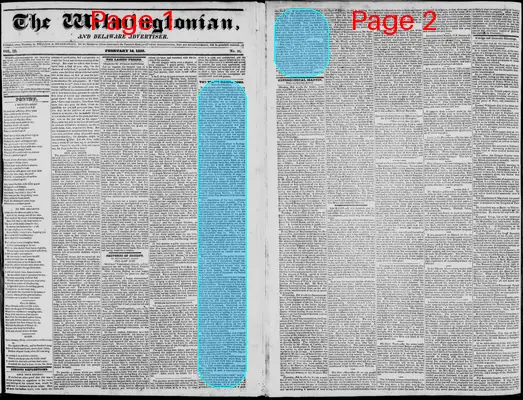
The Wilmingtonian, And Delaware Advertiser
Wilmington, New Castle County, Delaware
What is this article about?
Two neighboring men in Alesbury debate theories of happiness: one hoards wealth, the other spends freely. An old traveler intervenes, revealing himself as the Echo, teaching that human pursuits are empty reverberations without true contentment.
Merged-components note: Continuation of the narrative story 'THE WHITE HAIRED ECHO' across pages, merging the literary-labeled continuation with the initial story segment.
Clippings

1 of 2
OCR Quality
Full Text
From the Emporium.
In the pursuit after happiness—a pursuit in which all are earnestly engaged—though none ever arrive at its perfect attainment, it is most certain that some approximate nearer to it at far less expense of toil and sacrifice than others. The means made use of to obtain this object are as various as the minds of men, or as the diversification of countenances. Some seek it in wealth, in honour, in fame; some in the gratification of the various senses and appetites; and these reap something in anticipation, but very little in reality; they live in the shadow of a substance they are never to arrive at. Others, grasping after nothing future, make business, or literature, or social intercourse their means of happiness—but few bear witness of the success of their plans. They used to tell a strange story in Alesbury—which is still sometimes cited as authority for the doctrine that all men are equally mad; the unhappy for being so—and the happy for being so as no reasonable cause existed for either emotion.
As you travel from Alesbury to Burlingford, just on the top of the hill you will see an old sign bedaubed with various colours; the figure in the midst of which was intended to represent a spread eagle, but which really bears but little similitude to any thing on the earth or under the earth. The house is an ancient tenement, and is fitted up as a kind of an apology for an Inn, with a bar and bed room, and a little stable ten feet by twelve, adjoining. It was the venerable residence of my friend Merryman, who is noted as much for singularity of genius, as the bird upon his sign is for singularity of shape.—Nearly opposite is a farm house, one of those old-fashioned low stone buildings, which mark the dwelling places of the peace cultivating sons of Amsterdam, quietly moored in the over-spreading shadow of a ponderous barn, large enough almost to house away a village of such tenements; it was the homestead of Garrabrant Kersey, a lineal descendant of the Van Houten's of Kinderhook memory.
The dispositions of the two neighbours were as opposite as their pursuits. Garrabrant had been engaged all his life long in gathering money—while as Merryman religiously scattered abroad all that came into his hands—yet even he went just "so far and no farther"—the bottom of his purse was his limitation—he was careful not to encumber his old tavern house; he would not kill the goose that laid the golden egg, he said, though he professed openly and above board, his utter hostility to the plan of hoarding up the eggs themselves. He lived easy, and nobody sung more merrily, or looked more cheerfully than he. When he saw ambitious men striving after honour, and sacrificing their peace and conscience in chase of popularity, he laughed outright at their folly: these he allowed were mere seekers after bubbles; and those who like his friend Kersey, gave their whole life to money making, were but a little wiser; and satisfied of this he gave himself no trouble about one concern or the other.
Kersey grew rich by the policy he pursued; it cost him a great deal of care and labour; he lived a remarkably frugal life, and it rarely happened that a sixpence slipped through his fingers beyond what was absolutely necessary for his support; he was a hard dealing, close shaving man, whose whole stock of happiness was locked up in his money chests.
As might have been expected the vicinage of those opposite characters afforded them frequent opportunities of discussing their favourite theories. Kersey used to insist that Fortune was not only the foundation, but the very soul and essence of all happiness, and that the use made of it by its possessor had little to do with the question, inasmuch as, if he did not choose to enjoy the ease, the comfortable things, and the honours it would purchase, he still always had before his mind the consciousness of his ability to enjoy them if he pleased. Merryman, on the contrary, used to say that he did not understand how a man could enjoy a bowl of punch without calling for or tasting it, merely because he had two shillings in his pocket, and could buy it if he pleased; that the only good of money was to spend it; and ridiculed all Garrabrant's ideal notions with great glee and effect; making out that he himself was the paragon of wisdom, and that his neighbour was a mere sophist in theory, and a slave in practice.
One day an old gray-headed man stopped at the tavern towards evening, and while he was quietly smoking his pipe on the porch, Kersey came over the road and he and the landlord entered into an argument as usual, on the merits of their respective theories of the art of living happily. The old man listened very attentively, and his sage and venerable appearance at length led the disputants to refer the matter to him.
It is growing late, said he, looking towards the west, and knocking the ashes from his pipe, but if you will walk with me down the road, I will give you my opinion.
They both nodded assent, and followed him; wondering where the old man could be travelling at such a time—and as they walked on,
"I have lived long in the world," said he, "and never found wisdom in any man. If he seeks wealth to hoard it up, its promise of happiness is like the voice of the Echo all sound and emptiness. If to spend, it only gratifies the taste or the fancy, and is gone like the Echo. If he seeks Fame—what is the applause but an Echo? and what profit comes of it? Man needs but a little; a very little with a contented mind will make him happy; a great deal without it will not have the effect desired. You, Garrabrant, toil much; riches roll in upon you, but are you the better for that? or will you be better for it fifty years hence? and, Merryman, boast you that you live well and easy; have you braced your frame against sickness, or made a league with misfortune? where is your charter for happiness?
"The man is crazy," they both said—
"Not crazy," rejoined the white haired stranger. "I am the Echo which inhabits yonder Caves," pointing to the broken precipices that overhung the brook—and you are all the children of my spirit—to-day here, to-morrow, with all your schemes, silent and forgotten as my voice at midnight. Seeking enjoyments in the reverberations of fancy to the anticipations of your hearts—and fancying yourself wise and happy, when all you have, all you can enjoy, all you are, is but the echo of a passing sound."
They looked round, and the old man had vanished.
What sub-type of article is it?
What themes does it cover?
What keywords are associated?
What entities or persons were involved?
Where did it happen?
Story Details
Key Persons
Location
Road From Alesbury To Burlingford, Near The Tavern And Farm
Story Details
Two neighbors, Merryman and Garrabrant Kersey, debate whether happiness comes from hoarding or spending wealth. An old traveler listens and shares wisdom, revealing himself as the Echo personified, teaching that all pursuits of happiness are empty echoes without contentment.