Thank you for visiting SNEWPapers!
Sign up free
Daily National Intelligencer
Washington, District Of Columbia
What is this article about?
Proceedings of the U.S. House of Representatives on public lands legislation, including negatived amendments to a bill changing land disposal modes, its eventual passage (133-23), and actions on militia clothing, army uniforms in domestic manufactures, and other bills like land offices in Alabama and Indiana.
Merged-components note: Merging split components containing the House of Representatives proceedings for April 19-20, 1820, into a single coherent domestic news component.
Clipping
OCR Quality
Full Text
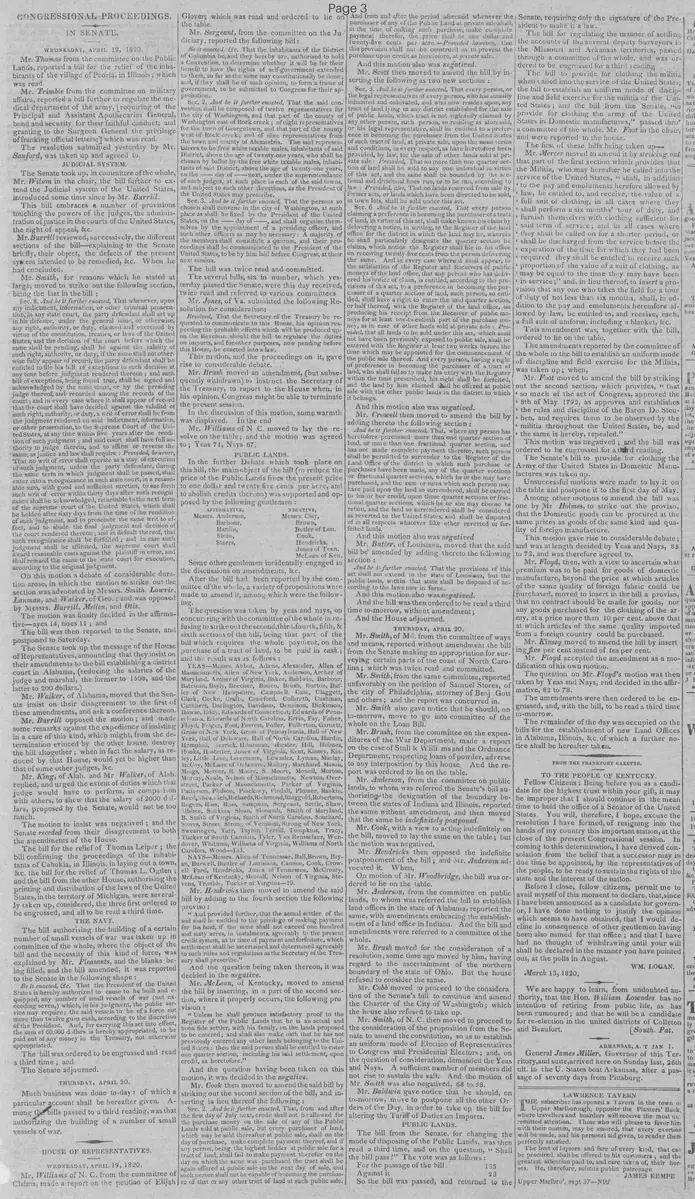
such person shall not be capable of becoming the purchaser of that or any other tract of land at such public sale.
And from and after the period aforesaid whenever the purchaser of any of the Public Land at private sale shall, at the time of making such purchase, make complete payment therefor, the price shall be one dollar and twenty-five cents per acre.—Provided however, that this provision shall not be construed as to prevent the purchase upon credit as heretofore, at private sale.
And this motion also was negatived.
Mr. Scott then moved to amend the bill by inserting the following as two new sections:
Sec. 5. And be it further enacted, That every person, or the legal representatives of every person, who has actually inhabited and cultivated, and who now resides upon, any tract of land lying in any district established for the sale of public lands, which tract is not rightfully claimed by any other person, such person, so residing as aforesaid, or his legal representative, shall be entitled to a preference in becoming the purchaser from the United States of such tract of land, at private sale, upon the same terms and conditions, in every respect, as have heretofore been provided, by law, for the sale of other lands sold at private sale: Provided, That no more than one quarter section of land shall be sold to any one individual in virtue of this act, and the same shall be bounded by the sectional and divisional lines run, or to be run, according to law: Provided, also, That no lands reserved from sale by former acts, or lands which have been directed to be sold, in town lots, shall be sold under this act.
Sec. 6. And be it further enacted, That every person claiming a preference in becoming the purchaser of a tract of land, in virtue of this act, shall make known his claim by delivering a notice, in writing, to the Register of the land office for the district in which the land may be, wherein he shall particularly designate the quarter section he claims, which notice the Register shall file in his office on receiving twenty-five cents from the person delivering the same. And in every case where it shall appear, to the satisfaction of the Register and Receivers of public moneys of the land office, that any person who has delivered his notice of claim, is entitled, according to the provisions of this act, to a preference in becoming the purchaser of a quarter section of land, such person, so entitled, shall have a right to enter the said quarter section, or half thereof, with the Register of the land office, on producing his receipt from the Receiver of public moneys for at least one-twentieth part of the purchase money, as in case of other lands sold at private sale: Provided, that all lands to be sold under this act, which shall not have been previously exposed to public sale, shall be entered with the Register at least two weeks before the time which may be appointed for the commencement of the public sale thereof. And every person, having a right of preference in becoming the purchaser of a tract of land, who shall fail so to make his entry with the Register within the time prescribed, his right shall be forfeited, and the land by him claimed shall be offered at public sale with the other public lands in the district to which it belongs.
And this motion also was negatived.
Mr. Crowell then moved to amend the bill by adding thereto the following section:
And be it further enacted, That, where any person has heretofore purchased more than one quarter section of land, or more than one fractional quarter section, and has not made complete payment therefor, such person shall be permitted to surrender to the Register of the Land Office of the district in which such purchase or purchases have been made, any of the quarter sections or fractional quarter sections, which he or she may have purchased, and the sum or sums which such person may have paid upon the land so surrendered, shall be carried to his or her credit, upon those quarter sections or fractional quarter sections, which he or she may choose to retain, and the land so surrendered shall be considered as reverted to the United States, and shall be disposed of in all respects whatever like other reverted or forfeited lands.
And this motion also was negatived.
Mr. Butler, of Louisiana, moved that the said bill be amended by adding thereto the following section:
And be it further enacted, That the provisions of this act shall not extend to the state of Louisiana, but the public lands, within that state shall be disposed of according to the laws now in force.
And this motion also was negatived.
And the bill was then ordered to be read a third time to-morrow, without amendment;
And the House adjourned.
THURSDAY, APRIL 20.
Mr. Smith, of Md. from the committee of ways and means, reported without amendment the bill from the Senate making an appropriation for surveying certain parts of the coast of North Carolina; which was twice read and committed.
Mr. Smith, from the same committee, reported unfavorably on the petition of Samuel Stores, of the city of Philadelphia, attorney of Benj. Gott and others; and the report was concurred in.
Mr. Smith also gave notice that he should, on to-morrow, move to go into committee of the whole on the Loan Bill.
Mr. Brush, from the committee on the expenditures of the War Department, made a report on the case of Stull & Williams and the Ordnance Department, respecting loans of powder, adverse to any interposition by this house. And the report was ordered to lie on the table.
Mr. Anderson, from the committee on public lands, to whom was referred the Senate's bill authorising the designation of the boundary between the states of Indiana and Illinois, reported the same without amendment, and then moved that the same be indefinitely postponed.
Mr. Cook, with a view to acting indefinitely on the bill, moved to lay the same on the table; but the motion was negatived.
Mr. Hendricks then opposed the indefinite postponement of the bill; and Mr. Anderson advocated it. When,
On motion of Mr. Woodbridge, the bill was ordered to lie on the table.
Mr. Anderson, from the committee on public lands, to whom was referred the bill to establish land offices in the state of Alabama, reported the same, with amendments embracing the establishment of a land office in Indiana. And the bill and amendments were referred to a committee of the whole.
Mr. Brush moved for the consideration of a resolution, some time ago moved by him, having regard to the ascertainment of the northern boundary of the state of Ohio. But the house refused to consider the same.
Mr. Cobb moved to proceed to the consideration of the Senate's bill to continue and amend the Charter of the City of Washington; which the house also refused to take up.
Mr. Smith, of N. C. then moved to proceed to the consideration of the proposition from the Senate to amend the constitution, so as to establish an uniform mode of Election of Representatives to Congress and Presidential Electors; and, on the question of consideration, demanded the Yeas and Nays. A sufficient number of members did not rise to sustain the call. And the motion of Mr. Smith was also negatived, 68 to 58.
Mr. Baldwin gave notice that he should, on to-morrow, move to postpone all the other Orders of the Day, in order to take up the bill for altering the Tariff of Duties on Imports.
PUBLIC LANDS.
The bill from the Senate, for changing the mode of disposing of the Public Lands, was then read a third time, and on the question, "Shall the bill pass?" The vote was as follows:
For the passage of the bill 133
Against it 23
So the bill was passed, and returned to the Senate, requiring only the signature of the President to make it a law.
The bill for regulating the manner of settling the accounts of the several deputy Surveyors in the Missouri and Arkansas territories, passed through a committee of the whole, and was ordered to be engrossed for a third reading.
The bill to provide for clothing the militia when called into the service of the United States; the bill to establish an uniform mode of discipline and field exercise for the militia of the United States; and the bill from the Senate, "to provide for clothing the army of the United States in Domestic manufactures," passed thro' a committee of the whole, Mr. Foot in the chair, and were reported to the house.
The first of these bills being taken up—
Mr. Mercer moved to amend it by striking out that part of the first section which provides that the Militia, who may hereafter be called into the service of the United States, "shall, in addition to the pay and emoluments heretofore allowed by law, be entitled to, and receive, the value of a full suit of clothing, in all cases where they shall perform a six months' tour of duty, and furnish themselves with clothing sufficient for said term of service; and in all cases where they shall be called on for a shorter period, or shall be discharged from the service before the expiration of the time for which they had been required, they shall be entitled to receive such proportion of the value of a suit of clothing, as may be equal to the time they may have been in service;" and, in lieu thereof, to insert a provision that any one who takes the field for a tour of duty of not less than six months, shall, in addition to the pay and emoluments heretofore allowed by law, be entitled to, and receive, each, a full suit of uniform, including a blanket, &c.
This amendment was, together with the bill, ordered to lie on the table.
The amendments reported by the committee of the whole to the bill to establish an uniform mode of discipline and field exercise for the Militia, was taken up; when,
Mr. Foot moved to amend the bill by striking out the second section, which provides, "that so much of the act of Congress, approved the 8th of May 1792, as approves and establishes the rules and discipline of the Baron De Steuben, and requires them to be observed by the militia throughout the United States, be, and the same is hereby, repealed."
This motion was negatived; and the bill was ordered to be engrossed for a third reading.
The Senate's bill to provide for clothing the Army of the United States in Domestic Manufactures was taken up.
Unsuccessful motions were made to lay it on the table and postpone it to the first day of May.
Among other motions to amend the bill was one by Mr. Holmes, to strike out the proviso, that the Domestic goods can be procured at the same prices as goods of the same kind and quality of foreign manufacture.
This motion gave rise to considerable debate; and was at length decided by Yeas and Nays, 85 to 73, and was therefore agreed to.
Mr. Floyd, then, with a view to ascertain what premium was to be paid for goods of domestic manufacture, beyond the price at which articles of the same quality of foreign fabric could be purchased, moved to insert in the bill a proviso, that no contract should be made for goods, nor any goods purchased for the clothing of the army, at a price more than 10 per cent. above that at which articles of the same quality imported from a foreign country could be purchased.
Mr. Kinsey moved to amend the bill by inserting five per cent instead of ten per cent.
Mr. Floyd accepted the amendment as a modification of his own motion.
The question on Mr. Floyd's motion was then taken by Yeas and Nays, and decided in the affirmative, 82 to 78.
The amendments were then ordered to be engrossed, and, with the bill, to be read a third time to-morrow.
The remainder of the day was occupied on the bills for the establishment of new Land Offices in Alabama, Illinois, &c. of which a further notice shall be hereafter taken.
What sub-type of article is it?
What keywords are associated?
What entities or persons were involved?
Domestic News Details
Event Date
April 20
Key Persons
Outcome
public lands bill passed 133-23; multiple amendments negatived; militia clothing bill laid on table; discipline bill engrossed for third reading; army clothing bill amended to allow up to 5% premium for domestic goods (82-78) and engrossed; other bills committed or tabled.
Event Details
U.S. House debates and votes on amendments to public lands disposal bill, all negatived; bill passes third reading. Reports on claims, petitions, boundaries, land offices. Discussions on militia clothing, discipline, and army uniforms in domestic manufactures with amendments passed.