Thank you for visiting SNEWPapers!
Sign up free
Literary
April 30, 1898
The Woman's Tribune
Beatrice, Gage County, Nebraska
What is this article about?
Essay by Lady Cook (Tennessee C. Claflin) arguing for women's legal and social equality, using 1871 British census statistics to demonstrate women's extensive labor in factories, food industries, and domestic work, countering claims that men dominate work and women belong only at home.
Clipping
OCR Quality
98%
Excellent
Full Text
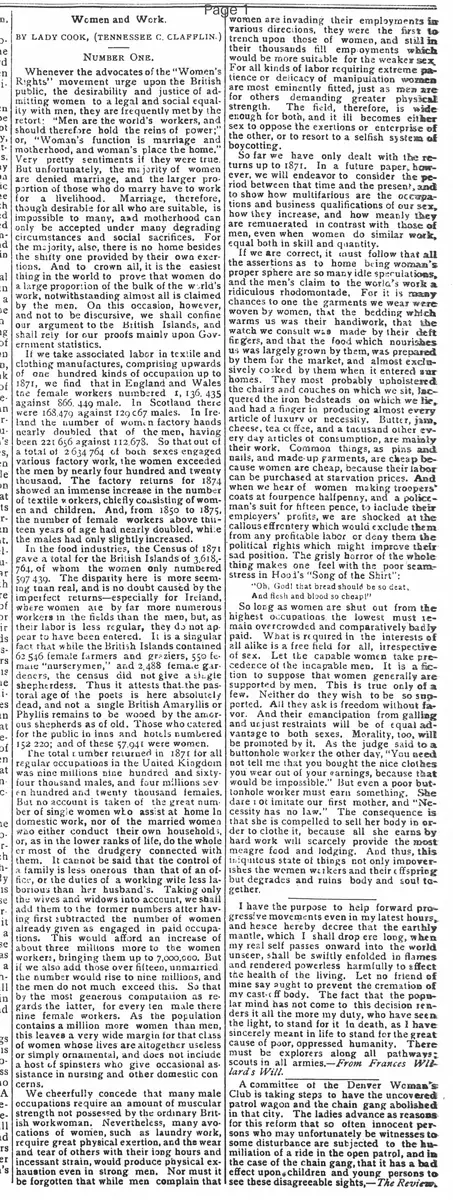
Women and Work.
BY LADY COOK, (TENNESSEE C. CLAFFLIN.)
NUMBER ONE.
Whenever the advocates of the "Women's Rights" movement urge upon the British public, the desirability and justice of admitting women to a legal and social equality with men, they are frequently met by the retort: "Men are the world's workers, and should therefore hold the reins of power;" or, "Woman's function is marriage and motherhood, and woman's place the home."
Very pretty sentiments if they were true. But unfortunately, the majority of women are denied marriage, and the larger proportion of those who do marry have to work for a livelihood. Marriage, therefore, though desirable for all who are suitable, is impossible to many, and motherhood can only be accepted under many degrading circumstances and social sacrifices. For the majority, also, there is no home besides the shifty one provided by their own exertions. And to crown all, it is the easiest thing in the world to prove that women do a large proportion of the bulk of the world's work, notwithstanding almost all is claimed by the men. On this occasion, however, and not to be discursive, we shall confine our argument to the British Islands, and shall rely for our proofs mainly upon Government statistics.
If we take associated labor in textile and clothing manufactures, comprising upwards of one hundred kinds of occupation up to 1871, we find that in England and Wales the female workers numbered 1,136,435 against 866,449 male. In Scotland there were 168,479 against 129,667 males. In Ireland the number of women factory hands nearly doubled that of the men, having been 221,656 against 112,678. So that out of a total of 2,634,764 of both sexes engaged various factory work, the women exceeded the men by nearly four hundred and twenty thousand. The factory returns for 1874 showed an immense increase in the number of textile workers, chiefly consisting of women and children. And, from 1850 to 1875, the number of female workers above thirteen years of age had nearly doubled, while the males had only slightly increased.
In the food industries, the Census of 1871 gave a total for the British Islands of 3,618,764, of whom the women only numbered 597,439. The disparity here is more seeming than real, and is no doubt caused by the imperfect returns-especially for Ireland, where women are by far more numerous workers in the fields than the men, but, as their labor is less regular, they do not appear to have been entered. It is a singular fact that while the British Islands contained 62,546 female farmers and graziers, 550 female "nurserymen," and 2,488 female gardeners, the census did not give a single shepherdess. Thus it attests that the pastoral age of the poets is here absolutely dead, and not a single British Amaryllis or Phyllis remains to be wooed by the amorous shepherds as of old. Those who catered for the public in inns and hotels numbered 152,220; and of these 57,941 were women.
The total number returned in 1871 for all regular occupations in the United Kingdom was nine millions nine hundred and sixty-four thousand males, and four millions seven hundred and twenty thousand females. But no account is taken of the great number of single women who assist at home in domestic work, nor of the married women who either conduct their own household; or, as in the lower ranks of life, do the whole or most of the drudgery connected with them. It cannot be said that the control of a family is less onerous than that of an office, or the duties of a working wife less laborious than her husband's. Taking only the wives and widows into account, we shall add them to the former numbers after having first subtracted the number of women already given as engaged in paid occupations. This would afford an increase of about three millions more to the women workers, bringing them up to 7,000,000. But if we also add those over fifteen, unmarried, the number would rise to nine millions, and the men do not much exceed this. So that by the most generous computation as regards the latter, for every ten male there are nine female workers. As the population contains a million more women than men, this leaves a very wide margin for that class of women whose lives are altogether useless or simply ornamental, and does not include a host of spinsters who give occasional assistance in nursing and other domestic concerns.
We cheerfully concede that many male occupations require an amount of muscular strength not possessed by the ordinary British workwoman. Nevertheless, many avocations of women, such as laundry work, require great physical exertion, and the wear and tear of others with their long hours and incessant strain, would produce physical exhaustion even in strong men. Nor must it be forgotten that while men complain that women are invading their employments in various directions, they were the first to trench upon those of women, and still in their thousands fill employments which would be more suitable for the weaker sex. For all kinds of labor requiring extreme patience or delicacy of manipulation women are most eminently fitted, just as men are for others demanding greater physical strength. The field, therefore, is wide enough for both, and it ill becomes either sex to oppose the exertions or enterprise of the other, or to resort to a selfish system of boycotting.
So far we have only dealt with the returns up to 1871. In a future paper, however, we will endeavor to consider the period between that time and the present, and to show how multifarious are the occupations and business qualifications of our sex, how they increase, and how meanly they are remunerated in contrast with those of men, even when women do similar work, equal both in skill and quantity.
If we are correct, it must follow that all the assertions as to home being woman's proper sphere are so many idle speculations, and the men's claim to the world's work a ridiculous rhodomontade. For it is many chances to one the garments we wear were woven by women, that the bedding which warms us was their handiwork, that the watch we consult was made by their deft fingers, and that the food which nourishes us was largely grown by them, was prepared by them for the market, and almost exclusively cooked by them when it entered our homes. They most probably upholstered the chairs and couches on which we sit, japanned the iron bedsteads on which we lie, and had a finger in producing almost every article of luxury or necessity. Butter, jam, cheese, tea, coffee, and a thousand other every-day articles of consumption, are mainly their work. Common things, as pins and nails, and made-up garments, are cheap because women are cheap, because their labor can be purchased at starvation prices. And when we hear of women making troopers' coats at fourpence halfpenny, and a policeman's suit for fifteen pence, to include their employers' profits, we are shocked at the callous effrontery which would exclude them from any profitable labor or deny them the political rights which might improve their sad position. The grisly horror of the whole thing makes one feel with the poor seamstress in Hood's "Song of the Shirt":
"Oh, God! that bread should be so dear,
And flesh and blood so cheap!"
So long as women are shut out from the highest occupations, the lowest must remain overcrowded and comparatively badly paid. What is required in the interests of all alike is a free field for all, irrespective of sex. Let the capable women take precedence of the incapable men. It is a fiction to suppose that women generally are supported by men. This is true only of a few. Neither do they wish to be so supported. All they ask is freedom without favor. And their emancipation from galling and unjust restraints will be of equal advantage to both sexes. Morality, too, will be promoted by it. As the judge said to a buttonhole worker the other day, "You need not tell me that you bought the nice clothes you wear out of your earnings, because that would be impossible." But even a poor buttonhole worker must earn something. She dare not imitate our first mother, and "Necessity has no law." The consequence is that she is compelled to sell her body in order to clothe it, because all she earns by hard work will scarcely provide the most meagre food and lodging. And thus, this iniquitous state of things not only impoverishes the women workers and their offspring but degrades and ruins body and soul together.
BY LADY COOK, (TENNESSEE C. CLAFFLIN.)
NUMBER ONE.
Whenever the advocates of the "Women's Rights" movement urge upon the British public, the desirability and justice of admitting women to a legal and social equality with men, they are frequently met by the retort: "Men are the world's workers, and should therefore hold the reins of power;" or, "Woman's function is marriage and motherhood, and woman's place the home."
Very pretty sentiments if they were true. But unfortunately, the majority of women are denied marriage, and the larger proportion of those who do marry have to work for a livelihood. Marriage, therefore, though desirable for all who are suitable, is impossible to many, and motherhood can only be accepted under many degrading circumstances and social sacrifices. For the majority, also, there is no home besides the shifty one provided by their own exertions. And to crown all, it is the easiest thing in the world to prove that women do a large proportion of the bulk of the world's work, notwithstanding almost all is claimed by the men. On this occasion, however, and not to be discursive, we shall confine our argument to the British Islands, and shall rely for our proofs mainly upon Government statistics.
If we take associated labor in textile and clothing manufactures, comprising upwards of one hundred kinds of occupation up to 1871, we find that in England and Wales the female workers numbered 1,136,435 against 866,449 male. In Scotland there were 168,479 against 129,667 males. In Ireland the number of women factory hands nearly doubled that of the men, having been 221,656 against 112,678. So that out of a total of 2,634,764 of both sexes engaged various factory work, the women exceeded the men by nearly four hundred and twenty thousand. The factory returns for 1874 showed an immense increase in the number of textile workers, chiefly consisting of women and children. And, from 1850 to 1875, the number of female workers above thirteen years of age had nearly doubled, while the males had only slightly increased.
In the food industries, the Census of 1871 gave a total for the British Islands of 3,618,764, of whom the women only numbered 597,439. The disparity here is more seeming than real, and is no doubt caused by the imperfect returns-especially for Ireland, where women are by far more numerous workers in the fields than the men, but, as their labor is less regular, they do not appear to have been entered. It is a singular fact that while the British Islands contained 62,546 female farmers and graziers, 550 female "nurserymen," and 2,488 female gardeners, the census did not give a single shepherdess. Thus it attests that the pastoral age of the poets is here absolutely dead, and not a single British Amaryllis or Phyllis remains to be wooed by the amorous shepherds as of old. Those who catered for the public in inns and hotels numbered 152,220; and of these 57,941 were women.
The total number returned in 1871 for all regular occupations in the United Kingdom was nine millions nine hundred and sixty-four thousand males, and four millions seven hundred and twenty thousand females. But no account is taken of the great number of single women who assist at home in domestic work, nor of the married women who either conduct their own household; or, as in the lower ranks of life, do the whole or most of the drudgery connected with them. It cannot be said that the control of a family is less onerous than that of an office, or the duties of a working wife less laborious than her husband's. Taking only the wives and widows into account, we shall add them to the former numbers after having first subtracted the number of women already given as engaged in paid occupations. This would afford an increase of about three millions more to the women workers, bringing them up to 7,000,000. But if we also add those over fifteen, unmarried, the number would rise to nine millions, and the men do not much exceed this. So that by the most generous computation as regards the latter, for every ten male there are nine female workers. As the population contains a million more women than men, this leaves a very wide margin for that class of women whose lives are altogether useless or simply ornamental, and does not include a host of spinsters who give occasional assistance in nursing and other domestic concerns.
We cheerfully concede that many male occupations require an amount of muscular strength not possessed by the ordinary British workwoman. Nevertheless, many avocations of women, such as laundry work, require great physical exertion, and the wear and tear of others with their long hours and incessant strain, would produce physical exhaustion even in strong men. Nor must it be forgotten that while men complain that women are invading their employments in various directions, they were the first to trench upon those of women, and still in their thousands fill employments which would be more suitable for the weaker sex. For all kinds of labor requiring extreme patience or delicacy of manipulation women are most eminently fitted, just as men are for others demanding greater physical strength. The field, therefore, is wide enough for both, and it ill becomes either sex to oppose the exertions or enterprise of the other, or to resort to a selfish system of boycotting.
So far we have only dealt with the returns up to 1871. In a future paper, however, we will endeavor to consider the period between that time and the present, and to show how multifarious are the occupations and business qualifications of our sex, how they increase, and how meanly they are remunerated in contrast with those of men, even when women do similar work, equal both in skill and quantity.
If we are correct, it must follow that all the assertions as to home being woman's proper sphere are so many idle speculations, and the men's claim to the world's work a ridiculous rhodomontade. For it is many chances to one the garments we wear were woven by women, that the bedding which warms us was their handiwork, that the watch we consult was made by their deft fingers, and that the food which nourishes us was largely grown by them, was prepared by them for the market, and almost exclusively cooked by them when it entered our homes. They most probably upholstered the chairs and couches on which we sit, japanned the iron bedsteads on which we lie, and had a finger in producing almost every article of luxury or necessity. Butter, jam, cheese, tea, coffee, and a thousand other every-day articles of consumption, are mainly their work. Common things, as pins and nails, and made-up garments, are cheap because women are cheap, because their labor can be purchased at starvation prices. And when we hear of women making troopers' coats at fourpence halfpenny, and a policeman's suit for fifteen pence, to include their employers' profits, we are shocked at the callous effrontery which would exclude them from any profitable labor or deny them the political rights which might improve their sad position. The grisly horror of the whole thing makes one feel with the poor seamstress in Hood's "Song of the Shirt":
"Oh, God! that bread should be so dear,
And flesh and blood so cheap!"
So long as women are shut out from the highest occupations, the lowest must remain overcrowded and comparatively badly paid. What is required in the interests of all alike is a free field for all, irrespective of sex. Let the capable women take precedence of the incapable men. It is a fiction to suppose that women generally are supported by men. This is true only of a few. Neither do they wish to be so supported. All they ask is freedom without favor. And their emancipation from galling and unjust restraints will be of equal advantage to both sexes. Morality, too, will be promoted by it. As the judge said to a buttonhole worker the other day, "You need not tell me that you bought the nice clothes you wear out of your earnings, because that would be impossible." But even a poor buttonhole worker must earn something. She dare not imitate our first mother, and "Necessity has no law." The consequence is that she is compelled to sell her body in order to clothe it, because all she earns by hard work will scarcely provide the most meagre food and lodging. And thus, this iniquitous state of things not only impoverishes the women workers and their offspring but degrades and ruins body and soul together.
What sub-type of article is it?
Essay
What themes does it cover?
Liberty Freedom
Political
Social Manners
What keywords are associated?
Women S Rights
Labor Statistics
Gender Equality
British Census
Factory Work
Domestic Labor
Women S Emancipation
What entities or persons were involved?
By Lady Cook, (Tennessee C. Clafflin.)
Literary Details
Title
Women And Work. Number One.
Author
By Lady Cook, (Tennessee C. Clafflin.)
Subject
Advocacy For Women's Rights And Labor Equality In Britain
Form / Style
Argumentative Prose Essay With Statistical Evidence
Key Lines
"Men Are The World's Workers, And Should Therefore Hold The Reins Of Power;" Or, "Woman's Function Is Marriage And Motherhood, And Woman's Place The Home."
"Oh, God! That Bread Should Be So Dear, And Flesh And Blood So Cheap!"
All They Ask Is Freedom Without Favor.
Let The Capable Women Take Precedence Of The Incapable Men.
This Iniquitous State Of Things Not Only Impoverishes The Women Workers And Their Offspring But Degrades And Ruins Body And Soul Together.