Thank you for visiting SNEWPapers!
Sign up free
Alexandria Daily Gazette, Commercial & Political
Alexandria, Virginia
What is this article about?
In this 1811 address, former Secretary of State Timothy Pickering claims President John Adams removed him in 1800 as a concession to Democratic-Republicans to gain their support for re-election, citing Hamilton's analysis, a certificate from Hazen Kimball, and a letter from Thomas C. Bowie confirming Robert Smith's foreknowledge. Pickering criticizes Adams's character and political apostasy.
Merged-components note: This is a single editorial piece by Timothy Pickering continued across columns on page 2.
Clipping
OCR Quality
Full Text
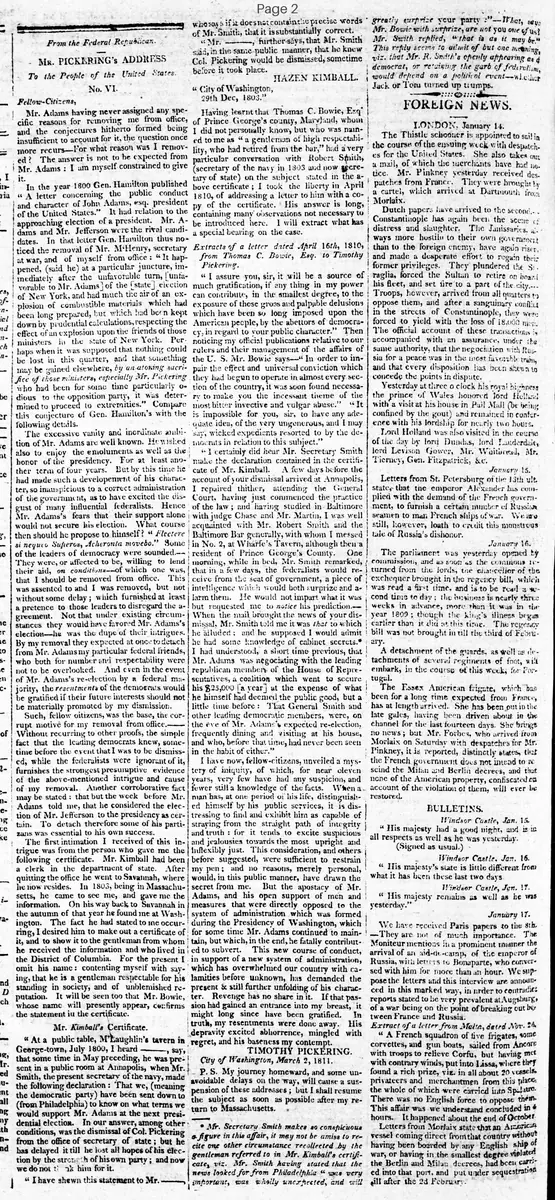
Mr. PICKERING's ADDRESS
To the People of the United States
Fellow-Citizens,
Mr. Adams having never assigned any specific reasons for removing me from office, and the conjectures hitherto formed being insufficient to account for it, the question once more recurs--For what reason was I removed? The answer is not to be expected from Mr. Adams: I am myself constrained to give it.
In the year 1800 Gen. Hamilton published "A letter concerning the public conduct and character of John Adams, esq. president of the United States." It had relation to the approaching election of a president. Mr. Adams and Mr. Jefferson were the rival candidates. In that letter Gen. Hamilton thus noticed the removal of Mr. M'Henry, secretary at war, and of myself from office: "It happened, (said he) at a particular juncture, immediately after the unfavorable turn, unfavorable to Mr. Adams] of the state election of New York, and had much the air of an explosion of combustible materials which had been long prepared, but which had been kept down by prudential calculations, respecting the effect of an explosion upon the friends of those ministers in the state of New York. Perhaps when it was supposed that nothing could be lost in this quarter, and that something may be gained elsewhere, by an atoning sacrifice of those ministers, especially Mr. Pickering who had been for some time particularly odious to the opposition party, it was determined to proceed to extremities." Compare this conjecture of Gen. Hamilton's with the following details.
The excessive vanity and inordinate ambition of Mr. Adams are well known. He wished also to enjoy the emoluments as well as the honor of the presidency. For at least another term of four years. But by this time he had made such a development of his character, so inauspicious to a correct administration of the government, as to have excited the disgust of many influential federalists. Hence Mr. Adams's fears that their support alone would not secure his election. What course then should he propose to himself? "Flectere si nequeo superos, Acheronta movebo." Some of the leaders of democracy were sounded.--They were, or affected to be, willing to lend their aid, on conditions--of which one was, that I should be removed from office. This was assented to and I was removed, but not without some delay; which furnished at least a pretence to those leaders to disregard the agreement. Not that under existing circumstances they would have favored Mr. Adams's election--he was the dupe of their intrigues. By my removal they expected at once to detach from Mr. Adams my particular federal friends, who both for number and respectability were not to be overlooked. And even in the event of Mr. Adams's re-election by a federal majority, the resentments of the democrats would be gratified if their future interests should not be materially promoted by my dismission.
Such, fellow citizens, was the base, the corrupt motive for my removal from office.--Without recurring to other proofs, the simple fact that the leading democrats knew, sometime before the event that I was to be dismissed, while the federalists were ignorant of it, furnishes the strongest presumptive evidence of the above-mentioned intrigue and cause of my removal.. Another corroborative fact may be stated: that but the week before Mr. Adams told me, that he considered the election of Mr. Jefferson to the presidency as certain. To detach therefore some of his partisans was essential to his own success.
The first intimation I received of this intrigue was from the person who gave me the following certificate. Mr. Kimball had been a clerk in the department of state. After quitting the office he went to Savannah, where he now resides. In 1803, being in Massachusetts, he came to see me, and gave me the information. On his way back to Savannah in the autumn of that year he found me at Washington. The fact he had stated to me occurring, I desired him to make out a certificate of it, and to show it to the gentleman from whom he received the information and who lived in the District of Columbia. For the present I omit his name: contenting myself with saying, that he is a gentleman respectable for his standing in society, and of unblemished reputation. It will be seen too that Mr. Bowie, whose name will presently appear, confirms the statement in the certificate.
Mr. Kimball's Certificate.
"At a public table, M'Eaughlin's tavern in George-town, July 1800, I heard - , say, that some time in May preceding, he was present in a public room at Annapolis, when Mr. Smith, the present secretary of the navy, made the following declaration: That we, (meaning the democratic party) have been sent down to (from Philadelphia) to know on what terms we would support Mr. Adams at the next presidential election. In our answer, among other conditions, was the dismissal of Col. Pickering from the office of secretary of state; but he has delayed it till he lost all hopes of his election by the strength of his own party; and now we do not ask him for it.
"I have shewn this statement to M. . - whose says if it doesn't contain the precise words of Mr. Smith, that it is substantially correct.
"Mr. -. further says, that Mr. Smith said, in the same public manner, that he knew Col. Pickering would be dismissed, sometime before it took place.
HAZEN KIMBALL.
"City of Washington 29th Dec, 1803."
Having learnt that Thomas C. Bowie, Esq of Prince George's county, Maryland, whom I did not personally know, but who was named to me as "a gentleman of high respectability, who had retired from the bar," had a very particular conversation with Robert Smith, (secretary of the navy in 1803 and now secretary of state) on the subject stated in the above certificate; I took the liberty in April 1810, of addressing a letter to him with a copy of the certificate. His answer is long containing many observations not necessary to be introduced here. I will extract what has a special bearing on the case.
Extracts of a letter dated April 16th, 1810 from Thomas C. Bowie, Esq. to Timothy Pickering.
"I assure you, sir, it will be a source of much gratification, if any thing in my power can contribute, in the smallest degree, to the exposure of those gross and palpable delusions which have been so long imposed upon the American people, by the abettors of democracy, in regard to your public character." Then noticing my official publications relative to our rulers and their management of the affairs of the U. S. Mr. Bowie says--"In order to impair the effect and universal conviction which they had begun to operate in almost every section of the country, it was soon found necessary to make you the incessant theme of the most bitter invective and vulgar abuse." "It is impossible for you, sir, to have any adequate idea, of the very ungenerous, and I may say, wicked expedients resorted to by the democrats in relation to this subject."
"I certainly did hear Mr. Secretary Smith make the declaration contained in the certificate of Mr. Kimball. A few days before the account of your dismissal arrived at Annapolis, I repaired thither, attending the General Court, having just commenced the practice of the law; and having studied in Baltimore with judge Chase and Mr. Martin. I was well acquainted with Mr. Robert Smith and the Baltimore Bar generally, with whom I messed in No. 2, at Wharfe's Tavern, although then a resident of Prince George's County. One morning, while in bed, Mr. Smith remarked, that in a few days, the federalists would receive from the seat of government, a piece of intelligence which would both surprize and alarm them. He would not impart what it was but requested me to notice his prediction.--When the mail brought the news of your dismissal. Mr. Smith told me it was that to which he alluded: and he supposed I would admit he had some knowledge of cabinet secrets.*
I had understood, a short time previous, that Mr. Adams was negotiating with the leading republican members of the House of Representatives, a coalition which went to secure his $25,000 a year at the expense of what he himself had deemed the public good, but a little time before: That General Smith and other leading democratic members, were, on the eve of Mr. Adams's expected re-election, frequently dining and visiting at his house, and who, before that time, had never been seen in the habit of either."
I have now, fellow-citizens, unveiled a mystery of iniquity, of which, for near eleven years, very few have had any suspicion, and fewer still a knowledge of the facts. When a man has, at one period of his life, distinguished himself by his public services, it is distressing to find and exhibit him as capable of straying from the straight path of integrity and truth: for it tends to excite suspicions and jealousies towards the most upright and inflexibly just. This consideration, and others before suggested, were sufficient to restrain my pen; and no reasons, merely personal, would, in this public manner, have drawn the secret from me. But the apostacy of Mr. Adams, and his open support of men and measures that were directly opposed to the system of administration which was formed during the Presidency of Washington, which for some time Mr. Adams continued to maintain, but which, in the end, he fatally contributed to subvert. This new course of conduct, in support of a new system of administration, which has overwhelmed our country with calamities before unknown, has demanded the present & still further unfolding of his character. Revenge has no share in it. If that passion had gained an entrance into my breast, it might long since have been gratified. In truth, my resentments were done away. His depavity excited abhorrence, mingled with regret, and his baseness my contempt.
TIMOTHY PICKERING.
City of Washington, March 2, 1811.
P. S. My journey homeward, and some unavoidable delays on the way, will cause a suspension of these addresses; but I shall resume the subject as soon as possible after my return to Massachusetts.
* Mr. Secretary Smith makes so conspicuous a figure in this affair, it may not be amiss to reconcile one other circumstance recollected by the gentleman referred to in Mr. Kimball's certificate, viz. Mr. Smith having stated that the news looked for from Philadelphia "was very important, was wholly unexpected, and will greatly surprize your party:"--That, says Mr. Bowie with surprize, are not you one of us? Mr. Smith replied, "that is as it may be."
This reply seems to admit of but one meaning. viz. that Mr. R. Smith's openly appearing as a democrat, or retaining the garb of federalism. would depend on a political event-whether Jack or Tom turned up trumps.
What sub-type of article is it?
What keywords are associated?
What entities or persons were involved?
Editorial Details
Primary Topic
Timothy Pickering's Removal From Office By John Adams Due To Political Intrigue With Democrats
Stance / Tone
Defensive And Accusatory Against Adams
Key Figures
Key Arguments