Thank you for visiting SNEWPapers!
Sign up free
Editorial
March 16, 1808
Alexandria Daily Advertiser
Alexandria, Virginia
What is this article about?
This editorial, translated from a French paper, examines the principles of armed neutrality proclaimed by Russia's emperor, echoing Catherine the Great's system. It outlines rights for neutral vessels and goods, critiques belligerent powers' restrictions, and highlights historical precedents supporting neutrality in international maritime law, with criticism of England's later opposition.
Clipping
OCR Quality
95%
Excellent
Full Text
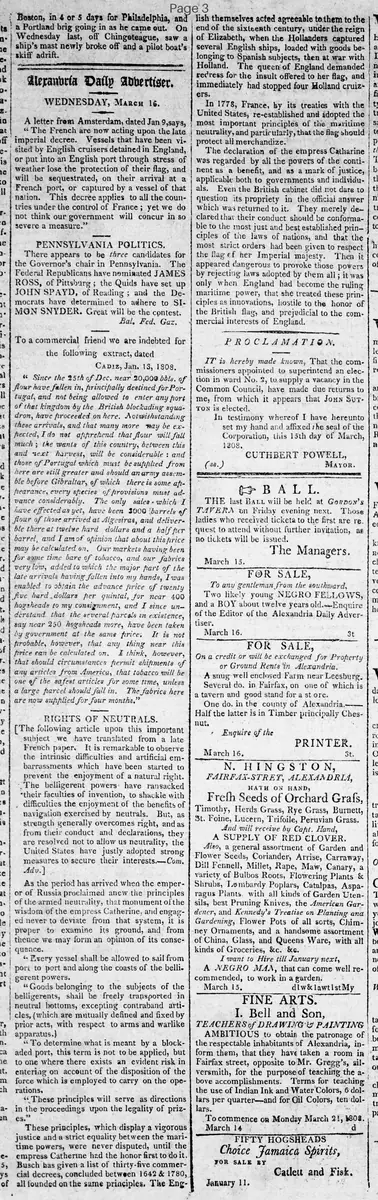
RIGHTS OF NEUTRALS.
[The following article upon this important subject we have translated from a late French paper. It is remarkable to observe the intrinsic difficulties and artificial embarrassments which have been started to prevent the enjoyment of a natural right. The belligerent powers have ransacked their faculties of invention, to shackle with difficulties the enjoyment of the benefits of navigation exercised by neutrals. But, as strength generally overcomes right, and as from their conduct and declarations, they are resolved not to allow us neutrality, the United States have justly adopted strong measures to secure their interests.--Com. Adv.]
As the period has arrived when the emperor of Russia proclaimed anew the principles of the armed neutrality, that monument of the wisdom of the empress Catherine, and engaged never to deviate from that system, it is proper to examine its ground, and from thence we may form an opinion of its consequence.
"Every vessel shall be allowed to sail from port to port and along the coasts of the belligerent powers.
"Goods belonging to the subjects of the belligerents, shall be freely transported in neutral bottoms, excepting contraband articles, (which are mutually defined and fixed by prior acts, with respect to arms and warlike apparatus.)
"To determine what is meant by a blockaded port, this term is not to be applied, but to one where there exists an evident risk in entering on account of the disposition of the force which is employed to carry on the operations,
"These principles will serve as directions in the proceedings upon the legality of prizes."
These principles, which display a vigorous justice and a strict equality between the maritime powers, were never disputed, until the empress Catherine had the honor first to do it. Bynkershoek has given a list of thirty-five commercial decrees, concluded between 1642 & 1780, all founded on the same principles. The English themselves acted agreeable to them to the end of the sixteenth century, under the reign of Elizabeth, when the Hollanders captured several English ships loaded with goods belonging to Spanish subjects, then at war with Holland. The queen of England demanded redress for the insult offered to her flag, and immediately had stopped four Holland cruisers.
In 1778, France, by its treaties with the United States, re-established and adopted the most important principles of the maritime neutrality, and particularly, that the flag should protect all merchandize.
The declaration of the empress Catharine was regarded by all the powers of the continent as a benefit, and as a mark of justice, applicable both to governments and individuals. Even the British cabinet did not dare to question its propriety in the official answer which was returned to it. They merely declared that their conduct should be conformable to the most just and best established principles of the laws of nations, and that the most strict orders had been given to respect the flag of her Imperial majesty. Then it appeared dangerous to provoke those powers by rejecting laws adopted by them all; it was only when England had become the ruling maritime power, that she treated these principles as innovations, hostile to the honor of the British flag, and prejudicial to the commercial interests of England.
[The following article upon this important subject we have translated from a late French paper. It is remarkable to observe the intrinsic difficulties and artificial embarrassments which have been started to prevent the enjoyment of a natural right. The belligerent powers have ransacked their faculties of invention, to shackle with difficulties the enjoyment of the benefits of navigation exercised by neutrals. But, as strength generally overcomes right, and as from their conduct and declarations, they are resolved not to allow us neutrality, the United States have justly adopted strong measures to secure their interests.--Com. Adv.]
As the period has arrived when the emperor of Russia proclaimed anew the principles of the armed neutrality, that monument of the wisdom of the empress Catherine, and engaged never to deviate from that system, it is proper to examine its ground, and from thence we may form an opinion of its consequence.
"Every vessel shall be allowed to sail from port to port and along the coasts of the belligerent powers.
"Goods belonging to the subjects of the belligerents, shall be freely transported in neutral bottoms, excepting contraband articles, (which are mutually defined and fixed by prior acts, with respect to arms and warlike apparatus.)
"To determine what is meant by a blockaded port, this term is not to be applied, but to one where there exists an evident risk in entering on account of the disposition of the force which is employed to carry on the operations,
"These principles will serve as directions in the proceedings upon the legality of prizes."
These principles, which display a vigorous justice and a strict equality between the maritime powers, were never disputed, until the empress Catherine had the honor first to do it. Bynkershoek has given a list of thirty-five commercial decrees, concluded between 1642 & 1780, all founded on the same principles. The English themselves acted agreeable to them to the end of the sixteenth century, under the reign of Elizabeth, when the Hollanders captured several English ships loaded with goods belonging to Spanish subjects, then at war with Holland. The queen of England demanded redress for the insult offered to her flag, and immediately had stopped four Holland cruisers.
In 1778, France, by its treaties with the United States, re-established and adopted the most important principles of the maritime neutrality, and particularly, that the flag should protect all merchandize.
The declaration of the empress Catharine was regarded by all the powers of the continent as a benefit, and as a mark of justice, applicable both to governments and individuals. Even the British cabinet did not dare to question its propriety in the official answer which was returned to it. They merely declared that their conduct should be conformable to the most just and best established principles of the laws of nations, and that the most strict orders had been given to respect the flag of her Imperial majesty. Then it appeared dangerous to provoke those powers by rejecting laws adopted by them all; it was only when England had become the ruling maritime power, that she treated these principles as innovations, hostile to the honor of the British flag, and prejudicial to the commercial interests of England.
What sub-type of article is it?
War Or Peace
Foreign Affairs
Trade Or Commerce
What keywords are associated?
Armed Neutrality
Neutral Rights
Maritime Law
Catherine The Great
Blockaded Ports
Contraband Goods
Laws Of Nations
What entities or persons were involved?
Emperor Of Russia
Empress Catherine
Bynkershoek
Queen Elizabeth
France
United States
British Cabinet
England
Editorial Details
Primary Topic
Principles Of Armed Neutrality And Rights Of Neutrals
Stance / Tone
Supportive Of Neutral Maritime Rights And Critical Of Belligerent Restrictions
Key Figures
Emperor Of Russia
Empress Catherine
Bynkershoek
Queen Elizabeth
France
United States
British Cabinet
England
Key Arguments
Neutral Vessels May Sail Freely Between Belligerent Ports And Coasts.
Belligerent Goods Can Be Transported In Neutral Ships Except Contraband.
Blockaded Ports Require Evident Risk From Forces To Qualify.
These Principles Guide Legality Of Prizes.
Principles Historically Undisputed Until Catherine's Declaration.
Thirty Five Decrees From 1642 1780 Based On These Principles.
England Followed Them Under Elizabeth.
France And Us Adopted Them In 1778 Treaties.
Continental Powers Viewed Catherine's Declaration As Beneficial.
England Later Opposed Them As Innovations When Dominant.