Thank you for visiting SNEWPapers!
Sign up free
The Union County Journal
Marysville, Union County, Ohio
What is this article about?
Veterinarians advise on safe application of DDT to farm animals in powder, liquid spray, or dip forms, emphasizing pressure for sprayers, types of preparations, and risks of toxic reactions including symptoms and antidotes.
Clipping
OCR Quality
Full Text
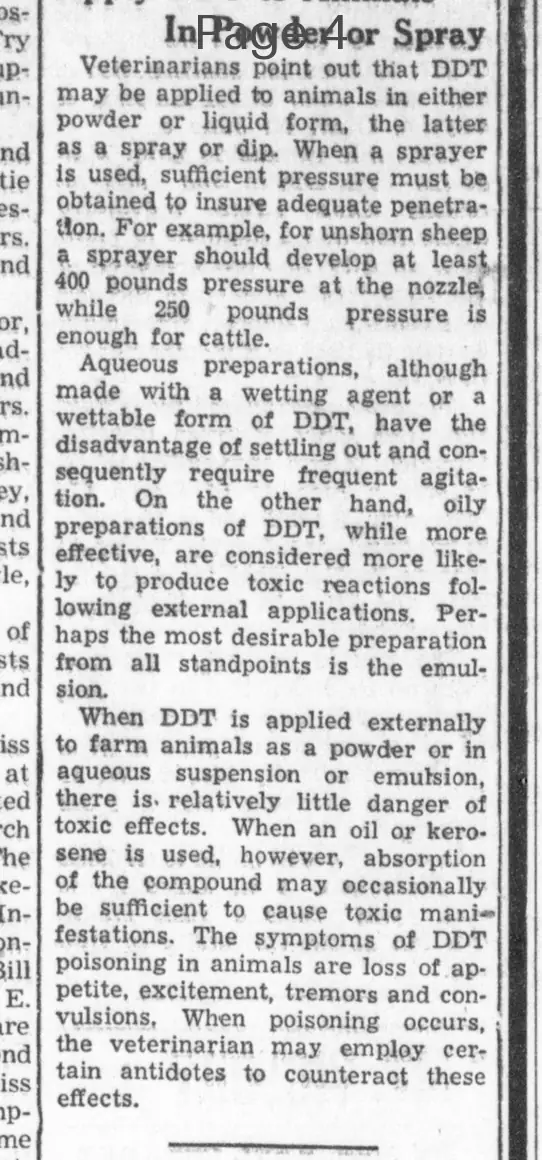
Aqueous preparations, although made with a wetting agent or a wettable form of DDT, have the disadvantage of settling out and consequently require frequent agitation. On the other hand, oily preparations of DDT, while more effective, are considered more likely to produce toxic reactions following external applications. Perhaps the most desirable preparation from all standpoints is the emulsion.
When DDT is applied externally to farm animals as a powder or in aqueous suspension or emulsion, there is, relatively little danger of toxic effects. When an oil or kerosene is used, however, absorption of the compound may occasionally be sufficient to cause toxic manifestations. The symptoms of DDT poisoning in animals are loss of appetite, excitement, tremors and convulsions. When poisoning occurs, the veterinarian may employ certain antidotes to counteract these effects.
What sub-type of article is it?
What keywords are associated?
Domestic News Details
Outcome
symptoms of ddt poisoning in animals include loss of appetite, excitement, tremors, and convulsions; antidotes may be used by veterinarians.
Event Details
Veterinarians recommend applying DDT to animals in powder or liquid form (spray or dip), with specific pressure requirements for sprayers (400 pounds for unshorn sheep, 250 for cattle). Aqueous preparations need agitation; oily ones are effective but riskier for toxicity; emulsions are ideal. Low risk with powder or aqueous forms, higher with oil or kerosene.