Thank you for visiting SNEWPapers!
Sign up free
Literary
December 7, 1880
Bristol News
Bristol, Washington County, Virginia
What is this article about?
Descriptive essay on winter constellations, highlighting Orion, Sirius, and others, their colors and positions. Discusses the Great Nebula in Orion, its gaseous nature, and potential for new worlds. Mentions historical novae in Cassiopeia, possibly periodic, with astrological ties to Christ's birth.
Clipping
OCR Quality
95%
Excellent
Full Text
SCIENTIFIC.
The Winter Firmament.
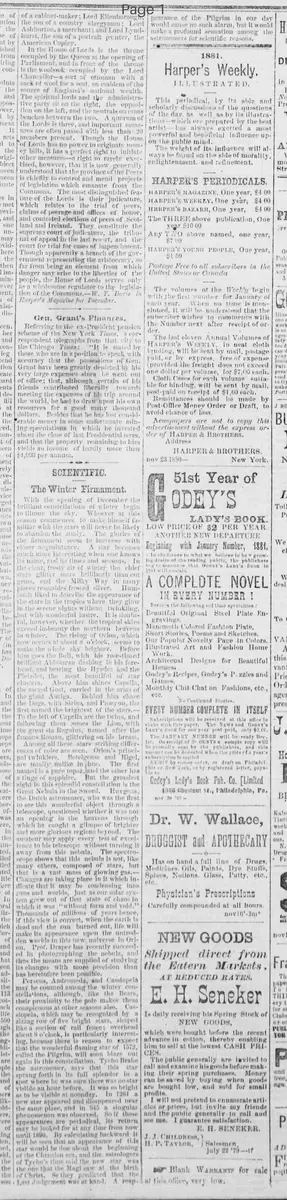
With the opening of December the brilliant constellations of winter begin to illumine the sky. Whoever at this season commences to make himself familiar with the stars will never be likely to abandon the study. The glories of the firmament seem to increase with closer acquaintance. A star becomes much more interesting when one knows its name, and its times and seasons. In the clear, frosty air of winter the chief stars glitter more brilliantly than cut gems, and the Milky Way in many places resembles frosted silver. Humboldt liked to describe the appearance of the stars in the tropics where they glow in the serene nights without twinkling, but with wonderful lustre. It is doubtful, however, whether the tropical skies exceed in beauty the northern heavens in winter. The rising of Orion, which now occurs at about 8 o'clock, seems to make the whole sky brighter. Before him rises the Bull, with his rose-tinted brilliant Aldebaran flashing in his forehead, and bearing the Hyades and the Pleiades, the most beautiful of star clusters. Above him shines Capella, the sacred Goat, carried in the arms of the giant Auriga. Behind him chase the Dogs, with Sirius, and Procyon, the Dog Star the brightest of the stars.
To the left of Capella are the twins, and following them comes the Lion, with the great star Regulus, named after the famous Roman, glittering on his breast. Among all these stars striking differences of color are seen. Orion's principal twinklers, Betelgeuse and Rigel, are totally unlike in hue. The first named is a pure topaz, and the other has a tinge of sapphire. But the grandest sight in this splendid constellation is the Great Nebula in the Sword. Huygens, the Dutch astronomer, who was the first to see this wonderful object through a telescope, questioned whether it was not an opening in the heavens through which he caught a glimpse of brighter and more glorious regions beyond. The amateur may apply every test of excellence to his telescope without turning it away from this nebula. The spectroscope shows that this nebula is not, like many others, composed of stars, but that it is a vast mass of glowing gas. Changes are taking place in it which indicate that it may be condensing into suns and worlds, just as our solar system grew out of that state of chaos in which it was "without form and void."
Thousands of millions of years hence, if this view is correct, when the earth is dead and the sun burned out, life will make its appearance upon the untrodden worlds in this new universe in Orion. Prof. Draper has recently succeeded in photographing the nebula, and thus the means are supplied of studying its changes with more precision than has heretofore been possible.
Perseus, Andromeda, and Cassiopeia may be counted among the winter constellations, although, like the Bears, their proximity to the pole makes them conspicuous at other seasons also. Cassiopeia, which may be recognized by a zigzag row of five bright stars, shaped like a section of rail fence; overhead about 8 o'clock, is particularly interesting, because there is reason to expect that the wonderful flaming star of 1572, called the Pilgrim, will soon blaze out again in this constellation. Tycho Brahe the astronomer, says that this star sprang forth in its full splendor in a spot where he was sure there was no star visible an hour before. It was so bright as to be visible at noonday. In 1200 a new star appeared and disappeared near the same place, and in 945 "a singular phenomenon was observed." So if these appearances are periodical, its return may be looked for at any time from now until 1880. By calculating backward it will be seen that an appearance of this star would be due about the beginning of the Christian era, and the astrologers of Tycho's time said the new star was the one that the Magi saw at the birth of Christ. So they predicted that the Last Judgement was at hand. A reappearance of the Pilgrim in our day would cause no such alarm, but it would make a profound sensation among the astronomers for scientific reasons.
The Winter Firmament.
With the opening of December the brilliant constellations of winter begin to illumine the sky. Whoever at this season commences to make himself familiar with the stars will never be likely to abandon the study. The glories of the firmament seem to increase with closer acquaintance. A star becomes much more interesting when one knows its name, and its times and seasons. In the clear, frosty air of winter the chief stars glitter more brilliantly than cut gems, and the Milky Way in many places resembles frosted silver. Humboldt liked to describe the appearance of the stars in the tropics where they glow in the serene nights without twinkling, but with wonderful lustre. It is doubtful, however, whether the tropical skies exceed in beauty the northern heavens in winter. The rising of Orion, which now occurs at about 8 o'clock, seems to make the whole sky brighter. Before him rises the Bull, with his rose-tinted brilliant Aldebaran flashing in his forehead, and bearing the Hyades and the Pleiades, the most beautiful of star clusters. Above him shines Capella, the sacred Goat, carried in the arms of the giant Auriga. Behind him chase the Dogs, with Sirius, and Procyon, the Dog Star the brightest of the stars.
To the left of Capella are the twins, and following them comes the Lion, with the great star Regulus, named after the famous Roman, glittering on his breast. Among all these stars striking differences of color are seen. Orion's principal twinklers, Betelgeuse and Rigel, are totally unlike in hue. The first named is a pure topaz, and the other has a tinge of sapphire. But the grandest sight in this splendid constellation is the Great Nebula in the Sword. Huygens, the Dutch astronomer, who was the first to see this wonderful object through a telescope, questioned whether it was not an opening in the heavens through which he caught a glimpse of brighter and more glorious regions beyond. The amateur may apply every test of excellence to his telescope without turning it away from this nebula. The spectroscope shows that this nebula is not, like many others, composed of stars, but that it is a vast mass of glowing gas. Changes are taking place in it which indicate that it may be condensing into suns and worlds, just as our solar system grew out of that state of chaos in which it was "without form and void."
Thousands of millions of years hence, if this view is correct, when the earth is dead and the sun burned out, life will make its appearance upon the untrodden worlds in this new universe in Orion. Prof. Draper has recently succeeded in photographing the nebula, and thus the means are supplied of studying its changes with more precision than has heretofore been possible.
Perseus, Andromeda, and Cassiopeia may be counted among the winter constellations, although, like the Bears, their proximity to the pole makes them conspicuous at other seasons also. Cassiopeia, which may be recognized by a zigzag row of five bright stars, shaped like a section of rail fence; overhead about 8 o'clock, is particularly interesting, because there is reason to expect that the wonderful flaming star of 1572, called the Pilgrim, will soon blaze out again in this constellation. Tycho Brahe the astronomer, says that this star sprang forth in its full splendor in a spot where he was sure there was no star visible an hour before. It was so bright as to be visible at noonday. In 1200 a new star appeared and disappeared near the same place, and in 945 "a singular phenomenon was observed." So if these appearances are periodical, its return may be looked for at any time from now until 1880. By calculating backward it will be seen that an appearance of this star would be due about the beginning of the Christian era, and the astrologers of Tycho's time said the new star was the one that the Magi saw at the birth of Christ. So they predicted that the Last Judgement was at hand. A reappearance of the Pilgrim in our day would cause no such alarm, but it would make a profound sensation among the astronomers for scientific reasons.
What sub-type of article is it?
Essay
What themes does it cover?
Nature
Seasonal Cycle
What keywords are associated?
Winter Constellations
Orion Nebula
Stars
Astronomy
Cassiopeia
Tycho Brahe
Nova
Literary Details
Title
The Winter Firmament
Key Lines
The Rising Of Orion, Which Now Occurs At About 8 O'clock, Seems To Make The Whole Sky Brighter.
But The Grandest Sight In This Splendid Constellation Is The Great Nebula In The Sword.
Huygens, The Dutch Astronomer, Who Was The First To See This Wonderful Object Through A Telescope, Questioned Whether It Was Not An Opening In The Heavens Through Which He Caught A Glimpse Of Brighter And More Glorious Regions Beyond.
Thousands Of Millions Of Years Hence, If This View Is Correct, When The Earth Is Dead And The Sun Burned Out, Life Will Make Its Appearance Upon The Untrodden Worlds In This New Universe In Orion.
A Reappearance Of The Pilgrim In Our Day Would Cause No Such Alarm, But It Would Make A Profound Sensation Among The Astronomers For Scientific Reasons.