Thank you for visiting SNEWPapers!
Sign up free
The New York Herald
New York, New York County, New York
What is this article about?
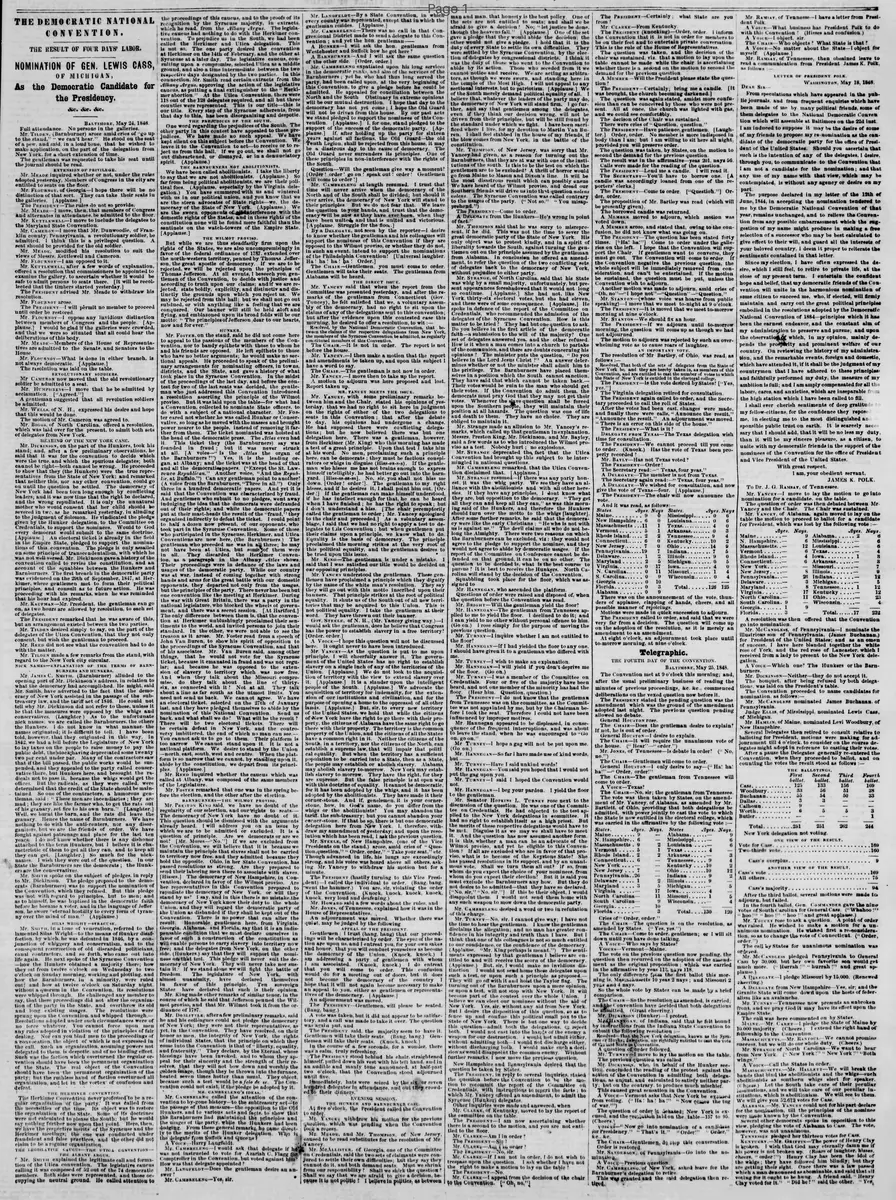
The 1848 Democratic National Convention in Baltimore debated the New York delegation dispute between Hunkers and Barnburners, admitted both, then nominated Lewis Cass of Michigan for President after four ballots, amid discussions on the Wilmot Proviso and party unity.
Merged-components note: These components form a single coherent article on the Democratic National Convention proceedings, including vote tallies and ballot results. Original labels were 'story' and 'table'; merged into 'domestic_news' as it covers US political events.
Clippings
1 of 2
OCR Quality
Full Text
THE RESULT OF FOUR DAYS LABOR.
NOMINATION OF GEN. LEWIS CASS,
OF MICHIGAN,
as the Democratic Candidate for
the Presidency.
&c. &c. &c.
BALTIMORE, May 24, 1848.
Full attendance. No persons in the galleries.
Mr. Tilden, (Barnburner) arose amid cries of "go up to the stand," "we can't hear."
He stood on the seat of a pew, and said, in a loud tone, that he wished to make application, on the part of the delegation from New York, for a short extension of time.
The gentleman was requested to take his seat until the journal should be read.
EXTENSION OF PRIVILEGE.
Mr. Meade inquired whether or not, under the rules adopted yesterday, Members of Congress in the city are entitled to seats on the floor.
Mr. Flournoy, of Georgia—I hope there will be no distinction of that sort. They can take their seats in the galleries. [Applause]
The President—The rules do not so provide.
Mr. Meade—I move, then, that members of Congress and alternates in attendance be admitted to the floor.
Mr. Kettlewell—I move to include the delegates to the Maryland State Convention.
Mr. Cameron—I move that Mr. Dunwoodie, of Franklin county, Pennsylvania, a revolutionary soldier, be admitted. I think this is a privileged question. A seat should be provided for the old soldier.
Mr. Meade modified his resolution to suit the views of Messrs. Kettlewell and Cameron.
Mr. Flournoy—I am opposed to it.
Mr. Kettlewell, after a few words of explanation, offered a resolution that commissioners be appointed to examine the gallery, to ascertain whether it would be safe to admit persons to seats there. [It will be recollected that the timbers started yesterday.]
The President advised Mr. Meade to withdraw his resolution.
Mr. Flournoy arose.
The President—I will permit no member to proceed until order be restored.
Mr. Flournoy—I oppose any invidious distinction between members of Congress and the people. [Applause.] I would be glad if the galleries were crowded, and that we were so situated that all could hear the deliberations of this body.
Mr. Meade—Members of the House of Representatives are admitted to the Senate, and Senators to the House.
Mr. Flournoy—What is done in either branch, is not always democratic. [Applause.]
The resolution was laid on the table.
REVOLUTIONARY SOLDIERS
Mr. Cameron now moved that the old revolutionary soldier be admitted to a seat.
Mr. Humphreys—I move that he be admitted by acclamation.
["Agreed."
A gentleman suggested that all revolution soldiers be admitted.
Mr. Wells, of N. H., expressed his desire and hope that this would be done.
The motion of Mr. Cameron was agreed to.
Mr. Biggs, of North Carolina, offered a resolution, which was laid over for the present, to admit both sets of delegates from New York.
HEARING OF THE NEW YORK CASE.
Mr. Dickinson, on the part of the Hunkers, took his stand; and, after a few preliminary observations, he said that it was for the convention to decide which were the true, and which the spurious delegates; both cannot be right—both cannot be wrong. He proceeded to show that they (the Hunkers) were the true representatives from the State of New York: and remarked that neither this, nor any other convention, could go on until the question be settled. The democracy of New York had been torn long enough by conflicting leaders; and it was now time that the right be declared, and the wrong repudiated. It is only the unnatural mother who would consent that her child should be severed in twain, as he remarked yesterday, in alluding to the judgment of Solomon. He vindicated the pledge given by the Hunker delegation, to the Committee on Credentials, to support the nominees. Would to God every democrat would submit to the same doctrine. [Applause.] An electoral ticket is already in the field in the Empire State, pledged to support the nominations of this convention. The pledge is only assailed on some principle of transcendentalism, with which he was not well versed. Mr. Dickinson gave a history of the convention called to revise the constitution, and an account of the squabbles between the Hunkers and Barnburners. The first breach in the democratic party was evidenced on the 29th of September, 1847, at Herkimer, where gentlemen met to form their political principles, and consult as to future action. He was proceeding with his remarks, when he was reminded that his hour had expired.
Mr. Kaufman—Mr. President, the gentleman can go on, as two hours are allowed by resolution, to each set of delegates.
The President remarked that he was aware of this, but an arrangement existed between the two parties.
Mr. Tilden desired simply to say, on the part of the delegates of the Utica Convention, that they not only consent, but wish the gentleman to proceed.
Mr. Reed did not see what the convention had to do with the matter.
Mr. Tilden made a few remarks from the stand, with regard to the New York city circular.
NICK NAMES EXPLANATION OF THE TERM BARN: BURNERS AND HUNKERS.
Mr. James C. Smith, (Barnburner) alluded to the opening part of Mr. Dickinson's address, in relation to what the democracy had accomplished. He might, said Mr. Smith, have adverted to the fact that the democracy of New York assisted in the passage of the sub-treasury law, and the tariff act of 1846. He could not tell why Mr. Dickinson did not refer to those, unless it be that the measures were opposed by the whigs and conservatives. (Laughter.) As to the unfortunate nick names: we are called the Barnburners, the others the Hunkers. I do not know in what manner the names originated; it is difficult to tell. I have been told, however, that they originated in this way. In 1842, we had a bill before the Legislature of New York to lay taxes on the people to raise money to pay the public debt, the stock having depreciated some twenty two per cent under par. Many of the contractors saw that if the bill passed, the public works would be suspended, and they appealed to the party called conservative there, but Hunkers here, and besought the radicals not to pass it, because the whigs would get the offices. But the radicals, as they were called, were determined that the credit of the State should be maintained. So one of the contractors, a humorous gentleman, said: "These men are incendiaries; they are mad; they are like the farmer who, to get the rats out of his granary, set fire to his own barn." [Laughter.] Well, we burnt the barn, and the rats did leave the granary. Hence the name of Barnburners. We have nothing to do with the anti-renters, nor any disorganizers, but we are the friends of order. We have fought against patronage and place for the last ten years. I do not know whether there is any dishonor attached to the term Hunkers, but I believe it is characteristic of them to get all they can, and to keep all they can get. [Laughter.] So much for the nick names. I wish they were out of the question. In our State the Barnburners are the democrats; the Hunkers are the conservatives.
Mr. Smith spoke on the subject of pledges, in reply to Mr. Dickinson. The pledge proposed to the democrats (Barnburners) was to support the nomination of the Convention, which they refused. But this pledge was not with regard to principles, but to men; and as to himself, he was baptised in the democratic faith before he became a voter, and in the language of Jefferson, he swore "eternal hostility to every form of tyranny over the mind of man." (Applause.)
SILAS WRIGHT—SYRACUSE
Mr. Smith, in a tone of veneration, referred to the lamented Silas Wright—to the means of Hunker disaffection, by which he was defeated in 1846, by a conjunction of whiggery and conservatism, and to the consequent resurrection of old discarded politicians, canal contractors, and so forth, who came out into life again. He next spoke of the Syracuse Convention—how the Hunkers obtained a majority there; how they sat from twelve o'clock on Wednesday to two o'clock on Sunday morning, working and plotting, and how the Barnburners, in a minority, were ruled out; and how at twelve o'clock on Saturday night, without a quorum in the Convention, its resolutions were whipped through. He challenged any member to say, that these proceedings did not alter the organization of the party in the State, and overthrow its old and long existing usages. The resolutions were sprung upon the Convention, and whipped through. Resolutions adopted under such circumstances were of no force whatever. You cannot force upon men any rules adopted in violation of the principles of fair dealing. Nor can you bind men to the proceedings of a convocation, the object of which is not expressed in the call. Such an organization, assuming powers not delegated to them, is despotic, and of no binding effect.
Such was the faction which overturned the regular organization of the State. The real object of the Convention should have been the permanent organization of the party: but the ruthless hand of faction overturned all organization, and let in the vortex of confusion and defection.
THE HERKIMER CONVENTION.
The Herkimer Convention never professed to be a regular organization of the party. It was called from the necessities of the time. Its object was to restore the organization of the State. Some of its doctrines were not calculated to please the South; but he would say nothing further now upon that point. Here, then, we have the respective merits of the Syracuse and the Herkimer meetings; the one was conducted under fraudulent and false practices, and the other did not claim to be a regular organization.
THE LEGISLATIVE CAUCUS—THE UTICA CONVENTION THE ALBANY ARGUS.
Mr. Smith explained the legitimate call and formation of the Utica convention. The legislative caucus calling it was composed of 52 out of the 74 democratic members. Both sides were represented, and those occupying the neutral ground. He called attention to the proceedings of this caucus, and to the proofs of its recognition by the Syracuse majority, in extracts, which he read, from the Albany Argus. The legislative caucus had nothing to do with the Herkimer convention. To prejudice us in the South, we had been called the Herkimer and Utica Delegation. This is not so. The one party desired the convention at Herkimer on the 1st of February, and the other at Syracuse at a later day. The legislative caucus, consulting upon compromise, selected Utica as a middle ground, and also a time intermediate between the two respective days designated by the two parties. In this connection, Mr. Smith read certain extracts from the Albany Argus, approving the action of the legislative caucus, as putting a final extinguisher to the "Herkimer abortion." "At the Utica Convention, there were 118 out of the 128 delegates required, and all but three counties were represented. This is our title—this is our title. Every step of the Syracuse adherents, from that day to this, has been disorganizing and despotic."
One word regarding the prejudices of the South. The other party in this contest have appealed to these prejudices. We have made no such appeal. We have kept silent on this subject before the Convention. We leave it to the Convention to act—to receive or to reject us from this hall. If we go out, we shall not go out disheartened, or dismayed, or in a denunciatory spirit. (Applause.)
THE BARNBURNERS NOT ABOLITIONISTS.
We have been called abolitionists. I take the liberty to say that we are not abolitionists. (Applause.) So far from being political abolitionists, we are their political foes. (Applause, especially by the Virginia delegation.) You have summered with us and wintered with us in our political union, and you know that we are the stern advocates of State rights—we, the democracy of the State of New York. (Applause.) We are the sworn opponents of interference with the domestic rights of the States, and in these rights of the constitution none will be found more faithful than the sentinels on the watch-towers of the Empire State. [Applause.]
THE WILMOT PROVISO.
But while we are thus steadfastly firm upon the rights of the States, we are also uncompromisingly in favor of the federal ordinance of 1787, extended over the north-western territory, penned by Thomas Jefferson, the great apostle of democracy. If we are to be rejected, we will be rejected upon the principles of Thomas Jefferson. At all events, I beseech you, gentlemen of the Convention, to decide with justice and according to truth upon our claims; and if we are rejected, state boldly, explicitly, and distinctly the grounds upon which you reject us. We may be rejected from this hall; but we shall not go out subdued, or with anything like a feeling that we are conquered. Our banner will still be held aloft and flying, and emblazoned upon its broad folds will be our motto: "The principles of Jefferson, dear to our hearts, now and for ever."
HUNKER.
Mr. Foster, on the stand, said he did not come here to appeal to the passions of the members of the Convention, nor to bandy epithets with those to whom he and his friends are opposed. He left epithets to those who have no better arguments; he would make no sectional appeals. He proceeded to speak of the preliminary arrangements for nominating officers, in towns, districts, and the State, and gave a history of what took place in the Syracuse Convention. In the midst of the proceedings of the last day, and before the contest for two of the last seats was decided, the gentleman who just addressed this Convention introduced a resolution asserting the principle of the Wilmot proviso. But it was laid upon the table—for what had a Convention, collected to nominate State officers, to do with a subject of a national character. Mr. Foster cared not whether he was called Hunker or Conservative, so long as he moved with the masses and brought power nearer to the people, instead of removing it farther from them. The ticket nominated was hoisted at the head of the democratic press. The Atlas even had it. This ticket they (the Barnburners) say was founded in fraud; but it was never struck at all. [A voice—Is the Atlas the organ of the Barnburners?'] Yes, it is the leading organ at Albany; and the ticket was at the head of that and all the democratic papers. ("Except the St. Lawrence Republican." Another voice, "And the Republic, at Buffalo.") Can any gentleman point to another? (A voice from the Barnburners, "Three in all.") Only three in a hundred democratic papers. And yet it is said that the Convention was characterized by fraud. And gentlemen who submit to no pledges, went away indulging the idea that the democrats were defrauded out of their rights; and while the democratic papers put at their mast-heads the result of the "fraud," they organized indirectly to defeat the ticket. I could point to half a dozen now present, of our opponents, who took part in the Syracuse Convention. Some of those who participated in the Syracuse, Herkimer, and Utica Conventions are now here, (the Barnburners.) The gentleman who preceded me was in all three; he may not have been at Utica, but some of them were in all. They discarded the Herkimer Convention, as a paragraph in the Albany Atlas shows. Their proceedings were in defiance of the laws and usages of the democratic party. While our country was at war, instead of coming together with strong hands and arms for the great battle with our domestic opponents, they departed not only from the usages, but the principles of the party. There never has been but one convention like the meeting at Herkimer. During the war with Great Britain, there was a party in the national legislature, who blocked the wheels of government, and there was a secret session. [At Hartford.] The only difference between them is, that the convention at Herkimer unblushingly proclaimed their sentiments to the world, and invited persons to join their standard. In the other, we were not able to see the treason as it arose. Mr. Foster read from a speech of John Van Buren, to show his spirit of opposition to the proceedings of the Syracuse Convention, and that of his associates. Mr. Van Buren said, among other things, that he would not vote for the Syracuse ticket, because it emanated in fraud and was not regular; and because he was opposed to the extension of slavery to territory which was now free. And when they talk about the Missouri compromise, do they talk about the line of thirty-six, as connected with it? Not at all. They talk about a line as far south as the utmost limits. You need not send us back. We cannot agree. We have an electoral ticket, selected on the 27th of January last, and they have pledged themselves to abide by the nomination of this National Convention. Send us back, and what shall we do? What will be the result? There will be two electoral tickets. There will be certain defeat in New York, and the controversy embittered, the end of which no man can see.—You cannot ask us to go to them. Their platform is too narrow. We cannot stand upon it. It is not a national platform. We desire to stand by the Union—north, east, south, west and centre. When the platform is so narrow that we cannot, by standing upon it, abide by the constitution, we depart from its principles. [Applause.]
Mr. Reed inquired whether the caucus which was called at Albany, was composed of the same members of the Legislature.
Mr. Foster remarked that one was in the spring before the election, and the other after the election.
BARNBURNERS—THE WILMOT PROVISO.
Mr. Preston King said, we have no doubt of the regularity of our selection, and our rights to seats—The democracy of New York have no doubt of it. This question should be dismissed with the arguments already heard. I will address you on an issue by which we are to be admitted or excluded. It is a question of principle. Are we democrats or are we not? [Mr. Moses—"No."] If we are excluded from the Convention, we will believe that it is because we maintain the principle that slaves shall not be carried to territory now free, and they admitted because they hold the opposite. Ohio, in her State Convention, has passed resolutions as strong. Are they prepared to send their laboring men there to associate with slaves. [Hisses.] The democracy of New Hampshire, in Convention, declared in favor of the Wilmot proviso. Are her representatives in this Convention prepared to repudiate the democracy of New York, or will they stand by us? I say, and in this there is no mistake, the democracy of New York know their duty to the whole Union, and they will regard the democratic party of the Union as disbanded if they shall be kept out of the Convention.
There is no power that can alter the result. Honorable gentlemen here, from Virginia, Georgia, Alabama, and Florida, say that it is an indispensable condition that we must declare ourselves in favor such construction the constitution will enable persons to carry slavery into territory now free; and the delegates from New York, on the other side, (Hunkers,) say that they will support the nominees on that test. This pledge will never suit the democracy of New York. They will never take nor sustain it. If we stand alone we will fight the battle of freedom.
The legislature of New York, with almost unanimity, have declared themselves in favor of this principle. Ten sovereign States have declared that such is their opinion.
Mr. King made other remarks of similar tenor, in the course of which he said that Jefferson penned the Wilmot proviso, and that Mr. Wilmot took it from the ordinance of 1787.
Mr. Doolittle, after a few preliminary remarks, said he and his colleagues could not pledge the democracy of New York; they were not their representatives, as yet, in the Convention. They have resolved, on their honor as men, the integrity of New York, the rights of individual States, that the principle on which they come into the Convention is that of liberty, equality, and fraternity. They declare, by the Eternal, whose blessings have been invoked, and to whom they appeal for their sincerity and the strength of their resolves, that they will not bow down and worship the golden image, though they be thrown into the furnace, heated seven times hotter than usual. They object, because such a test would be a felo de se. The Convention could not exist, if the pledge be adopted by it.
MR. CAMBRELENG'S IDEAS.
Mr. Cambreleng called the attention of the convention to by-gone history—to the sub-treasury act to the passage of that measure—the opposition to the Old Hunkers, and to various acts and facts, to show that the Barnburners had maintained the principles and the usages of the party, while the Hunkers had been dodging. From these general remarks, he came directly to the merits of the Hunker delegation. Who is the delegate from Suffolk and Queens?
A Voice—Harry Langfeldt.
Mr. Cambreleng—I would ask that delegate if he was not instructed to vote for Azariah C. Flagg for Comptroller in the Convention, but voted against him! How was that delegate appointed?
Mr. Langfeldt—Does the gentleman desire an answer?
Mr. Cambreleng—Yes, sir.
Mr. Langfeldt—By a State Convention. In that Convention every county was represented, except that in which the gentleman resides. [Applause.]
Mr. Cambreleng—There was no call in that Congressional District made to send a delegate to this Convention; and yet the hon. gentleman
A Hunker—I will ask the hon. gentleman from Westchester and Suffolk how he got here?
A Barnburner—And I will ask the same question of the other side. [Order, order.]
Mr. Cambreleng expatiated upon his long services in the democratic ranks, and also of the services of the Barnburners; yet he, who had thus long served the party, had been called upon, at the very beginning of this Convention, to give a pledge before he could be admitted. He appealed for conciliation between the North and the South. Obstinacy in extreme opinions will be our mutual destruction. I hope that day to the democracy has not yet come; I hope the Old Guard will not be driven from this house. By our past acts we stand pledged to support the nominees of this Convention. [Applause.] I, for one, stand pledged to the support of the success of the democratic party. [Applause.] If, after holding up the party for sixteen years against all factions, the Old Guard—the old Tenth Legion, shall be rejected from this house, it may be a disastrous day to the cause of democracy. The Old Guard never surrenders its principles. One of these principles is non-interference with the rights of the South.
Question—Will the gentleman give way a moment? [Order! order! go on: speak out! order! Gentlemen will come to order!]
Mr. Cambreleng at length resumed. I trust that time will never arrive when the democracy of the North and of the South shall be divided: but should it ever arrive, the democracy of New York will stand to their principles. But we do not fear that. We leave the question to your hands, and trust that the democracy will be now as they have ever been, when they have been united and that is united and victorious. [Applause. Struggle for the floor.]
By a Delegate, not seen by the reporter—I desire to know whether the gentleman and his colleagues will support the nominees of this Convention if they are opposed to the Wilmot proviso, or whether they do not, in such an event, intend to support the nominations of the Philadelphia Convention? [Universal laughter. Ha! ha! ha! ha! Order.]
The Chair—Gentlemen, you must come to order. Gentlemen will take their seats. The gentleman from Alabama will be heard.
THE DIRECT ISSUE.
Mr. Yancey said that when the report from the Committee was presented yesterday, and after the remarks of the gentleman from Connecticut (Gov. Toucey), he felt satisfied that we, a voluntary assembly of the democracy, had no right to sit upon the claims of any of the delegations sent to this convention; but after the evidence upon this contested case this morning, he desired to offer a resolution, to wit:—
Resolved, by the National Democratic Convention, that between the claims of the respective delegations from New York the members of the Syracuse Convention be admitted, as regularly constituted members of this Convention.
The Chair—It is not in order. The report is not before the house.
Mr. Yancey—I then make a motion that the report and amendments be taken up, and upon this subject I have a word to say.
The Chair—The gentleman is not now in order.
Mr. Yancey—I move then to take up the report.
A motion to adjourn was here proposed and lost.
Report taken up.
MR. YANCEY MEETS THE ISSUE.
Mr. Yancey, with some preliminary remarks between him and the Chair, stated his opinions of yesterday, that we had no right to sit here in judgment on the rights of either of the two delegations to seats in this Convention; that after the debate to day, his opinions had undergone a change. He had supposed there were conflicting delegations; but he now believed there was but one delegation here. There was a gentleman, however, from Herkimer (Mr. King) who this morning has made a test of a great principle. Upon that test I take him at his word. No men, proclaiming such a principle here, can be democrats; they must be factious conspirators or whigs in disguise (Hisses-s-s). If the gentleman who hisses me has not brains enough to express himself intelligibly, he had better go out into the barnyard. [Hiss-ss-ss-ss]. No, sir, you shall not hiss me down. [Order! order!]. The gentleman to my right hisses, and if he desires it, I shall point him out. [Order!] If the gentleman can make himself understood, if he has intellect enough for that, he can be heard when I have finished; but I don't understand a hiss. [The chair peremptorily called the gentleman to order; Mr. Yancey apologized to the chair and proceeded.] As a voluntary assemblage, I said that we had no right to apply a test to delegates to this Convention; but when gentlemen put their claims upon a principle, we know what to do. Equality is the basis of democracy. The principle proclaimed this morning strikes at the very root of this political equality, and the gentleman desires to be tried upon this issue.
Mr. King—The gentleman is under a mistake. I said that I was satisfied our title would be decided on our opposing principles.
Mr. Yancey understood the gentleman. These gentlemen have proclaimed a principle which they dignify by the name of the white man's resolution. They say they will go out with this motto inscribed upon their banners. That principle strikes at the root of political equality. It shuts us of the South out of all new territories that may be acquired to this Union. This is not political equality. I take the gentlemen at their word. They have thrown out their banner.
Gov. Steele, of N. H., (Mr. Yancey giving way.)—I would ask the gentleman, does he believe that Congress has the power to establish slavery in a free territory? [Order, order.]
A Voice—I hope this question will not be discussed here. It ought never to have been introduced.
Mr. Yancey—As the question is put to me upon principle, I will cheerfully answer it. The government of the United States has no right to establish slavery on a single inch of any of the territories of the Union. [Applause.] We do not look to the acquisition of territory with the view to extend slavery over it. [Applause.] It is a slander upon the intelligent people of the South. [Applause.] We advocate the acquisition of territory for indemnity, for the extension of our institutions and civilization, and for the purpose of opening a home to the oppressed of all other lands. [Applause.] But, sir, to every new territory of the United States, we hold that while the citizens of New York have the right to go there with their property, the citizens of Alabama have the same right to go there with their property. The territory is the common property of the Union, and the citizens of all the States have a common right in it. Neither the citizens of the South, in a territory, nor the citizens of the North, can establish a supreme law, that will impair that political equality. But when the territory has a sufficient population to be carried into a State, then as a State, the people may establish or abolish slavery. Alabama may abolish slavery to-morrow. New York may establish slavery to-morrow. They have the right, for they are supreme. But the false principle is at open war with this doctrine of equality. It cannot be democratic, for it has been adopted by the whigs, and it has been adopted by the abolitionists. They have made it their corner-stone. And if, gentlemen, it is your corner-stone, how, in God's name, do you differ from the whigs or the abolitionists? You may abandon the tariff, the sub-treasury; but you cannot abandon your corner-stone. If that be so, there is but one democratic delegation here from New York. I, therefore, withdraw my amendment of yesterday; and upon the resolution which has been read, I ask the previous question.
Mr. Steele, of New Hampshire, (one of the Vice Presidents on the stand, arose, amid cries of "Question, question," "Order, order." "Take your seat," etc. Though advanced in life, his lungs are exceedingly strong, and his voice was heard above all others, asking Mr. Yancey to withdraw his motion but for a minute.
The President (hastily turning to this Vice President)—I called the individual to order. (Bang, bang, went the hammer. You are, sir, violating the order of the Convention. (Knock, knock, knock, knock, knock, very loud and deafening.)
Mr. Howard said a few words about the rules, and Mr. Jones, of Tennessee, explained how it was in the House of Representatives.
An adjournment was moved. Whether there was quiet, may be judged by the following
APPEAL OF THE PRESIDENT.
Gentlemen: I trust (bang, bang) that our proceedings will be characterized by order. The eyes of the nation are upon us, and I entreat you, for your own sakes and honor, that you will conduct yourselves as become the democracy of the Union. (Knock, knock.) I am addressing a party of gentlemen with whom I am associated. (Knock, knock.) I do entreat that you will come to order. This confusion would do for a meeting out of doors, but it does not become the democracy of the country. I hope that it will not again become necessary to make an appeal to you, either as gentlemen or representatives of the democracy. [Applause.]
An adjournment was moved.
The President—Gentlemen, will please be seated. (Bang, bang.)
A vote was taken, but it did not appear to be satisfactory, and a call was made to take it over. The question was again put, and
The President said, the majority seem to have it. Gentlemen will take their seats. (Bang, bang.) Gentlemen will take their seats. (Knock, knock.)
In the course of a few seconds, for a wonder, there was a calm, truly refreshing.
The President stood behind his chair, straightened himself, pulled down his vest with his left hand, and in an audible and manly tone announced, at half-past two o'clock, that the Convention stood adjourned until five.
Immediately, hats were seized by the six or seven hundred delegates in attendance, and out they crowded to their dinners.
EVENING SESSION.
THE HUNKER AND BARNBURNER CASE.
At five o'clock, the President called the Convention to order.
Mr. Yancey withdrew his motion for the previous question, which was pending when the Convention took a recess.
Mr. Meade, and Mr. Thompson, of New Jersey, caused to be read substitutes for the resolution of Mr. Yancey.
Mr. McAllister, of Georgia, one of the Committee on Credentials, said the two sets of claimants were conjured to settle their own difficulties; but they say they cannot do it, and both demand seats. Must we shrink from our responsibility? Shall we shirk the question? Shall we say that we are afraid to give a decision, because it is not politic? I believe in politics, as between man and man, that honesty is the best policy. One of the sets are not entitled to seats; and shall we be afraid to give a decision? No; "let justice be done, though the heavens fall." [Applause.] One of the set gave a pledge that they would abide the decision; the other would not give a pledge. I hold that it is the duty of every State to settle its own difficulties. They were settled by the Syracuse Convention, by the election of delegates by congressional districts. I think it was the duty of those who went to the Convention to abide by its action. Those who seceded from it we cannot notice and receive. We are acting as arbitrators, as though we were sworn, and standing here in the temple of the Most High. I will not appeal to any sectional interests, but to patriotism. [Applause.] We of the South merely demand political equality of all. I believe that, whatever the leaders of the party may do the democracy of New York will stand firm. I go further, and say that gentlemen among the delegates, even if they think our decision wrong, will not be driven from their principles, but will be still found by the standard under which we fight. I have been sacrificed where I live, for my devotion to Martin Van Buren. I shall feel stabbed in the house of my friends, if the blow comes from New York, in the battle of the constitution.
Mr. Thompson, of New Jersey, was sorry that Mr. Yancey had given, as a reason for turning out the Barnburners, that they are at war with one of the institutions of the south. Is this to be the test on which the gentlemen are to be excluded? A thrill of horror would go from Maine to Mason and Dixon's line. It will be the most disastrous result which can possibly ensue. We have heard of the Wilmot proviso, and dread our Southern friends will drive us into that question nolens volens. The Syracuse Convention was called contrary to the usages of the party. ("Not so." "You misapprehend.")
The President—Come to order.
A Delegate from the Hunkers—He's wrong in point of fact.
Mr. Thompson said that he was sorry to misrepresent, if he did. This was not the time to sever the great democratic party of the State of New York. His only object was to protest kindly, and in a spirit of liberality towards the South, against turning the gentlemen out on the principle assumed by the gentleman from Alabama. In conclusion he offered an amendment, to refer the question of the two conflicting sets of delegates back to the democracy of New York, without prejudice to either party.
Mr. Strange, of North Carolina, said that his State was whig by a small majority, unfortunately, but present appearances foreshadowed that it would not long so continue. [Applause.] She had not, like New York, thirty-six electoral votes, but she had eleven, and these were of some consequence. [Applause.] He spoke in defence of the report of the Committee on Credentials, who recommended the admission of the delegates of the Syracuse Convention. How is this matter to be tried? They had but one question to ask. Do you believe in the first article of the democratic faith—a submission to the will of the majority? One set of delegates answered yea, and the other refused. How is it when a man comes into a church to partake of the communion, and there are doubts concerning his opinions? The minister puts the question, "Do you believe in the Lord Jesus Christ?" An answer determines whether or not the minister shall admit him to the privilege. The Barnburners have placed themselves in a position which the South cannot sanction. They have said that which cannot be taken back.—Their votes would be ruin to the man who should get their votes. If the Convention do admit them, the democrats must pray God that they may not get their votes. Whenever the slave question shall be forced upon the Southern people, they will maintain their position at all hazards. The question was one of life and death to them. They have no choice. They are obliged to maintain it.
Mr. Strange made an allusion to Mr. Yancey's remarks, which called up that gentleman in explanation.
Messrs. Preston King, Mr. Dickinson, and Mr. Bayley, said a few words as to who introduced the Wilmot proviso as a test. Nobody hurt; no explosions.
Mr. Strange deprecated the fact that the Utica Convention had brought up this subject to be intermingled in national questions.
Mr. Cambreleng remarked, that the Utica Convention disclaimed that. [Applause.]
Mr. Strange resumed—If there was any party honest, it was the whig party. We see they have an alliance with the abolitionists and with all other heresies. If they have any principles, I don't know what they are, but opposition to the democracy. "They get all they can and keep all they can," as was this morning said of the Hunkers, and therefore the Hunkers should turn over the motto to the whigs [laughter]. After some further remarks, he said that the democracy were like the early Christians: "He who is not with us is against us." The devil claims all who do not belong the Almighty. There were two reasons on which the Barnburners can be excluded, viz: they would not agree to the pledge to support the nominee, and they would not agree to abide by democratic usages. If the report of the Committee on Conference cannot be defended on that ground, it can be on no other. The question to be decided is, what is the best course to pursue? It is best to receive the Hunkers. North Carolina will stand by the decision of the Convention.
Squabbling took place for the floor, which was assigned to Mr. Hannegan, who ascended the platform.
Questions of order were raised and disposed of, when the question before the Convention was read.
Mr. Bright—Will the gentleman yield the floor?
Mr. Hannegan—The gentleman from Tennessee applied to me to yield the floor. I declined to do it; and I can yield to no other without personal offence to him. (Go on.) I rose simply for the purpose of moving the previous question.
Mr. Turney—Inquire whether I am not entitled to the floor?
Mr. Hannegan—If I had yielded the floor to any one, I should have given it to a gentleman who differed with me.
Mr. Turney—I wish to make an explanation.
Mr. Hannegan—I will yield if you don't deprive me of the floor. (Go on.)
Mr. Turney—I was a member of the Committee on Credentials. Four or five of the majority have been heard, and not one member of the minority has had the floor. (Hear him. Question, question.)
The President—I do not know that the gentleman from Tennessee was on the committee, as the Committee was not appointed by me, but by the Chairman before I took the seat. Therefore I could not have been influenced by improper motives.
Mr. Hannegan appeared to be displeased, in consequence of the frequent interruptions, and was about to leave the stand, when he was encouraged to "Go on, go on."
Mr. Turney—hope a gag will not be put upon me. (Go on.)
Mr. Hannegan—So far I have made use of kind words, but
Mr. Turney—Have I said unkind words?
Mr. Hannegan—You said you hoped that I would not put the gag upon you.
Mr. Turney—I said I hoped the Convention would not.
Mr. Hannegan—I beg your pardon. I yield the floor to the gentleman.
Mr. Senator Hopkins L. Turney rose next to the discussion of the question. He was one of the Committee on Credentials. He had objected to the test applied to the New York delegations in committee. It had no right to establish itself as a high priest. But the merits of these respective delegations would have to be met. Disguise it as we may we shall have to meet it. And the question has now assumed another form. It is this, whether a man can be an advocate of the Wilmot proviso, and yet be eligible to this Convention? If all are excluded who are in favor of that proviso, what is to become of the Keystone State? She has passed resolutions in its support, and by an unanimous vote. Shall we turn them all out? If so, from whom do you expect the choice of your nominees, from whom do you expect their election? But it is said you must exclude the Barnburners any how. But they do not desire to be admitted—that they have so declared. ["No, sir," "No, sir."] If this be their object, I would disappoint them. I would not send them home with any such weapon to maw down the democratic party.
Mr. Cambreleng desired a word or two in refutation of this charge.
Mr. Turney—No, sir. I cannot give way: I have not the time to hear the gentleman. I know the gentleman disclaims the allegation; and no man has greater confidence in his integrity and truth than I have. But I think that one of his colleagues is not so much entitled to our confidence, or the confidence of the democracy. (Applause. "Mr. King perhaps is meant." The sentiments expressed by that gentleman I believe are entitled to and will receive the scorn of the democracy. Applause.) But, sir, I would make no invidious distinction. I would not send home these delegates upon such a test, or upon such a principle as proposed.—They will go off with it and hoist the Taylor flag. The turning out of the Barnburners upon a mere opinion, or upon a test, will not stop with New York. It will become part of the contest over the whole Union. I believe we can elect our nominees without the aid of New York. Yes, sir, without any aid from New York. But I desire the disposition of this question, so as to fence up and confine this political small pox to the State of New York. There is but one way to decide this question—admit both the delegations, or reject both. I would not cast into the hands of the enemy a weapon for our destruction. I would not admit either, without admitting both—I would not discharge either, without discharging both. I would make such a decision as would disappoint the common enemy. Without further remarks, I now move the previous question.
New Hampshire and Pennsylvania desired that the question be taken by States,
The President, in reply to several inquiries, stated the question before the Convention to be the motion to recommit the report of the Committee on Credentials, with instructions to report the facts; to which Mr. Yancey offered an amendment, to admit the Syracuse (Hunker) delegates.
Other inquiries were made and answered, when Mr. Clarke, of Kentucky, moved to lay the report of the committee on the table.
The President—I am now ascertaining whether there is a second to the motion, and you are not entitled to the floor.
Mr. Clarke—Am I in order?
The President—Sir?
Mr. Clarke—Am I in order?
The President—No, sir.
Mr. Clarke—If I am not in order, I do not wish to trespass upon the question. I ask whether I have not the right to make a motion to lay on the table?
The President—No.
Mr. Clarke—I appeal from the decision of the chair to the Convention. ["Oh, no."]
The President—Certainly; what State are you from?
Mr. Clarke—From Kentucky.
The President (knocking)—Order, order. I inform the Convention that it is not in order for members to be on their feet and to entertain private conversation. This is the rule of the House of Representatives.
The question was taken, and the decision of the chair was sustained, viz. that a motion to lay upon the table cannot be made while the chair is ascertaining whether there is a second on the motion to second the demand for the previous question.
A Member—Will the President please state the question?
The President—Certainly; bring me a candle. [It was brought, the church becoming darkened.]
The question was again stated, amidst more confusion than can be conceived by those who were not present. All at once, the church was lighted with gas, and we could see comfortably.
The decision of the Chair was sustained.
There were cries of "Question, question."
The President—Have patience, gentlemen. (Laughter.) Order, order. No member is more indisposed in body than I am; but I am willing to sit here all night, provided you will preserve order.
The question was taken, by States, on the motion to second the demand for the previous question.
The result was in the affirmative—yeas 201, nays 56.
Calls were made for the reading of the question.
The President—Lend me a candle. I will read it.
The Secretary—You'll have to borrow one. [A candle was accordingly loaned from one of the reporters' clerks.]
The President—Come to order. ["Question."] Order, order.
The proposition of Mr. Bartley was read (which will be presently given).
The borrowed candle was returned.
A Member moved to adjourn, which motion was voted down.
A Member arose, and stated that, owing to the confusion, he did not know what was going on.
The President—The question has been stated forty times. ["Ha! ha!"] Come to order under the galleries on the left. I hope that the Convention will support the Chair. If gentlemen want to converse, they must go out. The Convention will come to order. If the Convention negative the previous question, the whole subject will be immediately removed from consideration, and can't be entertained. If the motion be sustained, the question must be put, unless the Convention wish to adjourn.
Another motion was made to adjourn, amid cries of "Oh, no" "I hope not" "Question" "Question."
Mr. Stanton—(whose voice was hoarse from public speaking)—I move that we meet to-night at 9 o'clock.
The President—It is moved that we meet to-morrow morning at nine o'clock.
Mr. Stanton—We should fix an hour.
The President—If we adjourn until to-morrow morning, the question will come up as though we had not adjourned.
The motion to adjourn was rejected by such an overwhelming vote as to cause roars of laughter.
IMPORTANT VOTE.
The resolution of Mr. Bartley, of Ohio, was read, as follows:
Resolved, That both of the sets of delegates from the State of New York be, and they are hereby taken in, as members of this Convention, and are entitled to cast the number of votes to which the State of New York is entitled in the electoral college.
The President—Is the vote desired by States? ["Yes, yes."]
The Virginia delegation retired for consultation.
The President again called to order, and the Secretary proceeded to call the roll of States.
After the votes had been cast, changes were made, and finally there were calls, "Announce the result," "Announce the result." An adjournment was moved.
"There is an error on this side of the house."
The President—What is it?
Delegate from Texas—The Texas delegation wish time for consultation.
The President—We cannot proceed till you come to order. (Knock.) Has the vote of Texas been properly recorded?
Mr. Bartley—Has not Texas voted?
The President—Order!
The Secretary read: "Texas, four yeas."
A Delegate—The member is not from Texas.
The Secretary again read: "Texas, four yeas."
A Delegate—We wished for consultation, and now give the vote of Texas—four. [Applause.]
The President—The chair will now announce the vote.
And it was read, as follows:
There was on the announcement of the vote, thunders of applause, clapping of hands, cheers, and all possible manner of rejoicings.
Motions were made in quick succession to adjourn.
The President called to order, and said that we were very far from a decision. The question will come up on the adoption of the resolution, as it is merely an amendment to an amendment.
At eight o'clock, an adjournment took place until to-morrow morning, at nine o'clock.
Telegraphic.
THE FOURTH DAY OF THE CONVENTION.
BALTIMORE, May 25, 1848.
The Convention met at 9 o'clock this morning; and, after the usual preliminary business of reading the minutes of previous proceedings, &c. &c., commenced deliberations on the vexed question now before it.
The President stated the pending question was the amendment which was the ground of the amendment adopted last night. The previous question pending allowed no debate.
General Houston rose.
The Chair—Does the gentleman desire to explain? If not, he is out of order.
General Houston—I desire to explain.
The Chair—It will require the unanimous vote of the house. ("Hear" "order.")
Mr. Jones, of Tennessee—Is debate in order? ("No, no.")
The Chair—Gentlemen will come to order.
General Houston—I only desire to say—("Ha! ha! ha!" "Order, order!')
The Chair—The gentleman from Tennessee will come to order.
A Voice—Texas?
The Chair—No, sir; the gentleman from Tennessee.
The vote was then taken by States, on the amendment of Mr. Yancey, of Alabama, as amended by Mr. Bartlett, of Ohio, providing that both delegations be admitted, with power jointly to cast the vote to which the State is now entitled in the electoral college, which was carried in the affirmative by the following vote:
Cries of "Order, order."
The Chair—The question is on the resolution, as amended by States. ("Yes, yes.")
The Chair—Come to order, gentlemen; or I will sit down until you have done talking.
A Voice—Who says by States?
Voices—Vermont—Maine.
The vote on the previous question now pending, the question then recurred on the adoption of the amendment as the original proposition; which was carried in the affirmative by yeas 113, nays 118.
The only difference from the first ballot this morning is, Massachusetts 10 yeas 2 nays; and Missouri 2 yeas and 4 nays.
So the whole vote by States can be made by a brief comparison,
The Chair—So the resolution as amended, is carried; and the Convention have decided that both delegations be admitted. (Great cheering.)
Mr. Dickinson (Hunker)—I protest.
Mr. McGahegan, of Indiana, said that he felt bound by instructions from the Indiana State Convention to submit the following resolution:
Resolved—that the New York delegation, known as the Syracuse or Hunker delegation, are rightfully entitled to cast the vote of the said State in Convention.
A question of order followed.
Mr. Turney—I move to lay the motion on the table.
The previous question was called.
Mr. Dickinson, who, in behalf of the Hunker section, concluded the reading of the protest against the action of the Convention in admitting both delegations, as unjust, and calculated to satisfy neither party: but on the contrary, to produce much mischief.
This caused great sensation in the Convention.
A Voice—Vermont asks that New York be excused from voting. ("Ha! ha! ha!" "Now comes the tug of war.")
The question of order is debated; New York is excused, and the resolution laid on the table—157 to 95. (Cheers.)
Voices—"Now go into nomination of a candidate for Presidency." "That's it." "Order!" Order," &c., &c.
The Chair—Gentlemen, do stop this conversation.
Order is restored.
Mr. Sanderson, of Pennsylvania—Go into the nomination.
A Voice—Previous question.
Mr. Cambreleng, of New York, asked leave for the Barnburner's delegation to retire.
This was granted and the said delegation then retired,
Mr. Ramsay, of Tennessee—I have a letter from President Polk.
A Voice—What business has President Polk to do with this Convention? (Hisses and confusion.)
A Voice—I object, sir.
The Chair—Who objects? What State is that?
A Voice—No matter about the State—I object for myself. (Applause.)
Mr. Ramsay, of Tennessee, then obtained leave to read a communication from President James K. Polk, as follows:—
LETTER OF PRESIDENT POLK.
WASHINGTON, May 18, 1848.
Dear Sir—
From speculations which have appeared in the public journals, and from frequent enquiries which have been made of me by many political friends, some of them delegates to the National Democratic Convention which will assemble at Baltimore on the 22d inst., I am induced to suppose it may be the desire of some of my friends to propose my re-nomination as the candidate of the democratic party for the office of President of the United States. Should you ascertain that such is the intention of any of the delegates, I desire, through you, to communicate to the Convention that I am not a candidate for the nomination: and that any use of my name with that view, which may be contemplated, is without any agency or desire on my part.
The purpose declared in my letter of the 12th of June, 1844, in accepting the nomination tendered to me by the Democratic National Convention of that year, remains unchanged, and to relieve the Convention from any possible embarrassment which the suggestion of my name might produce in making a free selection of a successor who may be best calculated to give effect to their will, and guard all the interests of your beloved country, I deem it proper to reiterate the sentiments contained in that letter.
Since my election, I have often expressed the desire, which I still feel, to retire to private life, at the close of my present term. I entertain the confident hope and belief, that my democratic friends of the Convention will unite in the harmonious nomination of some citizen to succeed me, who, if elected, will firmly maintain and carry out the great political principles embodied in the resolutions adopted by the Democratic National Convention of 1844—principles which it has been the earnest endeavor, and the constant aim of my administration to preserve and pursue; and upon the observance of which, in my opinion, mainly depends the prosperity and permanent welfare of our country. On reviewing the history of my administration, and the remarkable events, foreign and domestic, which have attended it, if it shall be the judgment of my countrymen that I have adhered to these principles and faithfully performed my duty, the measure of my ambition is full; and I am amply compensated for all the labors, cares, and anxieties, which are inseparable from the high station which I have been called to fill.
I shall ever cherish sentiments of deep gratitude to my fellow-citizens, for the confidence they reposed in me, in electing me to the most distinguished and responsible public trust on earth. It is scarcely necessary that I should add, that it will be no less my duty than it will be my sincere pleasure, as a citizen, to unite with my democratic friends in the support of the nominees of the Convention for the office of President and Vice President of the United States.
With great respect,
I am, your obedient servant,
JAMES K. POLK.
To Dr. J. G. Ramsay, of Tennessee.
Mr. Yancey—I move to lay the motion to go into nomination for a candidate, on the table.
The question of order was then debated between Mr. Yancey and the Chair. The Chair was sustained.
Mr. Yancey, of Alabama, again moved to lay on the table the motion to proceed to ballot for a candidate for President, which was lost by the following vote:
A resolution was then offered that the Convention go into nomination.
Mr. McCandless, of Pennsylvania—I nominate the illustrious son of Pennsylvania, (James Buchanan,) for President of the United States; and as an omen of success, I have here blended together the white rose of York, and the red rose of Lancaster, which I received from a lady to present to the New York delegation.
A Voice—Which one?
Mr. Hunkers or the Barn.
burners.
Mr. Dickinson—Neither—they do not accept it.
The bouquet, after being refused by both delegations, was laid on the President's table.
The Convention proceeded to name candidates for nomination, as follows:
Mr. McCandless nominated James Buchanan, of Pennsylvania.
Judge Ellis, of Mississippi, nominated Lewis Cass, of Michigan.
Mr. Hamlin, of Maine, nominated Levi Woodbury, of New Hampshire.
Several Delegates then retired to consult relative to balloting for President, motions were making for adjournment till 4 o'clock, to consider on the course delegates might adopt in reference to casting their votes.
After a pause the Delegates generally re-entered the Convention, when they proceeded to ballot, and on counting the votes the result stood as follows:
THE BALLOTINGS.
Total..........251
251
262
244
New York delegation not voting.
VIEW OF THE RESULT.
Vote for Cass 169
Two-thirds 160
Cass's overplus
Another view of the result,
Cass's vote 169
All oth Cass's majority. 94
After the third ballot, several motions were made to adjourn, but failed.
In the fourth ballot, Gen. Manigault gave the nine votes of South Carolina for General Cass. ("Whahoo!" "hoo!" "hoo!" "hoo!" and great applause.)
Mr. Toucey rose to ask a question. A point of order was raised. He wished to make motion for unanimous nomination. He wished first a re-consideration, so as to change the vote of Connecticut. ("Order, order.")
The call State inanimou nomination was ordered.
Mr. McCandless pledged Pennsylvania to General Cass by 30,000, but her own favorite son would get much more ("Hurrah!" "hurrah!" and grent applause.)
A Delegate pledge Missouri by 16,000. (Renewed cheering.)
A Delegate from New Hampshire—Yes, sir; and the Granite State will come down upon the hosts of federalism like an avalanche.
Mr. Turney—Tennessee now presents an unbroken front, and we pray God it may have its effect upon the Empire State ("New York!" "New York!" "Both wings.")
A Voice—Call the States in order.
Massachusetts.—Mr. Hallett—We will break the bands that bind the abolitionists and the whigs—such abolitionists as southern whigs elect for speaker. (Cheers.) Let the South take care of their peculiar institutions, and we will take care of our peculiar institutions, which is abolitionism. We will see to them. We will give you 52,612 votes for Cass.
Alabama.—Mr. Yancey could not for his part declare for the nomination, till the principles of the nominee were made known by the Convention.
Several other democrats spoke in opposition to this view, pledging the vote of Alabama to Cass. The vote, however, was not unanimous.
Tennessee pledged her thirteen votes for Cass.
Kentucky.—Mr. Griffin—The power of Henry Clay is broken. I wish that God may eternally damn me if his power is not broken up. (Roars of laughter, hisses, cheers, "order!") Henry Clay has been the idol of the whigs; they have followed him blindly; but they are getting their sight. Once there was a law passed which a man denounced as abominable, and said that all voting for it ought to be hung. A friend said, "Henry Clay voted for it." "Did he?" said the other. "Yes," said the friend, "he did." "Well, then," said the other, "hang Henry Clay." (Laughter and applause.) Kentucky will give 25,000 majority for Cass and Butler.
The call was here commented on by States.
MAINE. Mr. Carey—I pledge the State of Maine by 10,000 majority. (Cheers.) I extend the right hand of fellowship to the Convention.
MASSACHUSETTS.—Mr. Rastoul—We cannot promise success, but we will do our whole duty. (Cheers.)
Mr. Strange of North Carolina—We want to hear from New York.
("New York!" "New York!" "Both wings.")
A Voice—Call the States in order.
Massachusetts.—Mr. Hallett—We will break the bands that bind the abolitionists and the whigs—such abolitionists as southern whigs elect for speaker. (Cheers.) Let the South take care of their peculiar institutions, and we will take care of our peculiar institutions, which is abolitionism. We will see to them. We will give you 52,612 votes for Cass.
Alabama.—Mr. Yancey could not for his part declare for the nomination, till the principles of the nominee were made known by the Convention.
Several other democrats spoke in opposition to this view, pledging the vote of Alabama to Cass. The vote, however, was not unanimous.
Tennessee pledged her thirteen votes for Cass.
Kentucky.—Mr. Griffin—The power of Henry Clay is broken. I wish that God may eternally damn me if his power is not broken up. (Roars of laughter, hisses, cheers, "order!") Henry Clay has been the idol of the whigs; they have followed him blindly; but they are getting their sight. Once there was a law passed which a man denounced as abominable, and said that all voting for it ought to be hung. A friend said, "Henry Clay voted for it." "Did he?" said the other. "Yes," said the friend, "he did." "Well, then," said the other, "hang Henry Clay." (Laughter and applause.) Kentucky will give 25,000 majority for Cass and Butler.
| States. | Ayes. | Nays | States. | Ayes. | Nays |
| Maine. | 9 | 0 | Mississippi | 0 | 6 |
| New Hampshire | 6 | 0 | Louisiana | 0 | 6 |
| Massachusetts | 11 | 1 | Texas | 4 | 0 |
| Vermont | 5 | 1 | Arkansas | 0 | 3 |
| Rhode Island | 2 | 2 | Tennessee | 9 | 4 |
| Connecticut | 6 | 0 | Kentucky | 10 | 2 |
| New Jersey | 7 | 0 | Ohio | 14 | 9 |
| Pennsylvania | 19 | 7 | Indiana | 7 | 5 |
| Delaware | 1 | 2 | Illinois | 9 | 0 |
| Maryland | 2 | 5 | Michigan | 0 | 5 |
| Virginia | 0 | 17 | Iowa | 4 | 0 |
| N. Carolina | 0 | 11 | Missouri | 1 | 4 |
| S. Carolina | 0 | 9 | Wisconsin | 0 | 4 |
| Georgia | 0 | 10 | |||
| Florida | 0 | 3 | Total | 126 | 125 |
| States | Iyes | Nays | States | Iyes | Nays |
| Maine | 9 | — | Alabama | — | 9 |
| N. Hampshire | 6 | — | Mississippi | — | 6 |
| Massachusetts | 9 | 2 | Louisiana | — | 6 |
| Vermont | 5 | 1 | Texas | — | — |
| Rhode Island | 2 | 2 | Arkansas | — | 3 |
| Connecticut | 6 | — | Tennessee | 9 | 4 |
| New York | — | — | Kentucky | 10 | 2 |
| New Jersey | 7 | — | Ohio | 10 | 12 |
| Pennsylvania | 26 | — | Indiana | 9 | 2 |
| Delaware | 1 | 2 | Illinois | 9 | — |
| Maryland | 3 | 5 | Michigan | — | 5 |
| Virginia | — | 17 | Iowa | 4 | — |
| North Carolina | — | 11 | Missouri | 1 | 5 |
| South Carolina | — | 9 | Wisconsin | — | 4 |
| Georgia | — | 10 | — | — | — |
| Florida | — | 3 | Total | 130 | 120 |
| Maine | 9 | Alabama | 2 | 6 |
| N. Hampshire | 6 | Mississippi | - | 6 |
| Massachusetts | 12 | Louisiana | - | 6 |
| Vermont | 6 | Texas | - | 4 |
| Rhode Island | 4 | Iowa | 1 | 8 |
| Connecticut | 6 | Arkansas | - | 8 |
| New York | - | Missouri | - | 7 |
| New Jersey | 8 | Illinois | - | 9 |
| Pennsylvania | 26 | Indiana | - | 12 |
| Delaware | 3 | Michigan | - | 5 |
| Maryland | 8 | Tennessee | 1 | 12 |
| Virginia | 17 | Kentucky | - | 12 |
| North Carolina | 11 | Ohio | - | 23 |
| South Carolina | - | Wisconsin | - | 4 |
| Georgia | 9 | |||
| Florida | - | Total | 17 | 229 |
| First ballot. | Second ballot. | Third ballot. | Fourth ballot. | |
| Cass. | 125 | 133 | 156 | 169 |
| Woodbury | 53 | 56 | 51 | 38 |
| Buchanan | 55 | 54 | 50 | 33 |
| Dallas | 3 | 3 | — | — |
| Calhoun | 9 | — | — | — |
| Worth | 6 | 5 | 5 | 3 |
| Butler | — | — | — | 1 |
he did." Then. I'll be damned a hell If it ain't right; for Neary (lay has more sense than all other men put together." (Laughter.) One word more The New York difficulty appears to be settled, and hope every individual here is pleased with the result. and would like to hear from her. (Cheers) NEW YORK. -("Silence!" —a dead silence prevailed) Mr. Smith read a protest from the Barnburners. declining to come into the Convention with the Hunkers.
EVENING SESSION.
[Our despatch containing the proceedings of the Convention during the evening session, which continued until nine o'clock. by some negligence was not delivered at this office; and but for the following brief sketch, received from another source, we should have been without a report of the closing scenes of the day. The Barnburners left the Convention in disgust. Every effort was made to get the Hunkers who still remained to vote for New York. They went out to consult; but they had not the rashness to go quite so low as that. Mr. Dickinson threatened until he was called to order. Members began to go out. He apologized, and they came back. Messrs. Tremain and Sickles tried to persuade the Convention that New York would go for Cass, but it was no go-it was too late. The nomination of General Butler for Vice President shows that in the loss of New York, the Convention depends upon the West. The Convention adjourned to meet again to-morrow morning, at 9 o'clock.]
| 1st Ballot. | 2d Ballot. | 3d Ballot. | 4th Ballot. |
| Case | 125 | 133 | 156 |
| Woodbury | 53 | 56 | 51 |
| Buchanan | 55 | 54 | 50 |
| Dallas | 3 | 3 | — |
| Calhoun | 9 | — | — |
| Worth | 6 | 5 | 5 |
What sub-type of article is it?
What keywords are associated?
What entities or persons were involved?
Where did it happen?
Domestic News Details
Primary Location
Baltimore
Event Date
May 24 25, 1848
Key Persons
Outcome
both new york delegations (hunkers and barnburners) admitted but barnburners later withdrew in protest; lewis cass nominated for president on fourth ballot with 169 votes; william o. butler nominated for vice president.
Event Details
The Democratic National Convention debated seating rival New York delegations amid Wilmot Proviso tensions; admitted both but Barnburners protested and left; proceeded to nominate candidates, selecting Lewis Cass after ballots involving Buchanan and Woodbury; featured speeches on party unity, slavery, and state rights.