Thank you for visiting SNEWPapers!
Sign up free
Editorial
April 1, 1875
Mineral Point Tribune
Mineral Point, Iowa County, Wisconsin
What is this article about?
The editorial criticizes the 43rd Congress for passing a law that doubles postal rates on books, pamphlets, newspapers, and other non-letter mail, benefiting express companies and burdening the public, contrary to a Republican convention resolution for rate reduction.
Clipping
OCR Quality
98%
Excellent
Full Text
INCREASE IN POSTAL CHARGES.
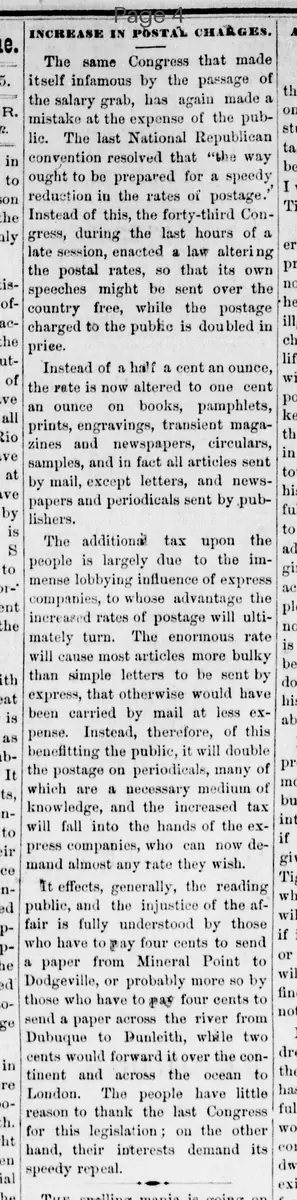
The same Congress that made itself infamous by the passage of the salary grab, has again made a mistake at the expense of the public. The last National Republican convention resolved that "the way ought to be prepared for a speedy reduction in the rates of postage." Instead of this, the forty-third Congress, during the last hours of a late session, enacted a law altering the postal rates, so that its own speeches might be sent over the country free, while the postage charged to the public is doubled in price. Instead of a half a cent an ounce, the rate is now altered to one cent an ounce on books, pamphlets, prints, engravings, transient magazines and newspapers, circulars, samples, and in fact all articles sent by mail, except letters, and newspapers and periodicals sent by publishers. The additional tax upon the people is largely due to the immense lobbying influence of express companies, to whose advantage the increased rates of postage will ultimately turn. The enormous rate will cause most articles more bulky than simple letters to be sent by express, that otherwise would have been carried by mail at less expense. Instead, therefore, of this benefitting the public, it will double the postage on periodicals, many of which are a necessary medium of knowledge, and the increased tax will fall into the hands of the express companies, who can now demand almost any rate they wish. It affects, generally, the reading public, and the injustice of the affair is fully understood by those who have to pay four cents to send a paper from Mineral Point to Dodgeville, or probably more so by those who have to pay four cents to send a paper across the river from Dubuque to Dunleith, while two cents would forward it over the continent and across the ocean to London. The people have little reason to thank the last Congress for this legislation: on the other hand, their interests demand its speedy repeal.
The same Congress that made itself infamous by the passage of the salary grab, has again made a mistake at the expense of the public. The last National Republican convention resolved that "the way ought to be prepared for a speedy reduction in the rates of postage." Instead of this, the forty-third Congress, during the last hours of a late session, enacted a law altering the postal rates, so that its own speeches might be sent over the country free, while the postage charged to the public is doubled in price. Instead of a half a cent an ounce, the rate is now altered to one cent an ounce on books, pamphlets, prints, engravings, transient magazines and newspapers, circulars, samples, and in fact all articles sent by mail, except letters, and newspapers and periodicals sent by publishers. The additional tax upon the people is largely due to the immense lobbying influence of express companies, to whose advantage the increased rates of postage will ultimately turn. The enormous rate will cause most articles more bulky than simple letters to be sent by express, that otherwise would have been carried by mail at less expense. Instead, therefore, of this benefitting the public, it will double the postage on periodicals, many of which are a necessary medium of knowledge, and the increased tax will fall into the hands of the express companies, who can now demand almost any rate they wish. It affects, generally, the reading public, and the injustice of the affair is fully understood by those who have to pay four cents to send a paper from Mineral Point to Dodgeville, or probably more so by those who have to pay four cents to send a paper across the river from Dubuque to Dunleith, while two cents would forward it over the continent and across the ocean to London. The people have little reason to thank the last Congress for this legislation: on the other hand, their interests demand its speedy repeal.
What sub-type of article is it?
Taxation
Economic Policy
What keywords are associated?
Postal Rates
Congress Legislation
Express Companies
Public Taxation
Periodicals Postage
Rate Increase
What entities or persons were involved?
Forty Third Congress
National Republican Convention
Express Companies
Editorial Details
Primary Topic
Increase In Postal Charges By Congress
Stance / Tone
Strongly Critical Of Congress And Express Companies
Key Figures
Forty Third Congress
National Republican Convention
Express Companies
Key Arguments
Congress Increased Postal Rates Instead Of Reducing Them As Resolved
Rates Doubled From Half Cent To One Cent Per Ounce On Non Letter Mail
Law Allows Congress Speeches To Be Sent Free While Public Pays More
Increased Rates Benefit Express Companies Through Lobbying
Public, Especially Readers, Burdened By Higher Costs On Periodicals
Examples Of Local High Postage Vs. Cheaper Long Distance Rates
Demands Speedy Repeal Of The Legislation