Thank you for visiting SNEWPapers!
Sign up free
Story
April 16, 1957
The Key West Citizen
Key West, Monroe County, Florida
What is this article about?
Scientists in Chicago report that sulfhydryl compounds taken before radiation exposure and bone marrow injections afterward can save lives from H-bomb radiation, based on experiments protecting monkeys from fatal X-ray doses.
Clipping
OCR Quality
98%
Excellent
Full Text
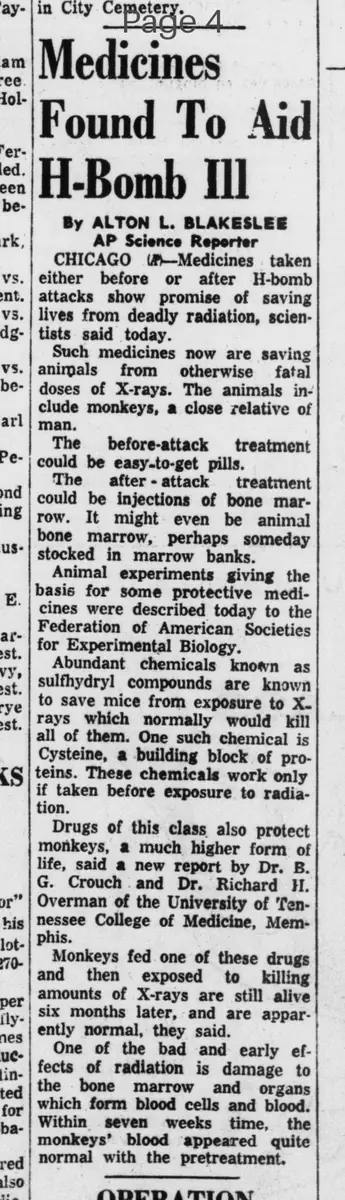
Medicines Found To Aid H-Bomb III
By Alton L. Blakeslee
AP Science Reporter
CHICAGO (/) Medicines taken either before or after H-bomb attacks show promise of saving lives from deadly radiation, scientists said today.
Such medicines now are saving animals from otherwise fatal doses of X-rays. The animals include monkeys, a close relative of man.
The before-attack treatment could be easy-to-get pills.
The after-attack treatment could be injections of bone marrow. It might even be animal bone marrow, perhaps someday stocked in marrow banks.
Animal experiments giving the basis for some protective medicines were described today to the Federation of American Societies for Experimental Biology.
Abundant chemicals known as sulfhydryl compounds are known to save mice from exposure to X-rays which normally would kill all of them. One such chemical is Cysteine, a building block of proteins. These chemicals work only if taken before exposure to radiation.
Drugs of this class also protect monkeys, a much higher form of life, said a new report by Dr. B. G. Crouch and Dr. Richard H. Overman of the University of Tennessee College of Medicine, Memphis.
Monkeys fed one of these drugs and then exposed to killing amounts of X-rays are still alive six months later, and are apparently normal, they said.
One of the bad and early effects of radiation is damage to the bone marrow and organs which form blood cells and blood.
Within seven weeks time, the monkeys' blood appeared quite normal with the pretreatment.
By Alton L. Blakeslee
AP Science Reporter
CHICAGO (/) Medicines taken either before or after H-bomb attacks show promise of saving lives from deadly radiation, scientists said today.
Such medicines now are saving animals from otherwise fatal doses of X-rays. The animals include monkeys, a close relative of man.
The before-attack treatment could be easy-to-get pills.
The after-attack treatment could be injections of bone marrow. It might even be animal bone marrow, perhaps someday stocked in marrow banks.
Animal experiments giving the basis for some protective medicines were described today to the Federation of American Societies for Experimental Biology.
Abundant chemicals known as sulfhydryl compounds are known to save mice from exposure to X-rays which normally would kill all of them. One such chemical is Cysteine, a building block of proteins. These chemicals work only if taken before exposure to radiation.
Drugs of this class also protect monkeys, a much higher form of life, said a new report by Dr. B. G. Crouch and Dr. Richard H. Overman of the University of Tennessee College of Medicine, Memphis.
Monkeys fed one of these drugs and then exposed to killing amounts of X-rays are still alive six months later, and are apparently normal, they said.
One of the bad and early effects of radiation is damage to the bone marrow and organs which form blood cells and blood.
Within seven weeks time, the monkeys' blood appeared quite normal with the pretreatment.
What sub-type of article is it?
Medical Curiosity
Curiosity
What themes does it cover?
Recovery
Triumph
What keywords are associated?
H Bomb Radiation
Sulfhydryl Compounds
Bone Marrow Treatment
Monkey Experiments
X Ray Protection
Cysteine
Radiation Damage
What entities or persons were involved?
Alton L. Blakeslee
Dr. B. G. Crouch
Dr. Richard H. Overman
Where did it happen?
Chicago
Story Details
Key Persons
Alton L. Blakeslee
Dr. B. G. Crouch
Dr. Richard H. Overman
Location
Chicago
Event Date
Today
Story Details
Medicines like sulfhydryl compounds (e.g., Cysteine) taken before exposure protect against fatal X-rays in mice and monkeys; bone marrow injections after exposure aid recovery; experiments show monkeys surviving six months post-treatment with normal blood after seven weeks.