Thank you for visiting SNEWPapers!
Sign up free
Story
March 1, 1836
Rutland Herald
Rutland, Rutland County, Vermont
What is this article about?
February advice for farmers: prepare seeds by testing vitality, gather tools and poles, stock woodpile until 1847, care for cattle and sheep especially cows and ewes for better yields, plan garden improvements for health and aesthetics.
Clipping
OCR Quality
88%
Good
Full Text
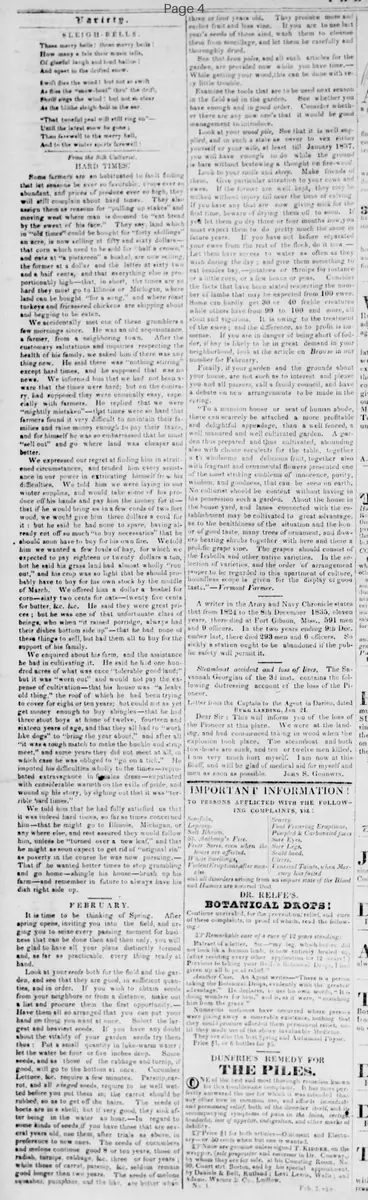
FEBRUARY.
It is time to be thinking of Spring. After spring opens, inviting you into the field, and urging you to seize every passing moment for business that can be done then and then only, you will be glad to have all your plans distinctly formed and, as far as practicable, every thing ready at hand.
Look at your seeds both for the field and the garden, and see that they are good, in sufficient quantities, and in order. If you wish to obtain seeds from your neighbors or from a distance, make out your list and procure them the first opportunity. Have them all so arranged that you can put your hand on those you want at once. Select the largest and heaviest seeds. If you have any doubt about the vitality of your garden seeds try them thus: Put a small quantity in luke-warm water; let the water be four or five inches deep. Some seeds, and as those of the cabbage and turnip, if good, will go to the bottom at once.
Cucumber Lettuce, &c. require a few minutes. Parsnip, carrot, and all similar seeds, require to be well wetted before you put them in; the carrot should be rubbed, so as to get off the hairs. The seeds of beets are in a shell; but if very good, they sink after being in the water an hour. In regard to some kinds of seeds, if you have those that are several years old, use them, after trial as above, in preference to new ones. The seeds of cucumbers and melons continue good 8 or ten years, those of radish, turnip, cabbage, &c. three or four years; while those of carrot, parsnip, &c. seldom remain good longer than two years. The seeds of melons squashes, pumpkins, and the like, are better when three or four years old. They produce more and larger fruit and freer vines. If you are to use last year's seeds of these kinds, wash them to cleanse them from mucilage, and let them be carefully and thoroughly dried.
See that bean poles, and such articles for the garden, are provided now while you have time. While getting your wood, this can be done with very little trouble.
Examine the tools that are to be used next season in the field and in the garden. See whether you have enough and in good order. Consider whether there are any new ones that it would be good management to introduce.
Look at your wood pile. See that it is well supplied, and in such a state as never to vex either yourself or your wife, at least till January 1847. You will have enough to do while the ground is bare without bestowing a thought on fire-wood.
Look to your cattle and sheep. Make friends of them. Give particular attention to your cows and ewes. If the former are well kept, they may be milked without injury till near the time of calving. If you have any that are now giving milk for the first time, beware of drying them off too soon. If you let them go dry three or four months now, you must expect them to do pretty much the same in future years. If you have not before separated your ewes from the rest of the flock, do it now. Let them have access to water as often as they wish during the day: and give them something to eat besides hay, potatoes or turnips for substance or a little corn, or a few beans or peas. Consider the facts that have been stated respecting the number of lambs that may be expected from 100 ewes. Some can hardly get 30 or 40 feeble creatures while others have from 90 to 100 and more, all stout and vigorous. It is owing to the treatment of the ewes; and the difference, as to profit is immense. If you are in danger of being short of fodder, if hay is likely to be in great demand in your neighborhood, look at the article on Browse in our number for February.
Finally, if your garden and the grounds about your house, are not such as to interest and please you and all passers, call a family council, and have a debate on new arrangements to be made in the spring.
"To a mansion house or seat of human abode, there can scarcely be attached a more profitable and delightful appendage, than a well fenced, a well manured and well cultivated garden. A garden thus prepared and thus cultivated, abounding also with choice vegetables for the table, together with wholesome and delicious fruit, together also with fragrant and ornamental flowers presented one of the most striking emblems of innocence, purity, wisdom, and goodness, that can be seen on earth. No cultivator should be content without having in his possession such a garden. About the house in the house yard, and lanes connected with the establishment may be cultivated to great advantage, as to the healthiness of the situation and the honor of good taste, many trees of ornament, and flowers bearing shrubs together with here and there a prolific grape vine. The grapes should consist of the Isabella and other native varieties. In the selection of varieties. and the order of arrangement proper to be regarded in this apartment of culture, boundless scope is given for the display of good taste."-Vermont Farmer.
It is time to be thinking of Spring. After spring opens, inviting you into the field, and urging you to seize every passing moment for business that can be done then and then only, you will be glad to have all your plans distinctly formed and, as far as practicable, every thing ready at hand.
Look at your seeds both for the field and the garden, and see that they are good, in sufficient quantities, and in order. If you wish to obtain seeds from your neighbors or from a distance, make out your list and procure them the first opportunity. Have them all so arranged that you can put your hand on those you want at once. Select the largest and heaviest seeds. If you have any doubt about the vitality of your garden seeds try them thus: Put a small quantity in luke-warm water; let the water be four or five inches deep. Some seeds, and as those of the cabbage and turnip, if good, will go to the bottom at once.
Cucumber Lettuce, &c. require a few minutes. Parsnip, carrot, and all similar seeds, require to be well wetted before you put them in; the carrot should be rubbed, so as to get off the hairs. The seeds of beets are in a shell; but if very good, they sink after being in the water an hour. In regard to some kinds of seeds, if you have those that are several years old, use them, after trial as above, in preference to new ones. The seeds of cucumbers and melons continue good 8 or ten years, those of radish, turnip, cabbage, &c. three or four years; while those of carrot, parsnip, &c. seldom remain good longer than two years. The seeds of melons squashes, pumpkins, and the like, are better when three or four years old. They produce more and larger fruit and freer vines. If you are to use last year's seeds of these kinds, wash them to cleanse them from mucilage, and let them be carefully and thoroughly dried.
See that bean poles, and such articles for the garden, are provided now while you have time. While getting your wood, this can be done with very little trouble.
Examine the tools that are to be used next season in the field and in the garden. See whether you have enough and in good order. Consider whether there are any new ones that it would be good management to introduce.
Look at your wood pile. See that it is well supplied, and in such a state as never to vex either yourself or your wife, at least till January 1847. You will have enough to do while the ground is bare without bestowing a thought on fire-wood.
Look to your cattle and sheep. Make friends of them. Give particular attention to your cows and ewes. If the former are well kept, they may be milked without injury till near the time of calving. If you have any that are now giving milk for the first time, beware of drying them off too soon. If you let them go dry three or four months now, you must expect them to do pretty much the same in future years. If you have not before separated your ewes from the rest of the flock, do it now. Let them have access to water as often as they wish during the day: and give them something to eat besides hay, potatoes or turnips for substance or a little corn, or a few beans or peas. Consider the facts that have been stated respecting the number of lambs that may be expected from 100 ewes. Some can hardly get 30 or 40 feeble creatures while others have from 90 to 100 and more, all stout and vigorous. It is owing to the treatment of the ewes; and the difference, as to profit is immense. If you are in danger of being short of fodder, if hay is likely to be in great demand in your neighborhood, look at the article on Browse in our number for February.
Finally, if your garden and the grounds about your house, are not such as to interest and please you and all passers, call a family council, and have a debate on new arrangements to be made in the spring.
"To a mansion house or seat of human abode, there can scarcely be attached a more profitable and delightful appendage, than a well fenced, a well manured and well cultivated garden. A garden thus prepared and thus cultivated, abounding also with choice vegetables for the table, together with wholesome and delicious fruit, together also with fragrant and ornamental flowers presented one of the most striking emblems of innocence, purity, wisdom, and goodness, that can be seen on earth. No cultivator should be content without having in his possession such a garden. About the house in the house yard, and lanes connected with the establishment may be cultivated to great advantage, as to the healthiness of the situation and the honor of good taste, many trees of ornament, and flowers bearing shrubs together with here and there a prolific grape vine. The grapes should consist of the Isabella and other native varieties. In the selection of varieties. and the order of arrangement proper to be regarded in this apartment of culture, boundless scope is given for the display of good taste."-Vermont Farmer.
What sub-type of article is it?
Agricultural Advice
Seasonal Preparation
What keywords are associated?
Seed Vitality Test
Livestock Care
Garden Preparation
Firewood Stock
Spring Planning
Story Details
Event Date
February 1846
Story Details
Practical guide for February preparations: test and select seeds, prepare tools and poles, stock firewood, care for livestock like cows and ewes to maximize yields, plan garden enhancements quoting Vermont Farmer on benefits.