Thank you for visiting SNEWPapers!
Sign up free
The Daily Advertiser
New York, New York County, New York
What is this article about?
In this pro-Constitution essay, Americanus refutes Anti-Federalist Cato's objections to the executive branch, arguing a strong national government is essential given U.S. geography, unlike the Swiss confederation. He defends the President's limited powers against monarchical comparisons and praises the Convention's bold replacement of the Articles.
Merged-components note: Continuation of the editorial 'For the Daily Advertiser. No. II.' across pages 2 and 3.
Clippings
1 of 2
OCR Quality
Full Text
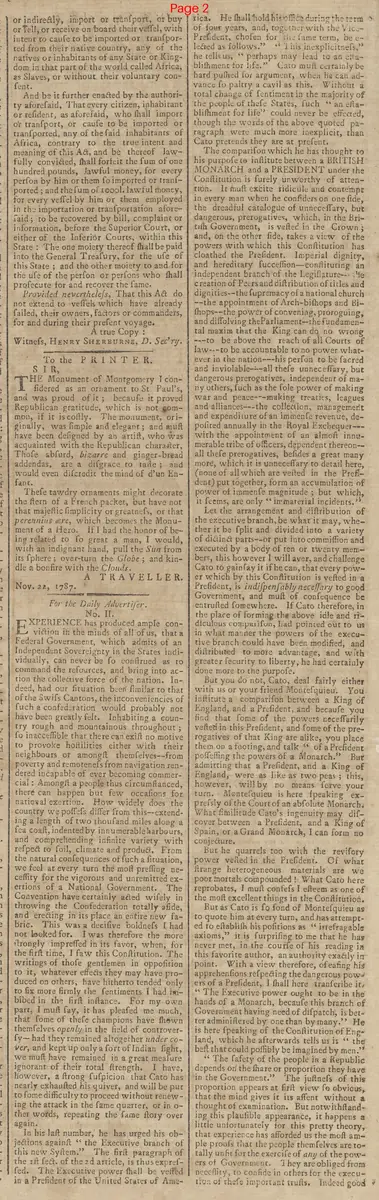
No. II.
EXPERIENCE has produced ample conviction in the minds of all of us, that a Federal Government, which admits of an Independent Sovereignty in the States individually, can never be so construed as to command the resources, and bring into action the collective force of the nation. Indeed, had our situation been similar to that of the Swiss Cantons, the inconveniencies of such a confederation would probably not have been greatly felt. Inhabiting a country rough and mountainous throughout; so inaccessible that there can exist no motive to provoke hostilities either with their neighbours or amongst themselves—from poverty and remoteness from navigation rendered incapable of ever becoming commercial: Amongst a people thus circumstanced, there can happen but few occasions for national exertion. How widely does the country we possess differ from this—extending a length of two thousand miles along a sea coast, indented by innumerable harbours, and comprehending infinite variety with respect to soil, climate and product. From the natural consequences of such a situation, we feel at every turn the most pressing necessity for the vigorous and unremitted exertions of a National Government. The Convention have certainly acted wisely in throwing the Confederation totally aside, and erecting in its place an entire new fabric. This was a decisive boldness I had not looked for. I was therefore the more strongly impressed in its favor, when, for the first time, I saw this Constitution. The writings of those gentlemen in opposition to it, whatever effects they may have produced on others, have hitherto tended only to fix more firmly the sentiments I had imbibed in the first instance. For my own part, I must say, it has pleased me much, that some of these champions have shown themselves openly in the field of controversy—had they remained altogether under cover, and kept up only a sort of Indian fight, we must have remained in a great measure ignorant of their total strength. I have, however, a strong suspicion that Cato has nearly exhausted his quiver, and will be put to some difficulty to proceed without renewing the attack in the same quarter, or in other words, repeating the same story over again.
In his last number, he has urged his objections against "the Executive branch of this new System." The first paragraph of the 1st sect. of the 2d article, is thus expressed. The Executive power shall be vested in a President of the United States of America. He shall hold his office during the term of four years, and, together with the Vice-President, chosen for the same term, be elected as follows." "This inexplicitness," he tells us, "perhaps may lead to an establishment for life." Cato must certainly be hard pushed for argument, when he can advance so paltry a cavil as this. Without a total change of sentiment in the majority of the people of these States, such "an establishment for life" could never be effected, though the words of the above quoted paragraph were much more inexplicit, than Cato pretends they are at present.
The comparison which he has thought to his purpose to institute between a BRITISH MONARCH and a PRESIDENT under the Constitution is surely unworthy of attention. It must excite ridicule and contempt in every man when he considers on one side, the dreadful catalogue of unnecessary, but dangerous, prerogatives, which, in the British Government, is vested in the Crown; and, on the other side, takes a view of the powers with which this Constitution has clothed the President. Imperial dignity, and hereditary succession—constituting an independent branch of the Legislature—the creation of Peers and distribution of titles and dignities—the supremacy of a national church—the appointment of Arch-bishops and Bishops—the power of convening, proroguing, and dissolving the Parliament—the fundamental maxim that the King can do no wrong—to be above the reach of all Courts of law—to be accountable to no power whatever in the nation—his person to be sacred and inviolable—all these unnecessary, but dangerous prerogatives, independent of many others, such as the sole power of making war and peace—making treaties, leagues and alliances—the collection, management and expenditure of an immense revenue, deposited annually in the Royal Exchequer—with the appointment of an almost innumerable tribe of officers, dependent thereon—all these prerogatives, besides a great many more, which it is unnecessary to detail here, (none of all which are vested in the President) put together, form an accumulation of power of immense magnitude; but which, it seems, are only "immaterial incidents."
Let the arrangement and distribution of the executive branch, be what it may, whether it be split and divided into a variety of distinct parts—or put into commission and executed by a body of ten or twenty members, this however I will aver, and challenge Cato to gainsay it if he can, that every power which by this Constitution is vested in a President, is indispensably necessary to good Government, and must of consequence be entrusted somewhere. If Cato therefore, in the place of forming the above idle and ridiculous comparison, had pointed out to us in what manner the powers of the executive branch could have been modified, and distributed to more advantage, and with greater security to liberty, he had certainly done more to the purpose.
But you do not, Cato, deal fairly either with us or your friend Montesquieu. You institute a comparison between a King of England, and a President, and because you find that some of the powers necessarily vested in this President, and some of the prerogatives of that King are alike, you place them on a footing, and talk "of a President possessing the powers of a Monarch." But admitting that a President, and a King of England, were as like as two peas; this, however, will by no means serve your turn. Montesquieu is here speaking expressly of the Court of an absolute Monarch. What similitude Cato's ingenuity may discover between a President, and a King of Spain, or a Grand Monarch, I can form no conjecture.
But he quarrels too with the revisory power vested in the President. Of what strange heterogeneous materials are we poor mortals compounded! What Cato here reprobates, I must confess I esteem as one of the most excellent things in the Constitution. But as Cato is so fond of Montesquieu as to quote him at every turn, and has attempted to establish his positions as "irrefragable axioms," it is surprising to me that he has never met, in the course of his reading in this favorite author, an authority exactly in point. With a view therefore, of easing his apprehensions respecting the dangerous powers of a President, I shall here transcribe it.
"The Executive power ought to be in the hands of a Monarch, because this branch of Government having need of dispatch, is better administered by one than by many." He is here speaking of the Constitution of England, which he afterwards tells us is "the best that could possibly be imagined by men."
"The safety of the people in a Republic depends on the share or proportion they have in the Government." The justness of this proportion appears at first view so obvious, that the mind gives it its assent without a thought of examination. But notwithstanding this plausible appearance, it happens a little unfortunately for this pretty theory, that experience has afforded us the most ample proofs that the people themselves are totally unfit for the exercise of any of the powers of Government. They are obliged from necessity, to confide in others for the execution of these important trusts. Indeed good
Government depends altogether on the proper delegation of the several powers thereof. I might here, after the example of our worthy Minister at the Court of Great-Britain, call all the Republican Governments that have ever existed in the world, whether ancient or modern, to pass in review before my gentle readers. But in pity to them I shall refrain. I will resist the temptation though great, and forego this glorious opportunity (which may perhaps never offer again during the course of a long life) of displaying an immensity of erudition. Suffice it to say, that on such an investigation it would be found invariably, that exactly in proportion to 'the share the people have in the Government,' has anarchy, violence, and the most shocking outrages and enormities of every kind prevailed. All power however in a free Government, must be derived originally from the people. But of themselves they are absolutely incapable of the exercise of any. This is an 'axiom.' I will venture to assert, much more 'irrefragable' than any Cato has yet thought fit to give us from Montesquieu's Spirit of Laws. But which, by the by, if it had suited his purpose, he might have found there. What Montesquieu has said of Harrington may in some measure be applied to Cato and his coadjutors. 'Harrington,' says he, in his Oceana, has also enquired into the utmost degree of liberty to which the Constitution of a State may be carried. But of him indeed it may be said, that for want of knowing the nature of real liberty, he busied himself in the pursuit of an imaginary one; and that he built a Chalcedon, tho' he had a Byzantium before his eyes.
AMERICANUS.
What sub-type of article is it?
What keywords are associated?
What entities or persons were involved?
Editorial Details
Primary Topic
Defense Of The Federal Constitution Against Anti Federalist Objections
Stance / Tone
Strongly Pro Constitution Refuting Cato's Criticisms
Key Figures
Key Arguments