Thank you for visiting SNEWPapers!
Sign up free
Editorial
June 20, 1915
Aberdeen Herald
Aberdeen, Grays Harbor County, Washington
What is this article about?
Editorial criticizes Aberdeen's outdated ward-councilmanic city government system, praises the Allen law's commission form adopted elsewhere in Washington state, highlights inefficiencies and waste, compares favorably to Hoquiam, and predicts strong voter support for change.
Clipping
OCR Quality
98%
Excellent
Full Text
Aberdeen, the Standpatter.
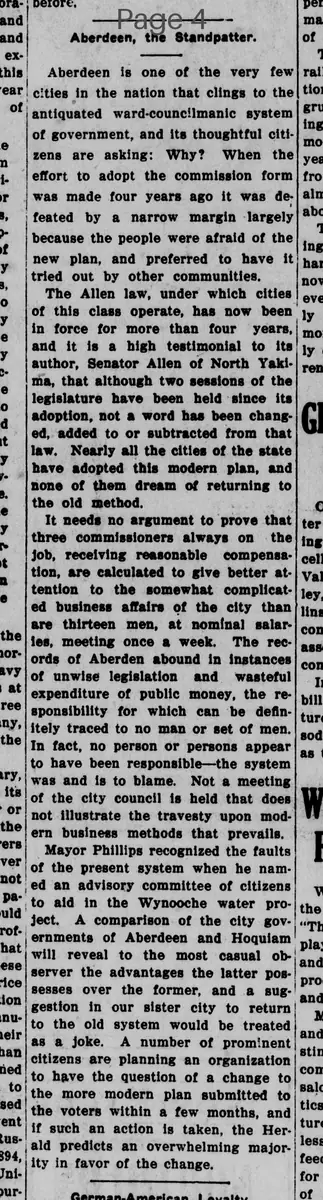
Aberdeen is one of the very few cities in the nation that clings to the antiquated ward-councilmanic system of government, and its thoughtful citizens are asking: Why? When the effort to adopt the commission form was made four years ago it was defeated by a narrow margin—largely because the people were afraid of the new plan, and preferred to have it tried out by other communities.
The Allen law, under which cities of this class operate, has now been in force for more than four years, and it is a high testimonial to its author, Senator Allen of North Yakima, that although two sessions of the legislature have been held since its adoption, not a word has been changed, added to or subtracted from that law. Nearly all the cities of the state have adopted this modern plan, and none of them dream of returning to the old method.
It needs no argument to prove that three commissioners always on the job, receiving reasonable compensation, are calculated to give better attention to the somewhat complicated business affairs of the city than are thirteen men, at nominal salaries, meeting once a week. The records of Aberdeen abound in instances of unwise legislation and wasteful expenditure of public money, the responsibility for which can be definitely traced to no man or set of men. In fact, no person or persons appear to have been responsible—the system was and is to blame. Not a meeting of the city council is held that does not illustrate the travesty upon modern business methods that prevails.
Mayor Phillips recognized the faults of the present system when he named an advisory committee of citizens to aid in the Wynooche water project. A comparison of the city governments of Aberdeen and Hoquiam will reveal to the most casual observer the advantages the latter possesses over the former, and a suggestion in our sister city to return to the old system would be treated as a joke. A number of prominent citizens are planning an organization to have the question of a change to the more modern plan submitted to the voters within a few months, and if such an action is taken, the Herald predicts an overwhelming majority in favor of the change.
Aberdeen is one of the very few cities in the nation that clings to the antiquated ward-councilmanic system of government, and its thoughtful citizens are asking: Why? When the effort to adopt the commission form was made four years ago it was defeated by a narrow margin—largely because the people were afraid of the new plan, and preferred to have it tried out by other communities.
The Allen law, under which cities of this class operate, has now been in force for more than four years, and it is a high testimonial to its author, Senator Allen of North Yakima, that although two sessions of the legislature have been held since its adoption, not a word has been changed, added to or subtracted from that law. Nearly all the cities of the state have adopted this modern plan, and none of them dream of returning to the old method.
It needs no argument to prove that three commissioners always on the job, receiving reasonable compensation, are calculated to give better attention to the somewhat complicated business affairs of the city than are thirteen men, at nominal salaries, meeting once a week. The records of Aberdeen abound in instances of unwise legislation and wasteful expenditure of public money, the responsibility for which can be definitely traced to no man or set of men. In fact, no person or persons appear to have been responsible—the system was and is to blame. Not a meeting of the city council is held that does not illustrate the travesty upon modern business methods that prevails.
Mayor Phillips recognized the faults of the present system when he named an advisory committee of citizens to aid in the Wynooche water project. A comparison of the city governments of Aberdeen and Hoquiam will reveal to the most casual observer the advantages the latter possesses over the former, and a suggestion in our sister city to return to the old system would be treated as a joke. A number of prominent citizens are planning an organization to have the question of a change to the more modern plan submitted to the voters within a few months, and if such an action is taken, the Herald predicts an overwhelming majority in favor of the change.
What sub-type of article is it?
Legal Reform
What keywords are associated?
Aberdeen Government
Commission Form
Ward Councilmanic
Allen Law
Municipal Reform
Hoquiam Comparison
City Council Waste
What entities or persons were involved?
Aberdeen
Senator Allen Of North Yakima
Mayor Phillips
Hoquiam
Wynooche Water Project
Herald
Editorial Details
Primary Topic
Adoption Of Commission Form Of Government In Aberdeen
Stance / Tone
Critical Of Current System, Supportive Of Commission Reform
Key Figures
Aberdeen
Senator Allen Of North Yakima
Mayor Phillips
Hoquiam
Wynooche Water Project
Herald
Key Arguments
Ward Councilmanic System Is Antiquated And Inefficient
Previous Attempt To Adopt Commission Form Failed Due To Fear Four Years Ago
Allen Law Has Proven Successful And Unchanged For Over Four Years
Commissioners Provide Better Attention Than Part Time Councilmen
Aberdeen's Records Show Unwise Legislation And Waste Due To The System
Mayor Phillips Used Advisory Committee To Address System Faults
Hoquiam's Commission Government Is Superior
Prominent Citizens Plan To Submit Change To Voters Soon
Predicted Overwhelming Majority For Commission Form