Thank you for visiting SNEWPapers!
Sign up free
Literary
July 20, 1814
Virginia Argus
Richmond, Virginia
What is this article about?
A pastoral poem from a Kentucky paper depicts a shepherdess urging her lover to join the revolutionary war for freedom, prioritizing country over romance, inspiring him to fight and return victorious.
Clipping
OCR Quality
98%
Excellent
Full Text
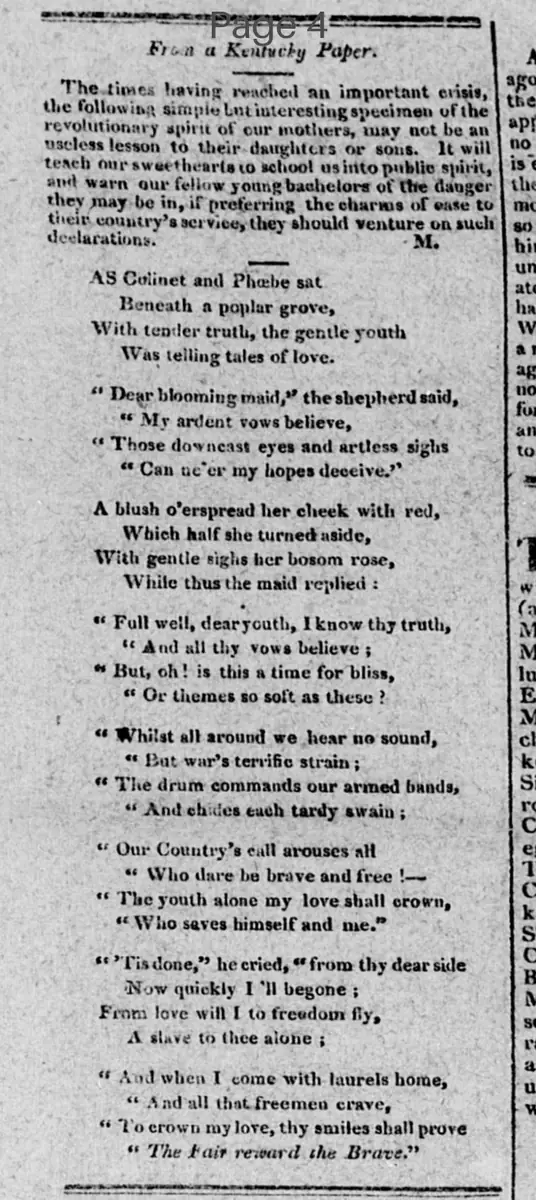
From a Kentucky Paper.
The times having reached an important crisis, the following simple but interesting specimen of the revolutionary spirit of our mothers, may not be an useless lesson to their daughters or sons. It will teach our sweethearts to school us into public spirit, and warn our fellow young bachelors of the danger they may be in, if preferring the charms of ease to their country's service, they should venture on such declarations.
-M.
AS Colinet and Phabe sat
Beneath a poplar grove,
With tender truth, the gentle youth
Was telling tales of love.
"Dear blooming maid," the shepherd said,
"My ardent vows believe,
"Those downcast eyes and artless sighs
"Can ne'er my hopes deceive."
A blush o'erspread her cheek with red,
Which half she turned aside,
With gentle sighs her bosom rose,
While thus the maid replied:
"Full well, dear youth, I know thy truth,
"And all thy vows believe;
"But, oh! is this a time for bliss,
"Or themes so soft as these?
"Whilst all around we hear no sound,
"But war's terrific strain;
"The drum commands our armed bands,
"And chides each tardy swain;
"Our Country's call arouses all
"Who dare be brave and free!--
"The youth alone my love shall crown,
"Who serves himself and me."
"'Tis done," he cried, "from thy dear side
Now quickly I'll begone;
From love will I to freedom fly,
A slave to thee alone;
"And when I come with laurels home,
"And all that freemen crave,
"To crown my love, thy smiles shall prove
"The fair reward the Brave."
The times having reached an important crisis, the following simple but interesting specimen of the revolutionary spirit of our mothers, may not be an useless lesson to their daughters or sons. It will teach our sweethearts to school us into public spirit, and warn our fellow young bachelors of the danger they may be in, if preferring the charms of ease to their country's service, they should venture on such declarations.
-M.
AS Colinet and Phabe sat
Beneath a poplar grove,
With tender truth, the gentle youth
Was telling tales of love.
"Dear blooming maid," the shepherd said,
"My ardent vows believe,
"Those downcast eyes and artless sighs
"Can ne'er my hopes deceive."
A blush o'erspread her cheek with red,
Which half she turned aside,
With gentle sighs her bosom rose,
While thus the maid replied:
"Full well, dear youth, I know thy truth,
"And all thy vows believe;
"But, oh! is this a time for bliss,
"Or themes so soft as these?
"Whilst all around we hear no sound,
"But war's terrific strain;
"The drum commands our armed bands,
"And chides each tardy swain;
"Our Country's call arouses all
"Who dare be brave and free!--
"The youth alone my love shall crown,
"Who serves himself and me."
"'Tis done," he cried, "from thy dear side
Now quickly I'll begone;
From love will I to freedom fly,
A slave to thee alone;
"And when I come with laurels home,
"And all that freemen crave,
"To crown my love, thy smiles shall prove
"The fair reward the Brave."
What sub-type of article is it?
Poem
Dialogue
What themes does it cover?
Liberty Freedom
Patriotism
War Peace
What keywords are associated?
Revolutionary Spirit
Pastoral Poem
Patriotism
War Call
Freedom Vows
Shepherd Lover
What entities or persons were involved?
M.
Literary Details
Author
M.
Subject
Revolutionary Spirit During Wartime Crisis
Form / Style
Pastoral Dialogue In Verse
Key Lines
"But, Oh! Is This A Time For Bliss, / "Or Themes So Soft As These?
"Our Country's Call Arouses All / Who Dare Be Brave And Free!
"The Youth Alone My Love Shall Crown, / Who Serves Himself And Me."
"From Love Will I To Freedom Fly, / A Slave To Thee Alone;