Thank you for visiting SNEWPapers!
Sign up free
Editorial
February 3, 1912
The Daily Telegram
Clarksburg, Harrison County, West Virginia
What is this article about?
Editorial mocks West Virginia Senator Chilton's maiden Senate speech opposing a $25,000 federal children's bureau bill on constitutional and fiscal grounds, suggesting his stance protects exploitative industries amid poor enforcement of state child labor laws. (198 characters)
Clipping
OCR Quality
95%
Excellent
Full Text
A Child Labor Hero.
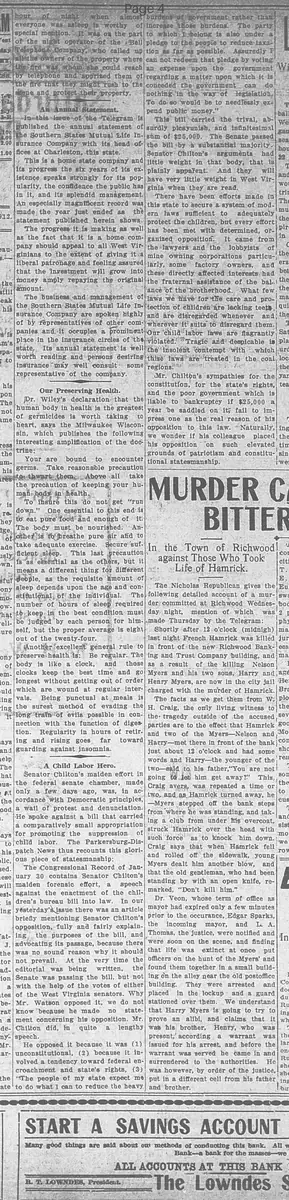
Senator Chilton's maiden effort in the federal senate chamber, made only a few days ago, was, in accordance with Democratic principles, a wail of protest and denunciation. He spoke against a bill that carried a comparatively small appropriation of child labor. The Parkersburg Dispatch News thus recounts this glorious piece of statesmanship:
The Congressional Record of January 30 contains Senator Chilton's maiden forensic effort, a speech against the enactment of the children's bureau bill into law. In our yesterday's issue there was an article briefly mentioning Senator Chilton's opposition, fully and fairly explaining the purposes of the bill, and advocating its passage, because there was no sound reason why it should not prevail. At the very time the editorial was being written, the Senate was passing the bill, but not with the help of the votes of either of the West Virginia senators. Why Mr. Watson opposed it, we do not know because he made no statement concerning his opposition. Mr. Chilton did, in quite a lengthy speech.
He opposed it because it was (1) unconstitutional, (2) because it involved a tendency toward federal encroachment and state's rights, (3) 'The people of my state expect me to do what I can to reduce the heavy burdens of government rather than increase those burdens. The party to which I belong is also under a pledge to the people to reduce taxation as far as possible. Assuredly I can not redeem that pledge by voting an expense upon the government regarding a matter upon which it is conceded the government can do nothing in the way of legislation. To do so would be to needlessly expend public money.'
This bill carried the trivial, absurdly picayunish, and infinitesimal sum of $25,000. The Senate passed the bill by a substantial majority. Senator Chilton's arguments had little weight in that body, that is plainly apparent. And they will have very little weight in West Virginia when they are read.
There have been efforts made in this state to secure a system of modern laws sufficient to adequately protect the children, but every effort has been met with determined, organized opposition. It came from the lawyers and the lobbyists of mine owning corporations particularly, some factory owners, and these directly affected interests had the fraternal assistance of the balances of the brotherhood. What few laws we have for the care and protection of children are lacking teeth, and are disregarded whenever and wherever it suits to disregard them. Our child labor laws are flagrantly violated. Tragic and despicable is the insolent contempt with which these laws are treated in the coal regions.
Mr. Chilton's sympathies for the constitution, for the state's rights and the poor government which is liable to bankruptcy if $25,000 a year be saddled on it, fail to impress one as the real reason of his opposition to this law. Naturally, we wonder if his colleague placed his opposition on such elevated grounds of patriotism and constitutional statesmanship.
Senator Chilton's maiden effort in the federal senate chamber, made only a few days ago, was, in accordance with Democratic principles, a wail of protest and denunciation. He spoke against a bill that carried a comparatively small appropriation of child labor. The Parkersburg Dispatch News thus recounts this glorious piece of statesmanship:
The Congressional Record of January 30 contains Senator Chilton's maiden forensic effort, a speech against the enactment of the children's bureau bill into law. In our yesterday's issue there was an article briefly mentioning Senator Chilton's opposition, fully and fairly explaining the purposes of the bill, and advocating its passage, because there was no sound reason why it should not prevail. At the very time the editorial was being written, the Senate was passing the bill, but not with the help of the votes of either of the West Virginia senators. Why Mr. Watson opposed it, we do not know because he made no statement concerning his opposition. Mr. Chilton did, in quite a lengthy speech.
He opposed it because it was (1) unconstitutional, (2) because it involved a tendency toward federal encroachment and state's rights, (3) 'The people of my state expect me to do what I can to reduce the heavy burdens of government rather than increase those burdens. The party to which I belong is also under a pledge to the people to reduce taxation as far as possible. Assuredly I can not redeem that pledge by voting an expense upon the government regarding a matter upon which it is conceded the government can do nothing in the way of legislation. To do so would be to needlessly expend public money.'
This bill carried the trivial, absurdly picayunish, and infinitesimal sum of $25,000. The Senate passed the bill by a substantial majority. Senator Chilton's arguments had little weight in that body, that is plainly apparent. And they will have very little weight in West Virginia when they are read.
There have been efforts made in this state to secure a system of modern laws sufficient to adequately protect the children, but every effort has been met with determined, organized opposition. It came from the lawyers and the lobbyists of mine owning corporations particularly, some factory owners, and these directly affected interests had the fraternal assistance of the balances of the brotherhood. What few laws we have for the care and protection of children are lacking teeth, and are disregarded whenever and wherever it suits to disregard them. Our child labor laws are flagrantly violated. Tragic and despicable is the insolent contempt with which these laws are treated in the coal regions.
Mr. Chilton's sympathies for the constitution, for the state's rights and the poor government which is liable to bankruptcy if $25,000 a year be saddled on it, fail to impress one as the real reason of his opposition to this law. Naturally, we wonder if his colleague placed his opposition on such elevated grounds of patriotism and constitutional statesmanship.
What sub-type of article is it?
Labor
Economic Policy
Partisan Politics
What keywords are associated?
Child Labor
Senator Chilton
Children's Bureau Bill
West Virginia
Federal Appropriation
State's Rights
What entities or persons were involved?
Senator Chilton
Senator Watson
West Virginia Senators
Mine Owning Corporations
Editorial Details
Primary Topic
Opposition To Federal Children's Bureau Bill
Stance / Tone
Critical Of Senator Chilton's Opposition
Key Figures
Senator Chilton
Senator Watson
West Virginia Senators
Mine Owning Corporations
Key Arguments
Chilton's Opposition Based On Unconstitutionality And Federal Encroachment
Bill Involves Only $25,000 Appropriation
Real Motive Likely Protecting Child Labor Interests In Coal Regions
State Child Labor Laws Inadequately Enforced
Chilton's Arguments Unlikely To Sway Public Opinion