Thank you for visiting SNEWPapers!
Sign up free
The Prison Mirror
Stillwater, Washington County, Minnesota
What is this article about?
Biography of railroad engineer Casey Jones, from his early life in Kentucky to his career on the Illinois Central Railroad, culminating in his heroic death in a 1900 train wreck near Vaughan, Mississippi, which inspired a famous folk song.
Merged-components note: Biographical story on Casey Jones continued across three sequential components on page 3.
Clipping
OCR Quality
Full Text
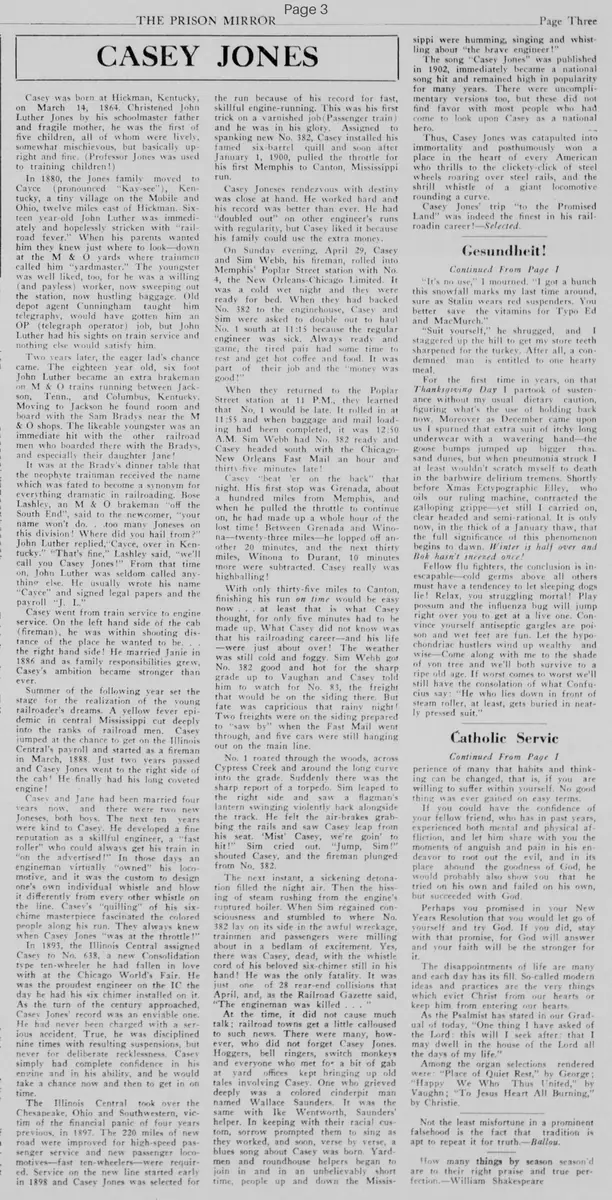
CASEY
JONES
Casey was born at Hickman, Kentucky.
on March 14, 1864. Christened John
Luther Jones by his schoolmaster father
and fragile mother, he was the first of
five children, all of whom were lively,
somewhat mischievous, but basically up-
right and fine. (Professor Jones was used
to training children!)
In 1880, the Jones family moved to
Cayce (pronounced "Kay-see"), Ken-
tucky, a tiny village on the Mobile and
Ohio, twelve miles east of Hickman. Six-
teen year-old John Luther was immedi-
ately and hopelessly stricken with "rail-
road fever." When his parents wanted
him they knew just where to look—down
at the M & O yards where trainmen
called him "yardmaster." The youngster
was well liked, too, for he was a willing
(and payless) worker, now sweeping out
the station, now hustling baggage. Old
depot agent Cunningham taught him
telegraphy, would have gotten him an
OP (telegraph operator) job, but John
Luther had his sights on train service and
nothing else would satisfy him.
Two years later, the eager lad's chance
came. The eighteen year old, six foot
John Luther became an extra brakeman
on M & O trains running between Jack-
son, Tenn., and Columbus, Kentucky.
Moving to Jackson he found room and
board with the Sam Bradys near the M
& O shops. The likeable youngster was an
immediate hit with the other railroad
men who boarded there with the Bradys,
and especially their daughter Jane!
It was at the Brady's dinner table that
the neophyte trainman received the name
which was fated to become a synonym for
everything dramatic in railroading. Bose
Lashley, an M & O brakeman "off the
South End", said to the newcomer, "your
name won't do... too many Joneses on
this division! Where did you hail from?"
John Luther replied, "Cayce, over in Ken-
tucky." "That's fine," Lashley said, "we'll
call you Casey Jones!" From that time
on, John Luther was seldom called any-
thing else. He usually wrote his name
"Cayce" and signed legal papers and the
payroll "J. L."
Casey went from train service to engine
service. On the left hand side of the cab
(fireman), he was within shooting dis-
tance of the place he wanted to be.
the right hand side! He married Janie in
1886 and as family responsibilities grew,
Casey's ambition became stronger than
ever.
Summer of the following year set the
stage for the realization of the young
railroader's dreams. A yellow fever epi-
demic in central Mississippi cut deeply
into the ranks of railroad men. Casey
jumped at the chance to get on the Illinois
Central's payroll and started as a fireman
in March, 1888. Just two years passed
and Casey Jones went to the right side of
the cab! He finally had his long coveted
engine!
Casey and Jane had been married four
years now, and there were two new
Joneses, both boys. The next ten years
were kind to Casey. He developed a fine
reputation as a skillful engineer, a "fast
roller" who could always get his train in
"on the advertised!" In those days an
engineman virtually "owned" his loco-
motive, and it was the custom to design
one's own individual whistle and blow
it differently from every other whistle on
the line. Casey's "quilling" of his six-
chime masterpiece fascinated the colored
people along his run. They always knew
when Casey Jones "was at the throttle!"
In 1893, the Illinois Central assigned
Casey to No. 638, a new Consolidation
type ten-wheeler he had fallen in love
with at the Chicago World's Fair. He
was the proudest engineer on the IC the
day he had his six chimes installed on it.
As the turn of the century approached,
Casey Jones' record was an enviable one.
He had never been charged with a ser-
ious accident. True, he was disciplined
nine times with resulting suspensions, but
never for deliberate recklessness. Casey
simply had complete confidence in his
engine and in his ability, and he would
take a chance now and then to get in on
time.
The Illinois Central took over the
Chesapeake, Ohio and Southwestern, vic-
tim of the financial panic of four years
previous, in 1897. The 220 miles of new
road were improved for high-speed pas-
senger service and new passenger loco-
motives—fast ten-wheelers—were requir-
ed. Service on the new line started early
in 1898 and Casey Jones was selected for
the run because of his record for fast
skillful engine-running. This was his first
trick on a varnished job (Passenger train)
and he was in his glory. Assigned to
spanking new No. 382, Casey installed his
famed six-barrel quill and soon after
January 1, 1900, pulled the throttle for
his first Memphis to Canton, Mississippi
run.
Casey Jones' rendezvous with destiny
was close at hand. He worked hard and
his record was better than ever. He had
"doubled out" on other engineer's runs
with regularity, but Casey liked it because
his family could use the extra money.
On Sunday evening, April 29, Casey
and Sim Webb, his fireman, rolled into
Memphis' Poplar Street station with No.
4, the New Orleans-Chicago Limited. It
was a cold wet night and they were
ready for bed. When they had backed
No. 382 to the enginehouse, Casey and
Sim were asked to double out to haul
No. 1 south at 11:15 because the regular
engineer was sick. Always ready and
game, the tired pair had some time to
rest and get hot coffee and food. It was
part of their job and the "money was
good!"
When they returned to the Poplar
Street station at 11 P.M. they learned
that No. 1 would be late. It rolled in at
11:55 and when baggage and mail load-
ing had been completed, it was 12:50
A.M. Sim Webb had No. 382 ready and
Casey headed south with the Chicago-
New Orleans Fast Mail an hour and
thirty-five minutes late!
Casey "beat 'er on the back" that
night. His first stop was Grenada, about
a hundred miles from Memphis, and
when he pulled the throttle to continue
on, he had made up a whole hour of the
lost time! Between Grenada and Wino-
na—twenty-three miles—he lopped off an-
other 20 minutes, and the next thirty
miles, Winona to Durant, 10 minutes
more were subtracted. Casey really was
highballing!
With only thirty-five miles to Canton,
finishing his run on time would be easy
now... at least that is what Casey
thought, for only five minutes had to be
made up. What Casey did not know was
that his railroading career—and his life
—were just about over! The weather
was still cold and foggy. Sim Webb got
No. 382 good and hot for the sharp
grade up to Vaughan and Casey told
him to watch for No. 83, the freight
that would be on the siding there. But
fate was capricious that rainy night!
Two freights were on the siding prepared
to "saw by" when the Fast Mail went
through, and five cars were still hanging
out on the main line.
No. 1 roared through the woods, across
Cypress Creek and around the long curve
into the grade. Suddenly there was the
sharp report of a torpedo. Sim leaped to
the right side and saw a flagman's
lantern swinging violently back alongside
the track. He felt the air-brakes grab-
bing the rails and saw Casey leap from
his seat. "Lower your head, Mist' Casey, we're goin' to
hit!" Sim cried out. "Jump, Sim!"
shouted Casey, and the fireman plunged
from No. 382.
The next instant, a sickening detona-
tion filled the night air. Then the hiss-
ing of steam rushing from the engine's
ruptured boiler. When Sim regained con-
sciousness and stumbled to where No.
382 lay on its side in the awful wreckage,
trainmen and passengers were milling
about in a bedlam of excitement. Yes,
there was Casey, dead, with the whistle
cord of his beloved six-chimer still in his
hand! He was the only fatality. It was
just one of 28 rear-end collisions that
April, and, as the Railroad Gazette said,
"The engineman was killed..."
At the time, it did not cause much
talk; railroad towns get a little calloused
to such news. There were many, how-
ever, who did not forget Casey Jones.
Hoggers, bell ringers, switch monkeys
and everyone who met for a bit of gab
at yard offices kept bringing up old
tales involving Casey. One who grieved
deeply was a colored cinderpit man
named Wallace Saunders. It was the
same with Ike Wentworth, Saunders'
helper. In keeping with their racial cus-
tom, sorrow prompted them to sing as
they worked, and soon, verse by verse, a
blues song about Casey was born. Yard-
men and roundhouse helpers began to
join in and in an unbelievably short
time, people up and down the Missis-
Page Three
sippi were humming, singing and whist-
ling about "the brave engineer!"
The song "Casey Jones" was published
in 1902, immediately became a national
song hit and remained high in popularity
for many years. There were uncompli-
mentary versions too, but these did not
find favor with most people who had
come to look upon Casey as a national
hero.
Thus, Casey Jones was catapulted into
immortality and posthumously won a
place in the heart of every American
who thrills to the clickety-click of steel
wheels roaring over steel rails, and the
shrill whistle of a giant locomotive
rounding a curve.
Casey Jones' trip "to the Promised
Land" was indeed the finest in his rail-
roadin career! Selected.
What sub-type of article is it?
What themes does it cover?
What keywords are associated?
What entities or persons were involved?
Where did it happen?
Story Details
Key Persons
Location
Hickman, Kentucky; Cayce, Kentucky; Jackson, Tennessee; Memphis, Tennessee; Vaughan, Mississippi
Event Date
March 14, 1864 To April 30, 1900
Story Details
John Luther 'Casey' Jones rises from brakeman to skilled engineer on southern railroads, marries Janie Brady, fathers two sons, and dies heroically in a rear-end collision at Vaughan, Mississippi, on April 30, 1900, while trying to make up time on the Chicago-New Orleans Fast Mail; his death inspires the folk song 'Casey Jones.'