Thank you for visiting SNEWPapers!
Sign up free
Story
July 13, 1786
Fowle's New Hampshire Gazette And General Advertiser
Portsmouth, Rockingham County, New Hampshire
What is this article about?
In a debate on redeeming public securities at depreciated value, a member delivers a passionate speech defending full redemption to uphold government integrity, honor, and public faith, warning against the moral and political perils of default.
Clipping
OCR Quality
98%
Excellent
Full Text
From the INDEPENDENT CHRONICLE.
On the debate in a certain respectable assembly; whether the Certificates should be called in at their current value, a member addressed the Court thus—
Mr. SPEAKER.
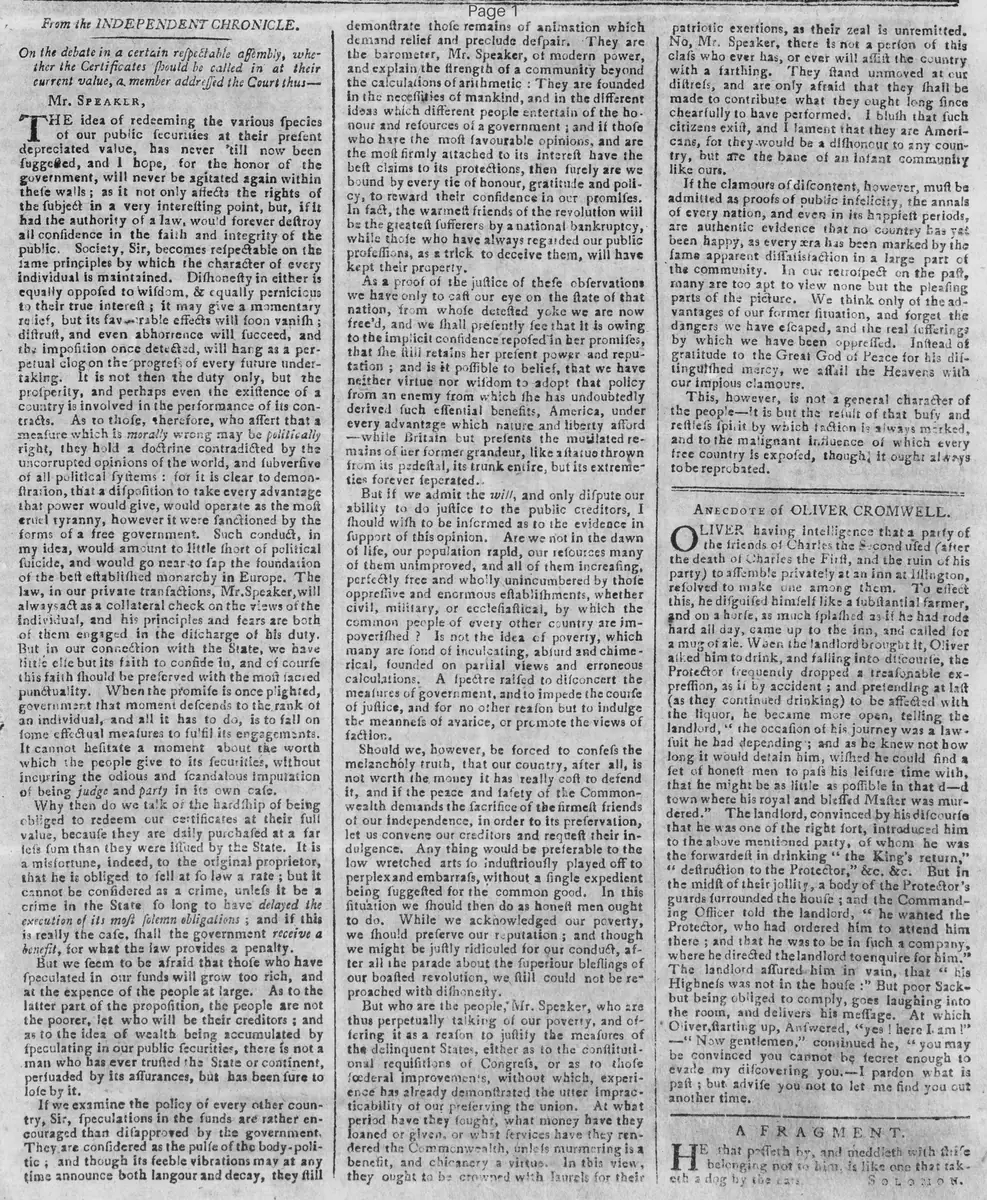
The idea of redeeming the various species of our public securities at their present depreciated value, has never till now been suggested, and I hope, for the honor of the government, will never be agitated again within these walls; as it not only affects the rights of the subject in a very interesting point, but, if it had the authority of a law, would forever destroy all confidence in the faith and integrity of the public. Society, Sir, becomes respectable on the same principles by which the character of every individual is maintained. Dishonesty in either is equally opposed to wisdom, & equally pernicious to their true interest; it may give a momentary relief, but its favorable effects will soon vanish; distrust, and even abhorrence will succeed, and the imposition once detected, will hang as a perpetual clog on the progress of every future undertaking. It is not then the duty only, but the prosperity, and perhaps even the existence of a country is involved in the performance of its contracts. As to those, therefore, who assert that a measure which is morally wrong may be politically right, they hold a doctrine contradicted by the uncorrupted opinions of the world, and subversive of all political systems: for it is clear to demonstration, that a disposition to take every advantage that power would give, would operate as the most cruel tyranny, however it were sanctioned by the forms of a free government. Such conduct, in my idea, would amount to little short of political suicide, and would go near to sap the foundation of the best established monarchy in Europe. The law, in our private transactions, Mr. Speaker will always act as a collateral check on the views of the individual, and his principles and fears are both of them engaged in the discharge of his duty. But in our connection with the State, we have little else but its faith to confide in, and of course this faith should be preserved with the most sacred punctuality. When the promise is once plighted, government that moment descends to the rank of an individual, and all it has to do, is to fall on some effectual measures to fulfil its engagements. It cannot hesitate a moment about the worth which the people give to its securities, without incurring the odious and scandalous imputation of being judge and party in its own case. Why then do we talk of the hardship of being obliged to redeem our certificates at their full value, because they are daily purchased at a far less sum than they were issued by the State. It is a misfortune, indeed, to the original proprietor, that he is obliged to sell at so low a rate; but it cannot be considered as a crime, unless it be a crime in the State so long to have delayed the execution of its most solemn obligations: and if this is really the case, shall the government receive a benefit, for what the law provides a penalty. But we seem to be afraid that those who have speculated in our funds will grow too rich, and at the expense of the people at large. As to the latter part of the proposition, the people are not the poorer, let who will be their creditors: and as to the idea of wealth being accumulated by speculating in our public securities, there is not a man who has ever trusted the State or continent, persuaded by its assurances, but has been sure to lose by it. If we examine the policy of every other country, Sir, speculations in the funds are rather encouraged than disapproved by the government. They are considered as the pulse of the body-politic: and though its feeble vibrations may at any time announce both languor and decay, they still demonstrate those remains of animation which demand relief and preclude despair. They are the barometer, Mr. Speaker, of modern power, and explain the strength of a community beyond the calculations of arithmetic: They are founded in the necessities of mankind, and in the different ideas which different people entertain of the honour and resources of a government; and if those who have the most favourable opinions, and are the most firmly attached to its interest have the best claims to its protection, then surely are we bound by every tie of honour, gratitude and policy, to reward their confidence in our promises. In fact, the warmest friends of the revolution will be the greatest sufferers by a national bankruptcy, while those who have always regarded our public professions, as a trick to deceive them, will have kept their property. As a proof of the justice of these observations we have only to cast our eye on the state of that nation, from whose detested yoke we are now freed, and we shall presently see that it is owing to the implicit confidence reposed in her promises, that she still retains her present power and reputation: and is it possible to believe, that we have neither virtue nor wisdom to adopt that policy from an enemy from which she has undoubtedly derived such essential benefits. America, under every advantage which nature and liberty afford—while Britain but presents the mutilated remains of her former grandeur, like a statue thrown from its pedestal, its trunk entire, but its extremities forever separated. But if we admit the will, and only dispute our ability to do justice to the public creditors, I should wish to be informed as to the evidence in support of this opinion. Are we not in the dawn of life, our population rapid, our resources many of them unimproved, and all of them increasing, perfectly free and wholly unincumbered by those oppressive and enormous establishments, whether civil, military, or ecclesiastical, by which the common people of every other country are impoverished? Is not the idea of poverty, which many are fond of inculcating, absurd and chimerical, founded on partial views and erroneous calculations. A spectre raised to disconcert the measures of government, and to impede the course of justice, and for no other reason but to indulge the meanness of avarice, or promote the views of faction. Should we, however, be forced to confess the melancholy truth, that our country, after all, is not worth the money it has really cost to defend it, and if the peace and safety of the Commonwealth demands the sacrifice of the firmest friends of our independence, in order to its preservation, let us convene our creditors and request their indulgence. Any thing would be preferable to the low wretched arts so industriously played off to perplex and embarrass, without a single expedient being suggested for the common good. In this situation we should then do as honest men ought to do. While we acknowledged our poverty, we should preserve our reputation; and though we might be justly ridiculed for our conduct, after all the parade about the superior blessings of our boasted revolution, we still could not be reproached with dishonesty. But who are the people, Mr. Speaker, who are thus perpetually talking of our poverty, and offering it as a reason to justify the measures of the delinquent States, either as to the constitutional requisitions of Congress, or as to those federal improvements, without which, experience has already demonstrated the utter impracticability of our preserving the union. At what period have they sought, what money have they loaned or given, or what services have they rendered the Commonwealth, unless murmuring is a benefit, and chicanery a virtue. In this view, patriotic exertions, as their zeal is unremitted. No. Mr. Speaker, there is not a person of this class who ever has, or ever will assist the Country with a farthing. They stand unmoved at our distress, and are only afraid that they shall be made to contribute what they ought long since cheerfully to have performed. I blush that such citizens exist, and I lament that they are Americans, for they would be a dishonour to any country, but are the bane of an infant community like ours. If the clamours of discontent, however, must be admitted as proofs of public infelicity, the annals of every nation, and even in its happiest periods, are authentic evidence that no country has yet been happy, as every era has been marked by the same apparent dissatisfaction in a large part of the community. In our retrospect on the past, many are too apt to view none but the pleasing parts of the picture. We think only of the advantages of our former situation, and forget the dangers we have escaped, and the real sufferings by which we have been oppressed. Instead of gratitude to the Great God of Peace for his distinguished mercy, we assail the Heavens with our impious clamours. This, however, is not a general character of the people—It is but the result of that busy and restless spirit by which faction is always marked, and to the malignant influence of which every free country is exposed, though it ought always to be reprobated.
On the debate in a certain respectable assembly; whether the Certificates should be called in at their current value, a member addressed the Court thus—
Mr. SPEAKER.
The idea of redeeming the various species of our public securities at their present depreciated value, has never till now been suggested, and I hope, for the honor of the government, will never be agitated again within these walls; as it not only affects the rights of the subject in a very interesting point, but, if it had the authority of a law, would forever destroy all confidence in the faith and integrity of the public. Society, Sir, becomes respectable on the same principles by which the character of every individual is maintained. Dishonesty in either is equally opposed to wisdom, & equally pernicious to their true interest; it may give a momentary relief, but its favorable effects will soon vanish; distrust, and even abhorrence will succeed, and the imposition once detected, will hang as a perpetual clog on the progress of every future undertaking. It is not then the duty only, but the prosperity, and perhaps even the existence of a country is involved in the performance of its contracts. As to those, therefore, who assert that a measure which is morally wrong may be politically right, they hold a doctrine contradicted by the uncorrupted opinions of the world, and subversive of all political systems: for it is clear to demonstration, that a disposition to take every advantage that power would give, would operate as the most cruel tyranny, however it were sanctioned by the forms of a free government. Such conduct, in my idea, would amount to little short of political suicide, and would go near to sap the foundation of the best established monarchy in Europe. The law, in our private transactions, Mr. Speaker will always act as a collateral check on the views of the individual, and his principles and fears are both of them engaged in the discharge of his duty. But in our connection with the State, we have little else but its faith to confide in, and of course this faith should be preserved with the most sacred punctuality. When the promise is once plighted, government that moment descends to the rank of an individual, and all it has to do, is to fall on some effectual measures to fulfil its engagements. It cannot hesitate a moment about the worth which the people give to its securities, without incurring the odious and scandalous imputation of being judge and party in its own case. Why then do we talk of the hardship of being obliged to redeem our certificates at their full value, because they are daily purchased at a far less sum than they were issued by the State. It is a misfortune, indeed, to the original proprietor, that he is obliged to sell at so low a rate; but it cannot be considered as a crime, unless it be a crime in the State so long to have delayed the execution of its most solemn obligations: and if this is really the case, shall the government receive a benefit, for what the law provides a penalty. But we seem to be afraid that those who have speculated in our funds will grow too rich, and at the expense of the people at large. As to the latter part of the proposition, the people are not the poorer, let who will be their creditors: and as to the idea of wealth being accumulated by speculating in our public securities, there is not a man who has ever trusted the State or continent, persuaded by its assurances, but has been sure to lose by it. If we examine the policy of every other country, Sir, speculations in the funds are rather encouraged than disapproved by the government. They are considered as the pulse of the body-politic: and though its feeble vibrations may at any time announce both languor and decay, they still demonstrate those remains of animation which demand relief and preclude despair. They are the barometer, Mr. Speaker, of modern power, and explain the strength of a community beyond the calculations of arithmetic: They are founded in the necessities of mankind, and in the different ideas which different people entertain of the honour and resources of a government; and if those who have the most favourable opinions, and are the most firmly attached to its interest have the best claims to its protection, then surely are we bound by every tie of honour, gratitude and policy, to reward their confidence in our promises. In fact, the warmest friends of the revolution will be the greatest sufferers by a national bankruptcy, while those who have always regarded our public professions, as a trick to deceive them, will have kept their property. As a proof of the justice of these observations we have only to cast our eye on the state of that nation, from whose detested yoke we are now freed, and we shall presently see that it is owing to the implicit confidence reposed in her promises, that she still retains her present power and reputation: and is it possible to believe, that we have neither virtue nor wisdom to adopt that policy from an enemy from which she has undoubtedly derived such essential benefits. America, under every advantage which nature and liberty afford—while Britain but presents the mutilated remains of her former grandeur, like a statue thrown from its pedestal, its trunk entire, but its extremities forever separated. But if we admit the will, and only dispute our ability to do justice to the public creditors, I should wish to be informed as to the evidence in support of this opinion. Are we not in the dawn of life, our population rapid, our resources many of them unimproved, and all of them increasing, perfectly free and wholly unincumbered by those oppressive and enormous establishments, whether civil, military, or ecclesiastical, by which the common people of every other country are impoverished? Is not the idea of poverty, which many are fond of inculcating, absurd and chimerical, founded on partial views and erroneous calculations. A spectre raised to disconcert the measures of government, and to impede the course of justice, and for no other reason but to indulge the meanness of avarice, or promote the views of faction. Should we, however, be forced to confess the melancholy truth, that our country, after all, is not worth the money it has really cost to defend it, and if the peace and safety of the Commonwealth demands the sacrifice of the firmest friends of our independence, in order to its preservation, let us convene our creditors and request their indulgence. Any thing would be preferable to the low wretched arts so industriously played off to perplex and embarrass, without a single expedient being suggested for the common good. In this situation we should then do as honest men ought to do. While we acknowledged our poverty, we should preserve our reputation; and though we might be justly ridiculed for our conduct, after all the parade about the superior blessings of our boasted revolution, we still could not be reproached with dishonesty. But who are the people, Mr. Speaker, who are thus perpetually talking of our poverty, and offering it as a reason to justify the measures of the delinquent States, either as to the constitutional requisitions of Congress, or as to those federal improvements, without which, experience has already demonstrated the utter impracticability of our preserving the union. At what period have they sought, what money have they loaned or given, or what services have they rendered the Commonwealth, unless murmuring is a benefit, and chicanery a virtue. In this view, patriotic exertions, as their zeal is unremitted. No. Mr. Speaker, there is not a person of this class who ever has, or ever will assist the Country with a farthing. They stand unmoved at our distress, and are only afraid that they shall be made to contribute what they ought long since cheerfully to have performed. I blush that such citizens exist, and I lament that they are Americans, for they would be a dishonour to any country, but are the bane of an infant community like ours. If the clamours of discontent, however, must be admitted as proofs of public infelicity, the annals of every nation, and even in its happiest periods, are authentic evidence that no country has yet been happy, as every era has been marked by the same apparent dissatisfaction in a large part of the community. In our retrospect on the past, many are too apt to view none but the pleasing parts of the picture. We think only of the advantages of our former situation, and forget the dangers we have escaped, and the real sufferings by which we have been oppressed. Instead of gratitude to the Great God of Peace for his distinguished mercy, we assail the Heavens with our impious clamours. This, however, is not a general character of the people—It is but the result of that busy and restless spirit by which faction is always marked, and to the malignant influence of which every free country is exposed, though it ought always to be reprobated.
What sub-type of article is it?
Historical Event
What themes does it cover?
Moral Virtue
Justice
What keywords are associated?
Public Securities
Redemption Debate
Government Integrity
Political Speech
American Revolution
Public Faith
Speculation In Funds
Where did it happen?
A Certain Respectable Assembly
Story Details
Location
A Certain Respectable Assembly
Story Details
A member argues in a legislative assembly against redeeming public securities at depreciated value, stressing the importance of governmental honesty, the perils of eroding public trust, and America's capacity to honor its debts post-Revolution.