Thank you for visiting SNEWPapers!
Sign up free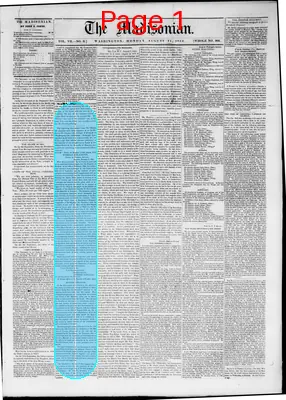
The Madisonian
Washington, District Of Columbia
What is this article about?
Spain's official recognition of Ecuador's independence via a 1840 treaty is detailed in documents from Gaceta del Ecuador. Luis Potestad appointed as Chargé d'Affaires arrives in Quito on August 10, 1842, the independence anniversary, fostering renewed amity.
Clipping

OCR Quality
Full Text
The following documents from the Gaceta del Ecuador have been handed to us by Mr. James H. Caustin (the Consul of Ecuador in Washington) for publication. Although bearing date as far back as a year, yet they are, we believe, the first official account published in this country of the recognition by Spain of the independence of the Republic of Ecuador, and as such are interesting to our commercial fellow-citizens:
From the "Gaceta del Ecuador" of 14th August, 1842.
FOREIGN RELATIONS
Office of Foreign Affairs,
Madrid, December 4, 1841.
Most Excellent Sir: By the treaty of peace and amity concluded between Spain and the Republic of Ecuador, on the 16th of February, 1840, the ratifications whereof were exchanged at this Court on the 30th day of September last, the relations of amity and good understanding which happily unite both nations are so well settled that the Government of her Majesty the Queen Doña Isabel II, desiring on its part to increase and extend them more and more every day, has believed that the surest mode of accomplishing this good end would be to appoint an Agent of her Majesty who might be the faithful interpreter of her sentiments towards the Government of the Republic of Ecuador. The prudence, talents and conciliatory character which distinguish Don Luis de Potestad, Caballero Comendador of the Royal American order of Isabella the Catholic; Chevalier of the Royal order of Dannebrog of Denmark. Counsellor of her Majesty; her Secretary with the exercise of law and an officer of this first Department of State; have induced her Highness, the Regent of the Kingdom, to select him, in the name of her Majesty, the Queen, for so important a mission, appointing him therefore Charge d'Affaires and Consul General of Spain in the Republic of Ecuador.
The Chevalier Potestad will have the honor to deliver to your Excellency this letter, which will, no doubt, serve to his favorable reception. The knowledge I possess of the commendable qualities which adorn him, is for me a secure guaranty that he will correspond to this proof of the confidence reposed in him. In this persuasion, and that he will take care to merit the esteem of your Excellency, with which he is especially charged, I hope that your Excellency will be pleased to lend him your aid and present him to his Excellency, the President of the Republic, giving entire faith and credit to all that he may have the honor to communicate on the part of the Government of her Catholic Majesty; confiding also in your Excellency's contributing effectually to extend more and more the bonds of amity existing between the two nations.
Flattering myself with the hope that your Excellency will extend the greatest deference towards the Chevalier Potestad, I avail myself of this occasion to request you to accept the assurances of my most sincere esteem and high consideration.
I have the honor to be,
Your Excellency's most
Obedient servant,
ANTONIO GONZALES.
To his Excellency the Minister
Of Foreign Affairs of the Republic of Ecuador, Quito.
SPANISH LEGATION.
On the 10th instant, at 2 o'clock in the afternoon the Señor Luis Potestad, Chargé d'Affaires of Spain, and the Señor Juan Pio Montufar* attached to the legation, made their entry into this capital. Many distinguished persons, and among them the relatives and friends of Mr. Montufar, went out to receive them on their arrival from the South. We call public attention at this time to a coincidence, which is rare and worthy of recollection, which consists in this capital having given the first exclamation for independence on the 10th of August, 1809, has witnessed the entry on the 10th of August, 1842, the day of the anniversary of the same independence, of the first messenger of peace and amity which the Spanish Monarchy has desired to send us to confirm, so to say, the explicit and solemn recognition which it has made, by public treaties, of the independence and sovereignty of Ecuador.
Mr. Potestad gave notice of his arrival on the 11th. and on the 12th delivered his credentials to the Minister of Foreign Affairs, and on the next day was presented to his Excellency, the President, who received him with the frankness and kind benevolence due to a Minister of our ancient mother country and to a person as frank and estimable as he whom the Spanish Cabinet, with so much prudence, have selected.
The good dispositions of our Government, and the sympathies which form his personal character, Mr. Potestad has already begun to merit, presage a happy advancement to the Spanish legation, and promise that the relations of two nations, who had a common origin, will be each day more and more extended for their benefit and happiness.
*Mr. Montufar is the son of Don Joaquin Montufar, a native of this city, and grandson of the late Marques de Salvalegre, one of the first promoters of independence. Mr. Juan Pio Montufar is a young man of 23 years of age, of fine appearance, good dispositions, and highly appreciable for his excellent qualities.
What sub-type of article is it?
What keywords are associated?
What entities or persons were involved?
Where did it happen?
Foreign News Details
Primary Location
Quito, Ecuador
Event Date
10th August 1842
Key Persons
Outcome
spain recognizes ecuador's independence via 1840 treaty; potestad appointed and arrives in quito, received warmly, strengthening bilateral relations.
Event Details
Documents detail Spain's 1840 treaty recognizing Ecuador's independence, with ratifications in 1841. Queen Isabel II appoints Luis Potestad as Chargé d'Affaires and Consul General. He arrives in Quito on August 10, 1842, with Juan Pio Montufar, coinciding with independence anniversary. Potestad presents credentials and meets the President, fostering amity.