Thank you for visiting SNEWPapers!
Sign up free
Story
December 24, 1787
The New York Journal, And Daily Patriotic Register
New York, New York County, New York
What is this article about?
The Pennsylvania ratifying convention in Philadelphia, December 12-15, 1787, debates the US Constitution, ratifies it 46-23, proclaims the ratification publicly, rejects inserting a bill of rights, and resolves to cede a district for the federal capital while excluding parts of Philadelphia.
Clipping
OCR Quality
98%
Excellent
Full Text
[Continued from Saturday's Paper.]
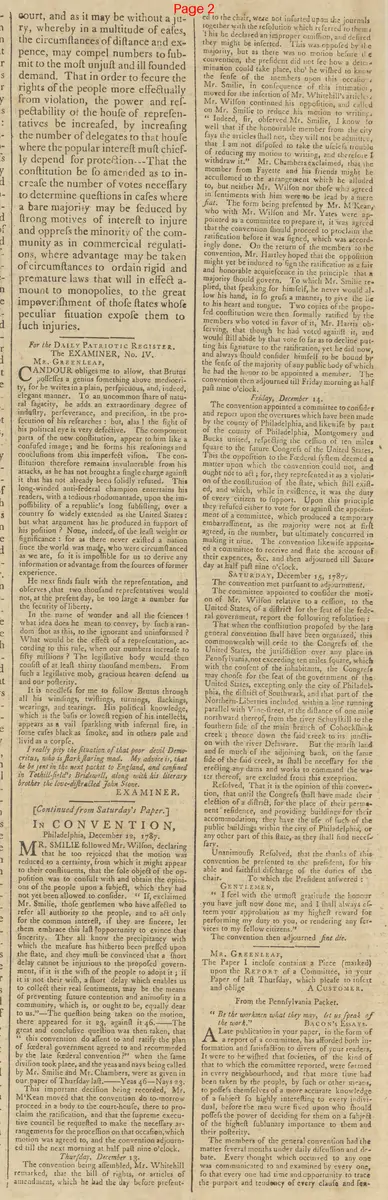
IN CONVENTION.
Philadelphia, December 12, 1787.
MR. SMILIE followed Mr. Wilson, declaring that he too rejoiced that the motion was reduced to a certainty, from which it might appear to their constituents, that the sole object of the opposition was to consult with and obtain the opinions of the people upon a subject, which they had not yet been allowed to consider. "If, exclaimed Mr. Smilie, those gentlemen who have affected to refer all authority to the people, and to act only for the common interest, if they are sincere, let them embrace this last opportunity to evince that sincerity. They all know the precipitancy with which the measure has hitherto been pressed upon the state, and they must be convinced that a short delay cannot be injurious to the proposed government, if it is the wish of the people to adopt it; if it is not their wish, a short delay which enables us to collect their real sentiments, may be the means of preventing future contention and animosity in a community, which is, or ought to be, equally dear to us."--The question being taken on the motion, there appeared for it 23, against it 46.--The great and conclusive question was then taken, that "this convention do assent to and ratify the plan of federal government agreed to and recommended by the late federal convention?" when the same division took place, and the yeas and nays being called by Mr. Smilie and Mr. Chambers, were as given in our paper of Thursday last.--Yeas 46--Nays 23.
This important decision being recorded, Mr. M'Kean moved that the convention do to-morrow proceed in a body to the court-house, there to proclaim the ratification, and that the supreme executive council be requested to make the necessary arrangements for the procession on that occasion, which motion was agreed to, and the convention adjourned till the next morning at half past nine o'clock.
Thursday, December 13.
The convention being assembled, Mr. Whitehill remarked, that the bill of rights, or articles of amendment, which he had the day before presented to the chair, were not inserted upon the journals together with the resolution which referred to them This he declared an improper omission, and desired they might be inserted. This was opposed by the majority, but as there was no motion before the convention, the president did not see how a determination could take place, tho' he wished to know the sense of the members upon this occasion Mr. Smilie, in consequence of this intimation, moved for the insertion of Mr. Whitehill's article. Mr. Wilson continued his opposition, and called on Mr. Smilie to reduce his motion to writing. "Indeed, sir, observed Mr. Smilie, I know so well that if the honourable member from the city says the articles shall not, they will not be admitted, that I am not disposed to take the useless trouble of reducing my motion to writing, and therefore I withdraw it." Mr. Chambers exclaimed, that the member from Fayette and his friends might be accustomed to the arrangement which he alluded to, but neither Mr. Wilson nor those who agreed in sentiments with him were to be lead by a mere fiat. The form being presented by Mr. M'Kean who with Mr. Wilson and Mr. Yates were appointed as a committee to prepare it, it was agreed that the convention should proceed to proclaim the ratification before it was signed, which was accordingly done. On the return of the members to the convention, Mr. Hartley hoped that the opposition might yet be induced to sign the ratification as a fair and honorable acquiescence in the principle that a majority should govern. To which Mr. Smilie replied, that speaking for himself, he never would allow his hand, in so gross a manner, to give the lie to his heart and tongue. Two copies of the proposed constitution were then formally ratified by the members who voted in favor of it, Mr. Harris observing, that though he had voted against it, and would still abide by that vote so far as to decline putting his signature to the ratification, yet he did now, and always should consider himself to be bound by the sense of the majority of any public body of which he had the honor to be appointed a member. The convention then adjourned till Friday morning at half past nine o'clock.
Friday, December 14.
The convention appointed a committee to consider and report upon the overtures which have been made by the county of Philadelphia, and likewise by part of the county of Philadelphia, Montgomery and Bucks united, respecting the cession of ten miles square to the future Congress of this United States. This the opposition to the Federal system deemed a matter upon which the convention could not, and ought not to act; for, they represented it as a violation of the constitution of the state, which still existed, and which, while in existence, it was the duty of every citizen to support. Upon this principle they refused either to vote for or against the appointment of a committee, which produced a temporary embarrassment, as the majority were not at first agreed, in the number, but ultimately concurred in making it nine. The convention likewise appointed a committee to receive and state the account of their expences, &c. and then adjourned till Saturday at half past nine o'clock.
SATURDAY, December 15, 1787.
The convention met pursuant to adjournment. The committee appointed to consider the motion of Mr. Wilson relative to a cession, to the United States, of a district for the seat of the federal government, report the following resolution:
That when the constitution proposed by the late general convention shall have been organized, this commonwealth will cede to the Congress of the United States, the jurisdiction over any place in Pennsylvania, not exceeding ten miles square, which with the consent of the inhabitants, the Congress may choose for the seat of the government of the United States, excepting only the city of Philadelphia, the district of Southwark, and that part of the Northern-Liberties included within a line running parallel with Vine-street, at the distance of one mile northward thereof, from the river Schuylkill to the southern side of the main branch of Cohocksink creek; thence down the said creek to its junction with the river Delaware. But the marsh land and so much of the adjoining bank, on the same side of the said creek, as shall be necessary for the erecting any dams and works to command the water thereof, are excluded from this exception.
Resolved, That it is the opinion of this convention, that until the Congress shall have made their election of a district, for the place of their permanent residence, and providing buildings for their accommodation, they have the use of such of the public buildings within the city of Philadelphia, or any other part of this state, as they shall find necessary.
Unanimously Resolved, that the thanks of this convention be presented to the president, for his able and faithful discharge of the duties of the chair.
To which the President answered:
GENTLEMEN,
"I feel with the utmost gratitude the honour you have just now done me, and I shall always esteem your approbation as my highest reward for performing my duty to you, or rendering any services to my fellow citizens."
The convention then adjourned sine die.
IN CONVENTION.
Philadelphia, December 12, 1787.
MR. SMILIE followed Mr. Wilson, declaring that he too rejoiced that the motion was reduced to a certainty, from which it might appear to their constituents, that the sole object of the opposition was to consult with and obtain the opinions of the people upon a subject, which they had not yet been allowed to consider. "If, exclaimed Mr. Smilie, those gentlemen who have affected to refer all authority to the people, and to act only for the common interest, if they are sincere, let them embrace this last opportunity to evince that sincerity. They all know the precipitancy with which the measure has hitherto been pressed upon the state, and they must be convinced that a short delay cannot be injurious to the proposed government, if it is the wish of the people to adopt it; if it is not their wish, a short delay which enables us to collect their real sentiments, may be the means of preventing future contention and animosity in a community, which is, or ought to be, equally dear to us."--The question being taken on the motion, there appeared for it 23, against it 46.--The great and conclusive question was then taken, that "this convention do assent to and ratify the plan of federal government agreed to and recommended by the late federal convention?" when the same division took place, and the yeas and nays being called by Mr. Smilie and Mr. Chambers, were as given in our paper of Thursday last.--Yeas 46--Nays 23.
This important decision being recorded, Mr. M'Kean moved that the convention do to-morrow proceed in a body to the court-house, there to proclaim the ratification, and that the supreme executive council be requested to make the necessary arrangements for the procession on that occasion, which motion was agreed to, and the convention adjourned till the next morning at half past nine o'clock.
Thursday, December 13.
The convention being assembled, Mr. Whitehill remarked, that the bill of rights, or articles of amendment, which he had the day before presented to the chair, were not inserted upon the journals together with the resolution which referred to them This he declared an improper omission, and desired they might be inserted. This was opposed by the majority, but as there was no motion before the convention, the president did not see how a determination could take place, tho' he wished to know the sense of the members upon this occasion Mr. Smilie, in consequence of this intimation, moved for the insertion of Mr. Whitehill's article. Mr. Wilson continued his opposition, and called on Mr. Smilie to reduce his motion to writing. "Indeed, sir, observed Mr. Smilie, I know so well that if the honourable member from the city says the articles shall not, they will not be admitted, that I am not disposed to take the useless trouble of reducing my motion to writing, and therefore I withdraw it." Mr. Chambers exclaimed, that the member from Fayette and his friends might be accustomed to the arrangement which he alluded to, but neither Mr. Wilson nor those who agreed in sentiments with him were to be lead by a mere fiat. The form being presented by Mr. M'Kean who with Mr. Wilson and Mr. Yates were appointed as a committee to prepare it, it was agreed that the convention should proceed to proclaim the ratification before it was signed, which was accordingly done. On the return of the members to the convention, Mr. Hartley hoped that the opposition might yet be induced to sign the ratification as a fair and honorable acquiescence in the principle that a majority should govern. To which Mr. Smilie replied, that speaking for himself, he never would allow his hand, in so gross a manner, to give the lie to his heart and tongue. Two copies of the proposed constitution were then formally ratified by the members who voted in favor of it, Mr. Harris observing, that though he had voted against it, and would still abide by that vote so far as to decline putting his signature to the ratification, yet he did now, and always should consider himself to be bound by the sense of the majority of any public body of which he had the honor to be appointed a member. The convention then adjourned till Friday morning at half past nine o'clock.
Friday, December 14.
The convention appointed a committee to consider and report upon the overtures which have been made by the county of Philadelphia, and likewise by part of the county of Philadelphia, Montgomery and Bucks united, respecting the cession of ten miles square to the future Congress of this United States. This the opposition to the Federal system deemed a matter upon which the convention could not, and ought not to act; for, they represented it as a violation of the constitution of the state, which still existed, and which, while in existence, it was the duty of every citizen to support. Upon this principle they refused either to vote for or against the appointment of a committee, which produced a temporary embarrassment, as the majority were not at first agreed, in the number, but ultimately concurred in making it nine. The convention likewise appointed a committee to receive and state the account of their expences, &c. and then adjourned till Saturday at half past nine o'clock.
SATURDAY, December 15, 1787.
The convention met pursuant to adjournment. The committee appointed to consider the motion of Mr. Wilson relative to a cession, to the United States, of a district for the seat of the federal government, report the following resolution:
That when the constitution proposed by the late general convention shall have been organized, this commonwealth will cede to the Congress of the United States, the jurisdiction over any place in Pennsylvania, not exceeding ten miles square, which with the consent of the inhabitants, the Congress may choose for the seat of the government of the United States, excepting only the city of Philadelphia, the district of Southwark, and that part of the Northern-Liberties included within a line running parallel with Vine-street, at the distance of one mile northward thereof, from the river Schuylkill to the southern side of the main branch of Cohocksink creek; thence down the said creek to its junction with the river Delaware. But the marsh land and so much of the adjoining bank, on the same side of the said creek, as shall be necessary for the erecting any dams and works to command the water thereof, are excluded from this exception.
Resolved, That it is the opinion of this convention, that until the Congress shall have made their election of a district, for the place of their permanent residence, and providing buildings for their accommodation, they have the use of such of the public buildings within the city of Philadelphia, or any other part of this state, as they shall find necessary.
Unanimously Resolved, that the thanks of this convention be presented to the president, for his able and faithful discharge of the duties of the chair.
To which the President answered:
GENTLEMEN,
"I feel with the utmost gratitude the honour you have just now done me, and I shall always esteem your approbation as my highest reward for performing my duty to you, or rendering any services to my fellow citizens."
The convention then adjourned sine die.
What sub-type of article is it?
Historical Event
What themes does it cover?
Justice
What keywords are associated?
Constitution Ratification
Pennsylvania Convention
Federal Government
Yeas Nays
Phildelphia Cession
Bill Of Rights
Majority Rule
What entities or persons were involved?
Mr. Smilie
Mr. Wilson
Mr. M'kean
Mr. Whitehill
Mr. Chambers
Mr. Hartley
Mr. Harris
Mr. Yates
Where did it happen?
Philadelphia
Story Details
Key Persons
Mr. Smilie
Mr. Wilson
Mr. M'kean
Mr. Whitehill
Mr. Chambers
Mr. Hartley
Mr. Harris
Mr. Yates
Location
Philadelphia
Event Date
December 12, 1787 To December 15, 1787
Story Details
The Pennsylvania convention debates ratification of the US Constitution, votes 46-23 in favor, proclaims it publicly, rejects inserting a bill of rights into journals, appoints committees on expenses and cession of a federal district, and adjourns after thanking the president.