Thank you for visiting SNEWPapers!
Sign up free
Editorial
February 21, 1852
New England Religious Herald
Hartford, Hartford County, Connecticut
What is this article about?
An editorial defends ministers' right to preach on political and moral issues, including anti-slavery, criticizing hypocritical political editors who warn clergy away from politics unless it supports pro-slavery views. It argues that true gospel preaching requires addressing sin in all spheres, including politics.
Clipping
OCR Quality
98%
Excellent
Full Text
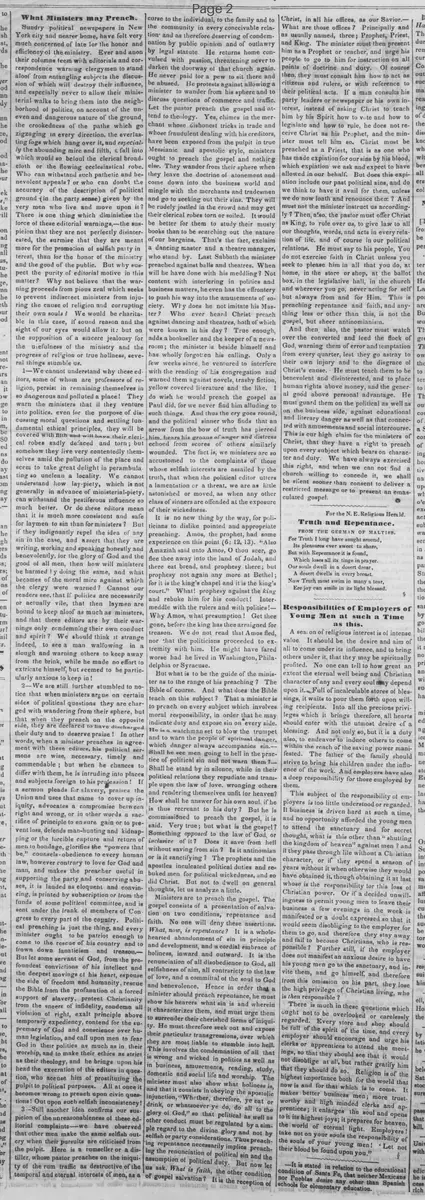
What Ministers may Preach.
Sundry political newspapers in New York city and nearer home, have felt very much concerned of late for the honor and efficiency of the ministry. Ever and anon their columns teem with editorials and correspondence warning clergymen to stand aloof from entangling subjects the discussion of which will destroy their influence, and especially never to allow their ministerial walks to bring them into the neighborhood of politics, on account of the uneven and dangerous nature of the ground, the crookedness of the paths which go zigzaging in every direction, the everlasting fogs which hang over it, and especially the abounding mire and filth, a fall into which would so befoul the clerical broadcloth or the flowing ecclesiastical robe. Who can withstand such pathetic and benevolent appeals? or who can doubt the accuracy of the description of political ground (in the party sense) given by the very men who live and move upon it?
There is one thing which diminishes the force of these editorial warnings,—the suspicion that they are not perfectly disinterested, the surmise that they are meant more for the promotion of selfish party interest, than for the honor of the ministry and the good of the public. But why suspect the purity of editorial motive in this matter? Why not believe that the warning proceeds from pious zeal which seeks to prevent indiscreet ministers from injuring the cause of religion and corrupting their own souls? We would be charitable in this case, if sound reason and the sight of our eyes would allow it: but on the supposition of a sincere jealousy for the usefulness of the ministry and the progress of religion or true holiness, several things stumble us.
1—We cannot understand why these editors, some of whom are professors of religion, persist in remaining themselves in so dangerous and polluted a place! They warn the ministers that if they venture into politics, even for the purpose of discussing moral questions and settling fundamental ethical principles, they will be covered with filth and will have their clerical robes sadly defaced and torn; but somehow they live very contentedly themselves amid the pollution of the place and seem to take great delight in perambulating so unclean a locality. We cannot understand how lay-piety, which is not generally in advance of ministerial-piety, can withstand the pestiferous influence so much better. Or do these editors mean that it is much more consistent and safe for laymen to sin than for ministers? But if they indignantly repel the idea of any sin in the case, and assert that they are writing, working and speaking honestly and benevolently, for the glory of God and the good of all men, then how will ministers be harmed by doing the same, and what becomes of the moral mire against which the clergy were warned? Cannot our readers see, that if politics are necessarily or actually vile, that then laymen are bound to keep aloof as much as ministers, and that these editors are by their warnings only condemning their own conduct and spirit? We should think it strange indeed, to see a man wallowing in a slough and warning others to keep away from the brink, while he made no effort to extricate himself, but seemed to be particularly anxious to keep in!
2—We are still further stumbled to notice that when ministers argue on certain sides of political questions they are charged with wandering from their sphere, but that when they preach on the opposite side, they are declared to have discharged their duty and to deserve praise! In other words, when a minister preaches in agreement with these editors, his political sermons are wise, necessary, timely and commendable; but when he chances to differ with them, he is intruding into places and subjects foreign to his profession! If a sermon pleads for slavery, praises the Union and uses that name to cover up iniquity, advocates a compromise between right and wrong, or in other words a sacrifice of principle to ensure gain or to prevent loss, defends man-hunting and kidnapping or the forcible capture and return of men to bondage, glorifies the "powers that be," counsels obedience to every human law, however contrary to love for God and man, and makes the preacher useful in supporting the party and conserving abuses, it is lauded as eloquent and convincing, is printed by subscription or from the funds of some political committee, and is sent under the frank of members of Congress to every part of the country. Political preaching is just the thing, and every minister ought to be patriot enough to come to the rescue of his country and to frown down fanaticism and treason.—
But let some servant of God, from the profoundest convictions of his intellect and the deepest movings of his heart, espouse the side of freedom and humanity, rescue the Bible from the profanation of a forced support of slavery, protect Christianity from the sneer of infidelity, condemn all violation of right, exalt principle above temporary expediency, contend for the supremacy of God and conscience over human legislation, and call upon men to fear God in their politics as much as in their worship, and to make their ethics as strict as their theology, and he brings upon his head the execration of the editors in question, who accuse him of prostituting the pulpit to political purposes. All at once it becomes wrong to preach upon civic questions! Out upon such selfish inconsistency!
3—Still another idea confirms our suspicion of the unreasonableness of these editorial complaints—we have observed that other men make the same selfish outcry when their pursuits are criticised from the pulpit. Here is a rumseller or a distiller, whose pastor preaches on the iniquity of the rum traffic as destructive of the temporal and eternal interests of men, as a curse to the individual, to the family and to the community in every conceivable relation, and as therefore deserving of condemnation by public opinion and of outlawry by legal statute. He returns home convulsed with passion, threatening never to darken the doorway of that church again. He never paid for a pew to sit there and be abused. He protests against allowing a minister to wander from his sphere and to discuss questions of commerce and traffic. Let the pastor preach the gospel and attend to theology. Yes, chimes in the merchant whose dishonest tricks in trade and whose fraudulent dealing with his creditors, have been exposed from the pulpit in true Messianic and apostolic style, ministers ought to preach the gospel and nothing else. They wander from their sphere when they leave the doctrine of atonement and come down into the business world and mingle with the merchants and tradesmen and go to seeking out their sins. They will be rudely jostled in the crowd and may get their clerical robes torn or soiled. It would be better for them to study their musty books than to be searching out the nature of our bargains. That's the fact, exclaim a dancing master and a theatre manager, who stand by. Last Sabbath the minister preached against balls and theatres. When will he have done with his meddling? Not content with interfering in politics and business matters, he even has the effrontery to push his way into the amusements of society. Why does he not imitate his Master? Who ever heard Christ preach against dancing and theatres, both of which were known in his day? True enough, adds a bookseller and the keeper of a news-room; the minister is beside himself and has wholly forgotten his calling. Only a few weeks since, he ventured to interfere with the reading of his congregation and warned them against novels, trashy fiction, yellow covered literature and the like. I do wish he would preach the gospel as Paul did, for we never find him alluding to such things. And thus the cry goes round, and the political sinner who finds that an arrow from the bow of truth has pierced him, hears his groans of anger and distress echoed from scores of others similarly wounded. The fact is, we ministers are so accustomed to the complaints of those whose selfish interests are assailed by the truth, that when the political editor utters a lamentation or a threat, we are as little astonished or moved, as when any other class of sinners are offended at the exposure of their wickedness.
It is no new thing by the way, for politicians to dislike pointed and appropriate preaching. Amos, the prophet, had some experience on this point (6: 12, 13). "Also Amaziah said unto Amos, O thou seer, go flee thee away into the land of Judah, and there eat bread, and prophesy there; but prophesy not again any more at Bethel; for it is the king's chapel and it is the king's court." What! prophesy against the king and rebuke him for his conduct! Intermeddle with the rulers and with politics!—Why Amos, what presumption! Get thee gone, before the king has thee arraigned for treason. We do not read that Amos fled, nor that the politicians proceeded to extremity with him. He might have fared worse had he lived in Washington, Philadelphia or Syracuse.
But what is to be the guide of the minister as to the range of his preaching? The Bible of course. And what does the Bible teach on this subject? That a minister is to preach on every subject which involves moral responsibility, in order that he may indicate duty and expose sin on every side. He is a watchman set to blow the trumpet and to warn the people of spiritual danger, which danger always accompanies sin.—Shall he see men going to hell in the practice of political sin and not warn them? Shall he stand by in silence, while in their political relations they repudiate and trample upon the law of love, wronging others and rendering themselves unfit for heaven? How shall he answer for his own soul, if he is thus recreant to his duty? But he is commissioned to preach the gospel, it is said. Very true; but what is the gospel? Something opposed to the law of God, or inclusive of it? Does it save from hell without saving from sin? Is it antinomian or is it sanctifying? The prophets and the apostles inculcated political duties and rebuked men for political wickedness, and so did Christ. But not to dwell on general thoughts, let us analyze a little.
Ministers are to preach the gospel. The gospel consists of a presentation of salvation on two conditions, repentance and faith. No one will deny these assertions What, now, is repentance? It is a whole-hearted abandonment of sin in principle and development, and a cordial embrace of holiness, inward and outward. It is the renunciation of all disobedience to God, all selfishness of aim, all contrariety to the law of love, and a committal of the soul to God and benevolence. Hence in order that a minister should preach repentance, he must show his hearers what sin is and wherein it characterizes them, and must urge them to surrender their cherished forms of iniquity. He must therefore seek out and expose their particular transgressions, over which they are most liable to stumble into hell. This involves the condemnation of all that is wrong and wicked in politics as well as in business, amusements, reading, study, domestic and social life and worship. The minister must also show what holiness is, and that it consists in obeying the apostolic injunction, "Whether, therefore, ye eat or drink, or whatsoever ye do, do all to the glory of God," so that political as well as other conduct must be regulated by a simple regard to the divine glory and not by selfish or party considerations. Thus preaching repentance necessarily implies preaching the renunciation of political sin and the assumption of political duty. But now let us ask. What is faith, the other condition of gospel salvation? It is the reception of Christ, in all his offices, as our Savior.—
What are those offices? Principally and as usually named, three; Prophet, Priest, and King. The minister must then present him as a Prophet or teacher, and urge his people to go to him for instruction on all points of doctrine and duty. Of course then, they must consult him how to act as citizens and rulers, or with reference to their political acts. If a man consults his party leaders or newspaper or his own interest, instead of asking Christ to teach him by his Spirit how to vote and how to legislate and how to rule, he does not receive Christ as his Prophet, and the minister must tell him so. Christ must be preached as a Priest, that is as one who has made expiation for our sins by his blood, which expiation we ask and expect to have allowed in our behalf. But does this expiation include our past political sins, and do we think to have it avail for them, unless we do now loath and renounce them? And must not the minister instruct us accordingly? Then, also, the pastor must offer Christ as King, to rule over us, to give law to all our thoughts, words, and acts in every relation of life, and of course in our political relations. He must say to his people, You do not exercise faith in Christ unless you seek to please him in all that you do, at home, in the store or shop, at the ballot box, in the legislative hall, in the church and wherever you go, never acting for self but always from and for Him. This is preaching repentance and faith, and anything less or other than this, is not the gospel, but sheer antinomianism.
And then also, the pastor must watch over the converted and feed the flock of God, warning them of error and temptation from every quarter, lest they go astray to their own injury and to the disgrace of Christ's cause. He must teach them to be benevolent and disinterested, and to place human rights above money, and the general good above personal advantage. He must guard them on the political as well as on the business side, against educational and literary danger as well as that connected with amusements and social intercourse. This is our high claim for the ministers of Christ, that they have a right to preach upon every subject which bears on character and duty. We have always exercised this right, and when we can not find a church willing to concede it, we shall be silent sooner than consent to deliver a restricted message or to present an emasculated gospel.
Sundry political newspapers in New York city and nearer home, have felt very much concerned of late for the honor and efficiency of the ministry. Ever and anon their columns teem with editorials and correspondence warning clergymen to stand aloof from entangling subjects the discussion of which will destroy their influence, and especially never to allow their ministerial walks to bring them into the neighborhood of politics, on account of the uneven and dangerous nature of the ground, the crookedness of the paths which go zigzaging in every direction, the everlasting fogs which hang over it, and especially the abounding mire and filth, a fall into which would so befoul the clerical broadcloth or the flowing ecclesiastical robe. Who can withstand such pathetic and benevolent appeals? or who can doubt the accuracy of the description of political ground (in the party sense) given by the very men who live and move upon it?
There is one thing which diminishes the force of these editorial warnings,—the suspicion that they are not perfectly disinterested, the surmise that they are meant more for the promotion of selfish party interest, than for the honor of the ministry and the good of the public. But why suspect the purity of editorial motive in this matter? Why not believe that the warning proceeds from pious zeal which seeks to prevent indiscreet ministers from injuring the cause of religion and corrupting their own souls? We would be charitable in this case, if sound reason and the sight of our eyes would allow it: but on the supposition of a sincere jealousy for the usefulness of the ministry and the progress of religion or true holiness, several things stumble us.
1—We cannot understand why these editors, some of whom are professors of religion, persist in remaining themselves in so dangerous and polluted a place! They warn the ministers that if they venture into politics, even for the purpose of discussing moral questions and settling fundamental ethical principles, they will be covered with filth and will have their clerical robes sadly defaced and torn; but somehow they live very contentedly themselves amid the pollution of the place and seem to take great delight in perambulating so unclean a locality. We cannot understand how lay-piety, which is not generally in advance of ministerial-piety, can withstand the pestiferous influence so much better. Or do these editors mean that it is much more consistent and safe for laymen to sin than for ministers? But if they indignantly repel the idea of any sin in the case, and assert that they are writing, working and speaking honestly and benevolently, for the glory of God and the good of all men, then how will ministers be harmed by doing the same, and what becomes of the moral mire against which the clergy were warned? Cannot our readers see, that if politics are necessarily or actually vile, that then laymen are bound to keep aloof as much as ministers, and that these editors are by their warnings only condemning their own conduct and spirit? We should think it strange indeed, to see a man wallowing in a slough and warning others to keep away from the brink, while he made no effort to extricate himself, but seemed to be particularly anxious to keep in!
2—We are still further stumbled to notice that when ministers argue on certain sides of political questions they are charged with wandering from their sphere, but that when they preach on the opposite side, they are declared to have discharged their duty and to deserve praise! In other words, when a minister preaches in agreement with these editors, his political sermons are wise, necessary, timely and commendable; but when he chances to differ with them, he is intruding into places and subjects foreign to his profession! If a sermon pleads for slavery, praises the Union and uses that name to cover up iniquity, advocates a compromise between right and wrong, or in other words a sacrifice of principle to ensure gain or to prevent loss, defends man-hunting and kidnapping or the forcible capture and return of men to bondage, glorifies the "powers that be," counsels obedience to every human law, however contrary to love for God and man, and makes the preacher useful in supporting the party and conserving abuses, it is lauded as eloquent and convincing, is printed by subscription or from the funds of some political committee, and is sent under the frank of members of Congress to every part of the country. Political preaching is just the thing, and every minister ought to be patriot enough to come to the rescue of his country and to frown down fanaticism and treason.—
But let some servant of God, from the profoundest convictions of his intellect and the deepest movings of his heart, espouse the side of freedom and humanity, rescue the Bible from the profanation of a forced support of slavery, protect Christianity from the sneer of infidelity, condemn all violation of right, exalt principle above temporary expediency, contend for the supremacy of God and conscience over human legislation, and call upon men to fear God in their politics as much as in their worship, and to make their ethics as strict as their theology, and he brings upon his head the execration of the editors in question, who accuse him of prostituting the pulpit to political purposes. All at once it becomes wrong to preach upon civic questions! Out upon such selfish inconsistency!
3—Still another idea confirms our suspicion of the unreasonableness of these editorial complaints—we have observed that other men make the same selfish outcry when their pursuits are criticised from the pulpit. Here is a rumseller or a distiller, whose pastor preaches on the iniquity of the rum traffic as destructive of the temporal and eternal interests of men, as a curse to the individual, to the family and to the community in every conceivable relation, and as therefore deserving of condemnation by public opinion and of outlawry by legal statute. He returns home convulsed with passion, threatening never to darken the doorway of that church again. He never paid for a pew to sit there and be abused. He protests against allowing a minister to wander from his sphere and to discuss questions of commerce and traffic. Let the pastor preach the gospel and attend to theology. Yes, chimes in the merchant whose dishonest tricks in trade and whose fraudulent dealing with his creditors, have been exposed from the pulpit in true Messianic and apostolic style, ministers ought to preach the gospel and nothing else. They wander from their sphere when they leave the doctrine of atonement and come down into the business world and mingle with the merchants and tradesmen and go to seeking out their sins. They will be rudely jostled in the crowd and may get their clerical robes torn or soiled. It would be better for them to study their musty books than to be searching out the nature of our bargains. That's the fact, exclaim a dancing master and a theatre manager, who stand by. Last Sabbath the minister preached against balls and theatres. When will he have done with his meddling? Not content with interfering in politics and business matters, he even has the effrontery to push his way into the amusements of society. Why does he not imitate his Master? Who ever heard Christ preach against dancing and theatres, both of which were known in his day? True enough, adds a bookseller and the keeper of a news-room; the minister is beside himself and has wholly forgotten his calling. Only a few weeks since, he ventured to interfere with the reading of his congregation and warned them against novels, trashy fiction, yellow covered literature and the like. I do wish he would preach the gospel as Paul did, for we never find him alluding to such things. And thus the cry goes round, and the political sinner who finds that an arrow from the bow of truth has pierced him, hears his groans of anger and distress echoed from scores of others similarly wounded. The fact is, we ministers are so accustomed to the complaints of those whose selfish interests are assailed by the truth, that when the political editor utters a lamentation or a threat, we are as little astonished or moved, as when any other class of sinners are offended at the exposure of their wickedness.
It is no new thing by the way, for politicians to dislike pointed and appropriate preaching. Amos, the prophet, had some experience on this point (6: 12, 13). "Also Amaziah said unto Amos, O thou seer, go flee thee away into the land of Judah, and there eat bread, and prophesy there; but prophesy not again any more at Bethel; for it is the king's chapel and it is the king's court." What! prophesy against the king and rebuke him for his conduct! Intermeddle with the rulers and with politics!—Why Amos, what presumption! Get thee gone, before the king has thee arraigned for treason. We do not read that Amos fled, nor that the politicians proceeded to extremity with him. He might have fared worse had he lived in Washington, Philadelphia or Syracuse.
But what is to be the guide of the minister as to the range of his preaching? The Bible of course. And what does the Bible teach on this subject? That a minister is to preach on every subject which involves moral responsibility, in order that he may indicate duty and expose sin on every side. He is a watchman set to blow the trumpet and to warn the people of spiritual danger, which danger always accompanies sin.—Shall he see men going to hell in the practice of political sin and not warn them? Shall he stand by in silence, while in their political relations they repudiate and trample upon the law of love, wronging others and rendering themselves unfit for heaven? How shall he answer for his own soul, if he is thus recreant to his duty? But he is commissioned to preach the gospel, it is said. Very true; but what is the gospel? Something opposed to the law of God, or inclusive of it? Does it save from hell without saving from sin? Is it antinomian or is it sanctifying? The prophets and the apostles inculcated political duties and rebuked men for political wickedness, and so did Christ. But not to dwell on general thoughts, let us analyze a little.
Ministers are to preach the gospel. The gospel consists of a presentation of salvation on two conditions, repentance and faith. No one will deny these assertions What, now, is repentance? It is a whole-hearted abandonment of sin in principle and development, and a cordial embrace of holiness, inward and outward. It is the renunciation of all disobedience to God, all selfishness of aim, all contrariety to the law of love, and a committal of the soul to God and benevolence. Hence in order that a minister should preach repentance, he must show his hearers what sin is and wherein it characterizes them, and must urge them to surrender their cherished forms of iniquity. He must therefore seek out and expose their particular transgressions, over which they are most liable to stumble into hell. This involves the condemnation of all that is wrong and wicked in politics as well as in business, amusements, reading, study, domestic and social life and worship. The minister must also show what holiness is, and that it consists in obeying the apostolic injunction, "Whether, therefore, ye eat or drink, or whatsoever ye do, do all to the glory of God," so that political as well as other conduct must be regulated by a simple regard to the divine glory and not by selfish or party considerations. Thus preaching repentance necessarily implies preaching the renunciation of political sin and the assumption of political duty. But now let us ask. What is faith, the other condition of gospel salvation? It is the reception of Christ, in all his offices, as our Savior.—
What are those offices? Principally and as usually named, three; Prophet, Priest, and King. The minister must then present him as a Prophet or teacher, and urge his people to go to him for instruction on all points of doctrine and duty. Of course then, they must consult him how to act as citizens and rulers, or with reference to their political acts. If a man consults his party leaders or newspaper or his own interest, instead of asking Christ to teach him by his Spirit how to vote and how to legislate and how to rule, he does not receive Christ as his Prophet, and the minister must tell him so. Christ must be preached as a Priest, that is as one who has made expiation for our sins by his blood, which expiation we ask and expect to have allowed in our behalf. But does this expiation include our past political sins, and do we think to have it avail for them, unless we do now loath and renounce them? And must not the minister instruct us accordingly? Then, also, the pastor must offer Christ as King, to rule over us, to give law to all our thoughts, words, and acts in every relation of life, and of course in our political relations. He must say to his people, You do not exercise faith in Christ unless you seek to please him in all that you do, at home, in the store or shop, at the ballot box, in the legislative hall, in the church and wherever you go, never acting for self but always from and for Him. This is preaching repentance and faith, and anything less or other than this, is not the gospel, but sheer antinomianism.
And then also, the pastor must watch over the converted and feed the flock of God, warning them of error and temptation from every quarter, lest they go astray to their own injury and to the disgrace of Christ's cause. He must teach them to be benevolent and disinterested, and to place human rights above money, and the general good above personal advantage. He must guard them on the political as well as on the business side, against educational and literary danger as well as that connected with amusements and social intercourse. This is our high claim for the ministers of Christ, that they have a right to preach upon every subject which bears on character and duty. We have always exercised this right, and when we can not find a church willing to concede it, we shall be silent sooner than consent to deliver a restricted message or to present an emasculated gospel.
What sub-type of article is it?
Moral Or Religious
Slavery Abolition
Partisan Politics
What keywords are associated?
Ministers Preaching Politics
Editorial Hypocrisy
Anti Slavery Sermons
Gospel And Morality
Political Sin
Clerical Duty
Biblical Precedent
What entities or persons were involved?
Political Newspapers In New York
Clergymen
Editors
Politicians
Rumsellers
Merchants
Dancing Masters
Theatre Managers
Booksellers
Amos The Prophet
Editorial Details
Primary Topic
Defense Of Ministers Preaching On Political Moral Issues Including Anti Slavery
Stance / Tone
Strongly Supportive Of Clerical Involvement In Politics For Moral Reasons, Critical Of Hypocritical Editors
Key Figures
Political Newspapers In New York
Clergymen
Editors
Politicians
Rumsellers
Merchants
Dancing Masters
Theatre Managers
Booksellers
Amos The Prophet
Key Arguments
Editors Hypocritically Warn Ministers From Politics While Engaging In It Themselves
Ministers Praised For Pro Slavery Political Preaching But Condemned For Anti Slavery Views
Other Professions Complain Similarly When Their Sins Are Pulpit Criticized
Biblical Precedent Like Amos Supports Preaching Against Political Wickedness
Gospel Preaching Requires Addressing Repentance And Faith, Including Political Sin And Duty
Christ's Offices As Prophet, Priest, King Demand Guidance On Political Conduct