Thank you for visiting SNEWPapers!
Sign up free
National Gazette
Philadelphia, Philadelphia County, Pennsylvania
What is this article about?
Continuation of U.S. House debate on Mr. Steele's motion to reduce the military establishment amid the Indian war. Speakers including Clark, Parker, Boudinot, Willis, Steele, Wadsworth, Milledge, and Findley argue over troop numbers, militia vs. regulars, expenditures, and frontier defense on January 2-3, 1793.
Clipping
OCR Quality
Full Text
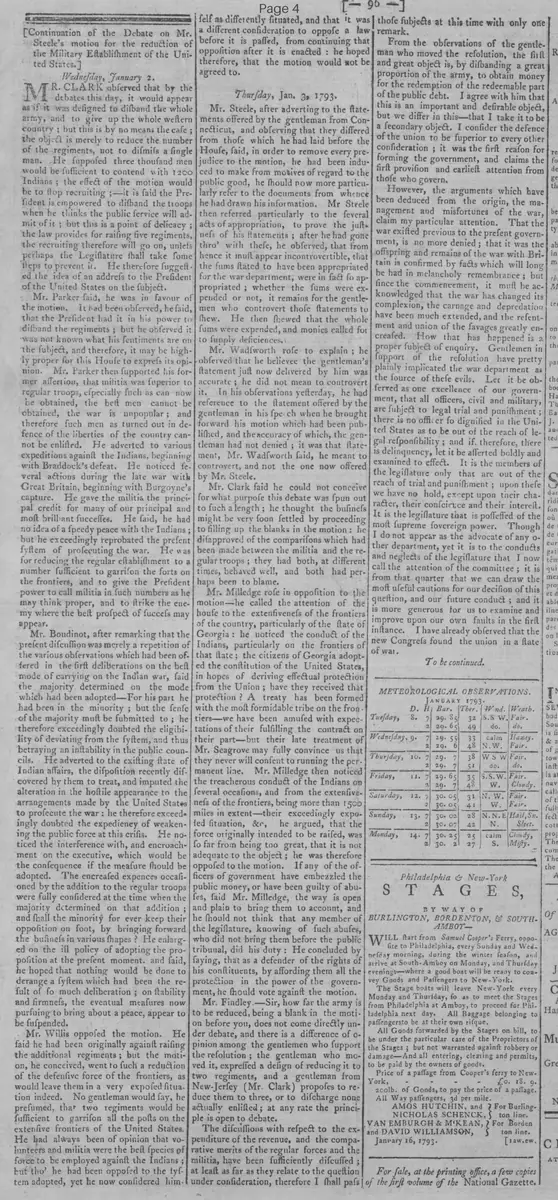
Wednesday, January 2.
Mr. CLARK observed that by the debates this day, it would appear as if it was designed to disband the whole army, and to give up the whole western country; but this is by no means the case: the object is merely to reduce the number of the regiments, not to dismiss a single man. He supposed three thousand men would be sufficient to contend with 1200 Indians: the effect of the motion would be to stop recruiting;—it is said the President is empowered to disband the troops when he thinks the public service will admit of it; but this is a point of delicacy; the law provides for raising five regiments, the recruiting therefore will go on, unless perhaps the Legislature shall take some steps to prevent it. He therefore suggested the idea of an address to the President of the United States on the subject.
Mr. Parker said, he was in favour of the motion. It had been observed, he said, that the President had it in his power to disband the regiments; but he observed it was not known what his sentiments are on the subject, and therefore, it may be highly proper for this House to express its opinion. Mr. Parker then supported his former assertion, that militia was superior to regular troops, especially such as can now be obtained, the best men cannot be obtained, the war is unpopular; and therefore such men as turned out in defence of the liberties of the country cannot be enlisted. He adverted to various expeditions against the Indians, beginning with Braddock's defeat. He noticed several actions during the late war with Great Britain, beginning with Burgoyne's capture. He gave the militia the principal credit for many of our principal and most brilliant successes. He said, he had no idea of a speedy peace with the Indians; but he exceedingly reprobated the present system of prosecuting the war. He was for reducing the regular establishment to a number sufficient to garrison the forts on the frontiers, and to give the President power to call militia in such numbers as he may think proper, and to strike the enemy where the best prospect of success may appear.
Mr. Boudinot, after remarking that the present discussion was merely a repetition of the various observations which had been offered in the first deliberations on the best mode of carrying on the Indian war, said the majority determined on the mode which had been adopted—For his part he had been in the minority; but the sense of the majority must be submitted to; he therefore exceedingly doubted the eligibility of deviating from the system, and thus betraying an instability in the public councils. He adverted to the existing state of Indian affairs, the disposition recently discovered by them to treat, and imputed the alteration in the hostile appearance to the arrangements made by the United States to prosecute the war: he therefore exceedingly doubted the expediency of weakening the public force at this crisis. He noticed the interference with, and encroachment on the executive, which would be the consequence if the measure should be adopted. The increased expenses occasioned by the addition to the regular troops were fully considered at the time when the majority determined on that addition: and shall the minority for ever keep their opposition on foot, by bringing forward the business in various shapes? He enlarged on the ill policy of adopting the proposition at the present moment. and said, he hoped that nothing would be done to derange a system which had been the result of so much deliberation; on stability and firmness, the eventual measures now pursuing to bring about a peace, appear to be suspended.
Mr. Willis opposed the motion. He said he had been originally against raising the additional regiments; but the motion, he conceived, went to such a reduction of the defensive force of the frontiers, as would leave them in a very exposed situation indeed. No gentleman would say, he presumed, that two regiments would be sufficient to garrison all the posts on the extensive frontiers of the United States. He had always been of opinion that volunteers and militia were the best species of force to be employed against the Indians; but tho' he had been opposed to the system adopted, yet he now considered himself as differently situated, and that it was a different consideration to oppose a law before it is passed, from continuing that opposition after it is enacted: he hoped therefore, that the motion would not be agreed to.
Thursday, Jan. 3. 1793.
Mr. Steele, after adverting to the statements offered by the gentleman from Connecticut, and observing that they differed from those which he had laid before the House, said, in order to remove every prejudice to the motion, he had been induced to make from motives of regard to the public good, he should now more particularly refer to the documents from whence he had drawn his information. Mr Steele then referred particularly to the several acts of appropriation, to prove the justice of his statements; after he had gone thro' with these, he observed, that from hence it must appear incontrovertible, that the sums stated to have been appropriated for the war department, were in fact so appropriated; whether the sums were expended or not, it remains for the gentlemen who controvert those statements to shew. He then shewed that the whole sums were expended, and monies called for to supply deficiencies.
Mr. Wadsworth rose to explain; he observed that he believes the gentleman's statement just now delivered by him was accurate; he did not mean to controvert it. In his observations yesterday, he had reference to the statement offered by the gentleman in his speech when he brought forward his motion which had been published, and the accuracy of which, the gentleman had not denied; it was that statement, Mr. Wadsworth said, he meant to controvert, and not the one now offered by Mr. Steele.
Mr. Clark said he could not conceive for what purpose this debate was spun out to such a length; he thought the business might be very soon settled by proceeding to filling up the blanks in the motion: he disapproved of the comparisons which had been made between the militia and the regular troops; they had both, at different times, behaved well, and both had perhaps been to blame.
Mr. Milledge rose in opposition to the motion—he called the attention of the house to the extensiveness of the frontiers of the country, particularly of the state of Georgia: he noticed the conduct of the Indians, particularly on the frontiers of that state; the citizens of Georgia adopted the constitution of the United States, in hopes of deriving effectual protection from the Union; have they received that protection? A treaty has been formed with the most formidable tribe on the frontiers —we have been amused with expectations of their fulfilling the contract on their part—but their late treatment of Mr. Seagrove may fully convince us that they never will consent to running the permanent line. Mr. Milledge then noticed the treacherous conduct of the Indians on several occasions, and from the extensiveness of the frontiers, being more than 1500 miles in extent—their exceedingly exposed situation, &c, he argued, that the force originally intended to be raised, was so far from being too great, that it is not adequate to the object; he was therefore opposed to the motion. If any of the officers of government have embezzled the public money, or have been guilty of abuses, said Mr. Milledge, the way is open and plain to bring them to account, and he should not think that any member of the legislature, knowing of such abuses, who did not bring them before the public tribunal, did his duty: He concluded by saying, that as a defender of the rights of his constituents, by affording them all the protection in the power of the government, he should vote against the motion.
Mr. Findley.—Sir, how far the army is to be reduced, being a blank in the motion before you, does not come directly under debate, and there is a difference of opinion among the gentlemen who support the resolution; the gentleman who moved it, expressed a design of reducing it to two regiments, and a gentleman from New-Jersey (Mr. Clark) proposes to reduce them to three, or to discharge none actually enlisted; at any rate the principle is open to debate.
The discussions with respect to the expenditure of the revenue, and the comparative merits of the regular forces and the militia, have been sufficiently discussed; at least as far as they relate to the question under consideration, therefore I shall pass those subjects at this time with only one remark.
From the observations of the gentleman who moved the resolution, the first and great object is, by disbanding a great proportion of the army, to obtain money for the redemption of the redeemable part of the public debt. I agree with him that this is an important and desirable object, but we differ in this—that I take it to be a secondary object. I consider the defence of the union to be superior to every other consideration: it was the first reason for forming the government, and claims the first provision and earliest attention from those who govern.
However, the arguments which have been deduced from the origin, the management and misfortunes of the war, claim my particular attention. That the war existed previous to the present government, is no more denied; that it was the offspring and remains of the war with Britain is confirmed by facts which will long be had in melancholy remembrance; but since the commencement, it must be acknowledged that the war has changed its complexion, the carnage and depredation have been much extended, and the resentment and union of the savages greatly increased. How that has happened is a proper subject of enquiry. Gentlemen in support of the resolution have pretty plainly implicated the war department as the source of these evils. Let it be observed as one excellence of our government, that all officers, civil and military, are subject to legal trial and punishment; there is no officer so dignified in the United States as to be out of the reach of legal responsibility; and if, therefore, there is delinquency, let it be asserted boldly and examined to effect. It is the members of the legislature only that are out of the reach of trial and punishment; upon these we have no hold, except upon their character, their conscience and their interest.
It is the legislature that is possessed of the most supreme sovereign power. Though I do not appear as the advocate of any other department, yet it is to the conducts and neglects of the legislature that I now call the attention of the committee; it is from that quarter that we can draw the most useful cautions for our decision of this question, and our future conduct; and it is more generous for us to examine and improve upon our own faults in the first instance.
I have already observed that the new Congress found the union in a state of war.
To be continued.
What sub-type of article is it?
What keywords are associated?
What entities or persons were involved?
Domestic News Details
Event Date
January 2 3, 1793
Key Persons
Outcome
debate ongoing; motion to reduce army to two or three regiments discussed but not resolved; to be continued.
Event Details
U.S. House of Representatives debates Mr. Steele's motion to reduce the military establishment from five to two or three regiments to save funds for public debt redemption and rely more on militia against Indians. Supporters argue for cost savings and militia superiority; opponents cite frontier defense needs, Indian hostilities, and policy stability. Discussions cover expenditures, historical precedents, and executive interference.