Thank you for visiting SNEWPapers!
Sign up free
Editorial
July 28, 1843
New York Daily Tribune
New York, New York County, New York
What is this article about?
Editorial rebuts Albany Argus's claim that Louisiana is a uniformly Whig state, credits Democratic Governor Mouton for pushing suffrage extension but notes Whig legislatures initiated convention calls. Defends suffrage as popular movement, respects opposition due to Louisiana's diverse population, and questions Democratic progress in other states like Virginia and Rhode Island.
Clipping
OCR Quality
95%
Excellent
Full Text
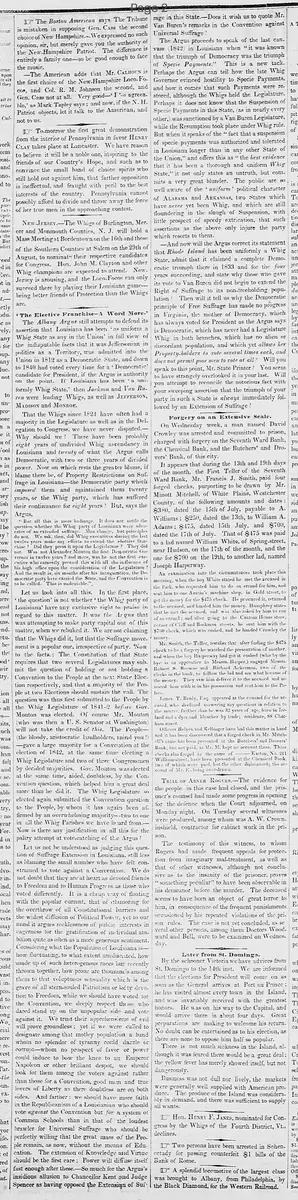
The Elective Franchise—A Word More.
The Albany Argus still attempts to defend its assertion that Louisiana has been 'as uniform a Whig State as any in the Union' in full view of the indisputable facts that it was Jeffersonian in politics as a Territory, was admitted into the Union in 1812 as a Democratic State, and down to 1840 had voted every time for a 'Democratic' candidate for President, if the Argus is authority on the point. If Louisiana has been 'a uniformly Whig State,' then Jackson and Van Buren were leading Whigs, as well as Jefferson, Madison and Monroe.
That the Whigs since 1824 have often had a majority in the Legislature as well as in the Delegation to Congress, we have never disputed.— Why should we? There have been probably eight years of undivided Whig ascendancy in Louisiana and twenty of what the Argus calls Democratic, with two or three years of divided power. Now on which rests the greater blame, if blame there be, of Property Restrictions on Suffrage in Louisiana—the Democratic party which imposed them and maintained them twenty years, or the Whig party, which has suffered their continuance for eight years? But, says the Argus,
"But all this is mere badinage. It does not settle the question whether the Whig party of Louisiana were advocates of an extended suffrage. Men change, but principles do not. We ask, then, did Whig executives during the last twelve years make any efforts to extend the elective franchise?" Did they press it upon the Legislature? They did not. Was not Alexander Mouton the first Democratic Governor in twelve years? and more, was he not the first executive who earnestly pressed this with all the influence of his high office upon the consideration of the Legislature? And the result is, six months after his inauguration, the Democratic party have carried the State, and the Convention is to be called. "This is undeniable."
Let us look into all this. In the first place, the question is not whether 'the Whig party of Louisiana' have any exclusive right to praise in regard to this matter. It was the Argus that was attempting to make party capital out of this matter, when we rebuked it. We are not claiming that the Whigs did it, but that the Suffrage movement is a popular one, irrespective of party. Now to the facts. The Constitution of that State requires that two several Legislatures may submit the question of holding or not holding a Convention to the People at the next State Election respectively, and that a majority of the People at two Elections should sustain the call. The question was thus first submitted to the People by the Whig Legislature of 1841-2 before Gov. Mouton was elected. Of course Mr. Mouton (who was then a U. S. Senator at Washington) will not take the credit of this. The People— (the bloody, aristocratic landholders, mind you!) —gave a large majority for a Convention at the election of 1842, at the same time electing a Whig Legislature and two of three Congressmen by decided majorities. Gov. Mouton was elected at the same time, aided, doubtless, by the Convention question, which helped him a great deal more than he did it. The Whig Legislature so elected again submitted the Convention question to the People, by whom it has again been affirmed by an overwhelming majority—two to one in all the Whig Parishes we have heard from.
Now is there any justification in all this for the paltry attempt at vote-catching of the Argus?
Let us not be understood as judging this question of Suffrage Extension in Louisiana, still less as blaming the small number who have felt constrained to vote against a Convention. We do not doubt that they are at heart as devoted friends to Freedom and to Human Progress as those who voted differently. It is a cheap way of floating with the popular current, that of clamoring for the overthrow of all Constitutional barriers and the widest diffusion of Political Power, yet to our mind it argues recklessness of public interests in eagerness for the gratification of individual ambition quite as often as a more generous sentiment.
Considering what the Population of Louisiana is— how fluctuating, to what extent uneducated, how made up of such heterogeneous races but recently thrown together, how prone are thousands among them to that voluptuous sensuality which is the grave of all stern-souled Patriotism or loyal devotion to Freedom, while we should have voted for the Convention, we deeply respect those who dared stand up on the unpopular side and vote against it. We trust their apprehensions of evil will prove groundless; yet if we were called to designate among that motley population a band whom no splendor of tyranny could dazzle or corrupt—whom no prospect of favor or power could induce to bow the knee to an Emperor Napoleon or other brilliant despot, we should look for them among the voters against rather than those for a Convention, good men and true lovers of Liberty as there doubtless are on both sides. And farther: we should have more faith in the Republicanism of a Louisianian who should vote against the Convention but for a system of Common Schools than in that of the loudest brawler for Universal Suffrage who should be perfectly willing that the great mass of the People remain, as now, without the means of Education. The extension of Knowledge and Virtue should be the first care: Power will diffuse itself fast enough after these.—So much for the Argus's insidious allusion to Chancellor Kent and Judge Spencer as having opposed the Extension of Suffrage in this State.—Does it wish us to quote Mr. Van Buren's remarks in the Convention against Universal Suffrage?
The Argus proceeds to speak of the last canvass (1842) in Louisiana when "it was known that the triumph of Democracy was the triumph of Specie Payments." This is a new tack. Perhaps the Argus can tell how the late Whig Governor evinced hostility to Specie Payments, and how it comes that such Payments were restored, although the Whigs held the Legislature. Perhaps it does not know that the Suspension of Specie Payments in this State, (as in nearly every other,) was sanctioned by a Van Buren Legislature, while the Resumption took place under Whig rule. But when it speaks of the "fact that a suspension of specie payments was authorized and tolerated in Louisiana longer than in any other State of the Union," and offers this as "the best evidence that it has been a thorough and uniform Whig State," it not only states an untruth, but commits a very great blunder. The public are so well aware of the 'uniform' political character of ALABAMA and ARKANSAS, two States which have never yet been Whig, and which are still floundering in the slough of Suspension, with little prospect of speedy extrication, that such assertions as the above only injure the party which resorts to them.
—And now will the Argus correct its statement that Rhode Island has been uniformly a Whig State, admit that it claimed a complete Democratic triumph there in 1833 and for the four years succeeding, and state why those who gave its vote to Van Buren did not begin to extend the Right of Suffrage to its non-freeholding population? Then will it tell us why the Democratic principle of Free Suffrage has made no progress in Virginia, the mother of Democracy, which has always voted for President as the Argus says is Democratic, which has never had a Legislature Whig in both branches, which has no alien or discordant population, and which yet allows her Property-holders to vote several times each, and does not permit poor men to vote at all? Will you speak to this point, Mr. State Printer? You seem to have strangely overlooked it in your last. Will you attempt to reconcile the notorious fact with your sweeping assertion that the triumph of your party in such a State is always immediately followed by an Extension of Suffrage?
The Albany Argus still attempts to defend its assertion that Louisiana has been 'as uniform a Whig State as any in the Union' in full view of the indisputable facts that it was Jeffersonian in politics as a Territory, was admitted into the Union in 1812 as a Democratic State, and down to 1840 had voted every time for a 'Democratic' candidate for President, if the Argus is authority on the point. If Louisiana has been 'a uniformly Whig State,' then Jackson and Van Buren were leading Whigs, as well as Jefferson, Madison and Monroe.
That the Whigs since 1824 have often had a majority in the Legislature as well as in the Delegation to Congress, we have never disputed.— Why should we? There have been probably eight years of undivided Whig ascendancy in Louisiana and twenty of what the Argus calls Democratic, with two or three years of divided power. Now on which rests the greater blame, if blame there be, of Property Restrictions on Suffrage in Louisiana—the Democratic party which imposed them and maintained them twenty years, or the Whig party, which has suffered their continuance for eight years? But, says the Argus,
"But all this is mere badinage. It does not settle the question whether the Whig party of Louisiana were advocates of an extended suffrage. Men change, but principles do not. We ask, then, did Whig executives during the last twelve years make any efforts to extend the elective franchise?" Did they press it upon the Legislature? They did not. Was not Alexander Mouton the first Democratic Governor in twelve years? and more, was he not the first executive who earnestly pressed this with all the influence of his high office upon the consideration of the Legislature? And the result is, six months after his inauguration, the Democratic party have carried the State, and the Convention is to be called. "This is undeniable."
Let us look into all this. In the first place, the question is not whether 'the Whig party of Louisiana' have any exclusive right to praise in regard to this matter. It was the Argus that was attempting to make party capital out of this matter, when we rebuked it. We are not claiming that the Whigs did it, but that the Suffrage movement is a popular one, irrespective of party. Now to the facts. The Constitution of that State requires that two several Legislatures may submit the question of holding or not holding a Convention to the People at the next State Election respectively, and that a majority of the People at two Elections should sustain the call. The question was thus first submitted to the People by the Whig Legislature of 1841-2 before Gov. Mouton was elected. Of course Mr. Mouton (who was then a U. S. Senator at Washington) will not take the credit of this. The People— (the bloody, aristocratic landholders, mind you!) —gave a large majority for a Convention at the election of 1842, at the same time electing a Whig Legislature and two of three Congressmen by decided majorities. Gov. Mouton was elected at the same time, aided, doubtless, by the Convention question, which helped him a great deal more than he did it. The Whig Legislature so elected again submitted the Convention question to the People, by whom it has again been affirmed by an overwhelming majority—two to one in all the Whig Parishes we have heard from.
Now is there any justification in all this for the paltry attempt at vote-catching of the Argus?
Let us not be understood as judging this question of Suffrage Extension in Louisiana, still less as blaming the small number who have felt constrained to vote against a Convention. We do not doubt that they are at heart as devoted friends to Freedom and to Human Progress as those who voted differently. It is a cheap way of floating with the popular current, that of clamoring for the overthrow of all Constitutional barriers and the widest diffusion of Political Power, yet to our mind it argues recklessness of public interests in eagerness for the gratification of individual ambition quite as often as a more generous sentiment.
Considering what the Population of Louisiana is— how fluctuating, to what extent uneducated, how made up of such heterogeneous races but recently thrown together, how prone are thousands among them to that voluptuous sensuality which is the grave of all stern-souled Patriotism or loyal devotion to Freedom, while we should have voted for the Convention, we deeply respect those who dared stand up on the unpopular side and vote against it. We trust their apprehensions of evil will prove groundless; yet if we were called to designate among that motley population a band whom no splendor of tyranny could dazzle or corrupt—whom no prospect of favor or power could induce to bow the knee to an Emperor Napoleon or other brilliant despot, we should look for them among the voters against rather than those for a Convention, good men and true lovers of Liberty as there doubtless are on both sides. And farther: we should have more faith in the Republicanism of a Louisianian who should vote against the Convention but for a system of Common Schools than in that of the loudest brawler for Universal Suffrage who should be perfectly willing that the great mass of the People remain, as now, without the means of Education. The extension of Knowledge and Virtue should be the first care: Power will diffuse itself fast enough after these.—So much for the Argus's insidious allusion to Chancellor Kent and Judge Spencer as having opposed the Extension of Suffrage in this State.—Does it wish us to quote Mr. Van Buren's remarks in the Convention against Universal Suffrage?
The Argus proceeds to speak of the last canvass (1842) in Louisiana when "it was known that the triumph of Democracy was the triumph of Specie Payments." This is a new tack. Perhaps the Argus can tell how the late Whig Governor evinced hostility to Specie Payments, and how it comes that such Payments were restored, although the Whigs held the Legislature. Perhaps it does not know that the Suspension of Specie Payments in this State, (as in nearly every other,) was sanctioned by a Van Buren Legislature, while the Resumption took place under Whig rule. But when it speaks of the "fact that a suspension of specie payments was authorized and tolerated in Louisiana longer than in any other State of the Union," and offers this as "the best evidence that it has been a thorough and uniform Whig State," it not only states an untruth, but commits a very great blunder. The public are so well aware of the 'uniform' political character of ALABAMA and ARKANSAS, two States which have never yet been Whig, and which are still floundering in the slough of Suspension, with little prospect of speedy extrication, that such assertions as the above only injure the party which resorts to them.
—And now will the Argus correct its statement that Rhode Island has been uniformly a Whig State, admit that it claimed a complete Democratic triumph there in 1833 and for the four years succeeding, and state why those who gave its vote to Van Buren did not begin to extend the Right of Suffrage to its non-freeholding population? Then will it tell us why the Democratic principle of Free Suffrage has made no progress in Virginia, the mother of Democracy, which has always voted for President as the Argus says is Democratic, which has never had a Legislature Whig in both branches, which has no alien or discordant population, and which yet allows her Property-holders to vote several times each, and does not permit poor men to vote at all? Will you speak to this point, Mr. State Printer? You seem to have strangely overlooked it in your last. Will you attempt to reconcile the notorious fact with your sweeping assertion that the triumph of your party in such a State is always immediately followed by an Extension of Suffrage?
What sub-type of article is it?
Suffrage
Partisan Politics
Constitutional
What keywords are associated?
Elective Franchise
Suffrage Extension
Louisiana Politics
Whig Democratic Debate
Property Restrictions
Convention Call
Specie Payments
What entities or persons were involved?
Albany Argus
Whig Party
Democratic Party
Alexander Mouton
Jackson
Van Buren
Jefferson
Madison
Monroe
Louisiana
Rhode Island
Virginia
Alabama
Arkansas
Editorial Details
Primary Topic
Extension Of Suffrage In Louisiana
Stance / Tone
Critical Of Partisan Claims, Supportive Of Suffrage With Reservations
Key Figures
Albany Argus
Whig Party
Democratic Party
Alexander Mouton
Jackson
Van Buren
Jefferson
Madison
Monroe
Louisiana
Rhode Island
Virginia
Alabama
Arkansas
Key Arguments
Louisiana Historically Democratic Until 1840
Whig Legislatures Initiated Suffrage Convention Calls
Suffrage Movement Popular Across Parties
Democratic Inaction In Other States Like Virginia And Rhode Island
Concerns Over Rapid Suffrage Extension Given Louisiana's Population
Priority Of Education Over Power Diffusion
Whigs Restored Specie Payments Despite Argus Claims