Thank you for visiting SNEWPapers!
Sign up free
The Times News
Hendersonville, Henderson County, North Carolina
What is this article about?
During the 1935 Lindbergh baby murder trial in Flemington, NJ, defense attorney Edward J. Reilly accuses Lindbergh household servants of disloyalty and possible involvement in the kidnapping, while prosecutor Anthony B. Hauck argues Hauptmann's guilt based on evidence of breaking, entering, kidnapping, and murder. The case nears jury deliberation amid defense tensions.
Clipping
OCR Quality
Full Text
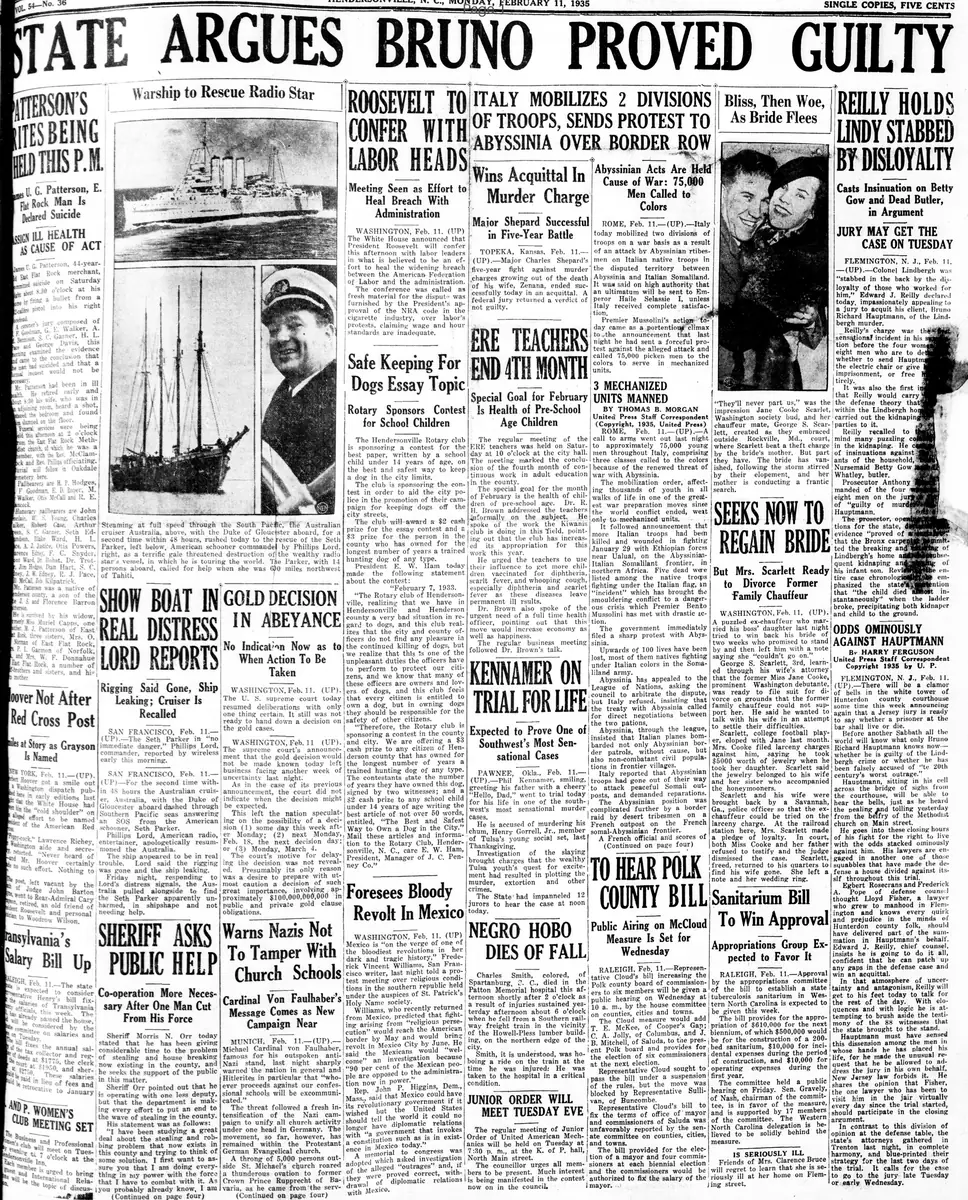
REILLY HOLDS LINDY STABBED BY DISLOYALTY
Casts Insinuation on Betty Gow and Dead Butler, in Argument
JURY MAY GET THE CASE ON TUESDAY
FLEMINGTON, N. J., Feb. 11.-(UP).-Colonel Lindbergh was "stabbed in the back by the disloyalty of those who worked for him," Edward J. Reilly declared today, impassionedly appealing to a jury to acquit his client, Bruno Richard Hauptmann, of the Lindbergh murder.
Reilly's charge was the sensational incident in his summation before the four women and eight men who are to determine whether to send Hauptmann to the electric chair or give him life imprisonment, or free him entirely.
It was also the first indication that Reilly would carry the defense theory that someone within the Lindbergh household carried out the kidnaping or was party to it.
Reilly recalled to mind many puzzling circumstances in the kidnaping. He cast a series of insinuations against servants of the household, Nursemaid Betty Gow and Whatley, butler.
Prosecutor Anthony B. Hauck demanded of the twelve men and women on the jury a verdict of "guilty of murder" against Hauptmann.
The prosecutor, opening his contentions for the state, said the evidence "proved beyond a doubt that the Bronx carpenter committed the breaking and entering of Lindbergh's home and the subsequent kidnaping and murder of his infant son." Reviewing the entire case chronologically, he emphasized the state's contention that "the child died almost instantaneously" when the ladder broke, precipitating both kidnapper and child to the ground.
ODDS OMINOUSLY AGAINST HAUPTMANN
By Harry Ferguson
United Press Staff Correspondent
Copyright 1935 by U. P.
FLEMINGTON, N. J., Feb. 11.-(UP).-There will be a clamor of bells in the white tower of Hunterdon county courthouse some time this week announcing again that a Jersey jury is ready to say whether a prisoner at the bar shall live or die.
Before another Sabbath all the world will know what only Bruno Richard Hauptmann knows now-whether he is guilty of the Lindbergh crime or whether he has been falsely accused of "the 20th century's worst outrage."
Hauptmann, sitting in his cell across the bridge of sighs from the courthouse, will be able to hear the bells, just as he heard the pealing and tolling yesterday from the belfry of the Methodist church on Main street.
He goes into these closing hours of his fight for the right to live with the odds stacked ominously against him. His lawyers are engaged in another one of those squabbles that have made the defense a house divided against itself throughout this trial.
Egbert Rosecrans and Frederick A. Pope of defense counsel thought Lloyd Fisher, a lawyer who grew to manhood in Flemington and knows every quirk and prejudice in the minds of Hunterdon county folk, should have delivered part of the summation in Hauptmann's behalf.
Edward J. Reilly, chief counsel, insists he is going to do it all, confident that he can patch up any gaps in the defense case and win an acquittal.
In that atmosphere of uncertainty and antagonism, Reilly will get to his feet today to talk for the rest of the day. With eloquence and with logic he is attempting to brush aside the testimony of the 88 witnesses that the state brought to the stand.
Hauptmann must have sensed this dissension among the men in whose hands he has placed his life, for he made the unusual request that he be allowed to address the jury in his own behalf. New Jersey law forbids it. He shares the opinion that Fisher, the one lawyer who has been to visit him in jail virtually every day since the trial started, should participate in the closing argument.
In contrast to this division of opinion at the defense table, the state's attorneys gathered in Trenton last night, in complete harmony, and blue-printed their strategy for the last two days of the trial. It calls for the case to go to the jury-late Tuesday or early Wednesday.
What sub-type of article is it?
What themes does it cover?
What keywords are associated?
What entities or persons were involved?
Where did it happen?
Story Details
Key Persons
Location
Flemington, N. J.
Event Date
Feb. 11, 1935
Story Details
Defense attorney Reilly accuses Lindbergh household servants of disloyalty and possible involvement in the kidnapping during summation, while prosecutor Hauck argues Hauptmann's guilt in the murder. Defense faces internal conflicts as the trial nears jury deliberation.