Thank you for visiting SNEWPapers!
Sign up free
Story
September 18, 1926
The St. Paul Echo
St. Paul, Minneapolis, Ramsey County, Hennepin County, Minnesota
What is this article about?
Factual explanation of locomotive engine puffing mechanism, tied to driving wheel circumference and speed, with example calculations at 50 mph.
Clipping
OCR Quality
100%
Excellent
Full Text
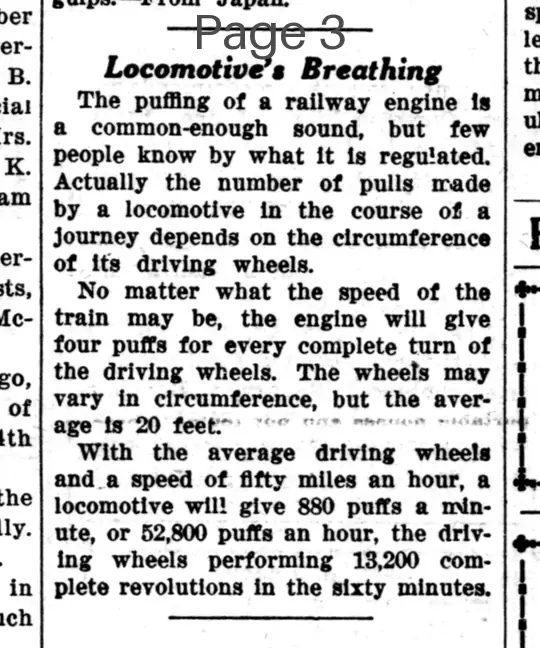
Locomotive's Breathing
The puffing of a railway engine is a common-enough sound, but few people know by what it is regulated. Actually the number of pulls made by a locomotive in the course of a journey depends on the circumference of its driving wheels.
No matter what the speed of the train may be, the engine will give four puffs for every complete turn of the driving wheels. The wheels may vary in circumference, but the average is 20 feet.
With the average driving wheels and a speed of fifty miles an hour, a locomotive will give 880 puffs a minute, or 52,800 puffs an hour, the driving wheels performing 13,200 complete revolutions in the sixty minutes.
The puffing of a railway engine is a common-enough sound, but few people know by what it is regulated. Actually the number of pulls made by a locomotive in the course of a journey depends on the circumference of its driving wheels.
No matter what the speed of the train may be, the engine will give four puffs for every complete turn of the driving wheels. The wheels may vary in circumference, but the average is 20 feet.
With the average driving wheels and a speed of fifty miles an hour, a locomotive will give 880 puffs a minute, or 52,800 puffs an hour, the driving wheels performing 13,200 complete revolutions in the sixty minutes.
What sub-type of article is it?
Curiosity
What keywords are associated?
Locomotive Puffing
Driving Wheels
Circumference
Puffs Per Minute
Revolutions
Story Details
Story Details
The puffing of a railway engine is regulated by the circumference of its driving wheels, with four puffs per complete turn. Average circumference is 20 feet. At 50 miles per hour, it gives 880 puffs a minute or 52,800 per hour, with wheels making 13,200 revolutions per hour.