Thank you for visiting SNEWPapers!
Sign up free
Editorial
September 27, 1797
Gazette Of The United States, & Philadelphia Daily Advertiser
Philadelphia, Philadelphia County, Pennsylvania
What is this article about?
Satirical editorial defends Federalist leaders like Washington and Adams against 'exclusive patriots' (Democratic-Republicans) accused of French ties, personal vices, and hypocrisy, contrasting their integrity with opponents' flaws, referencing 1790s political divisions.
Clipping
OCR Quality
98%
Excellent
Full Text
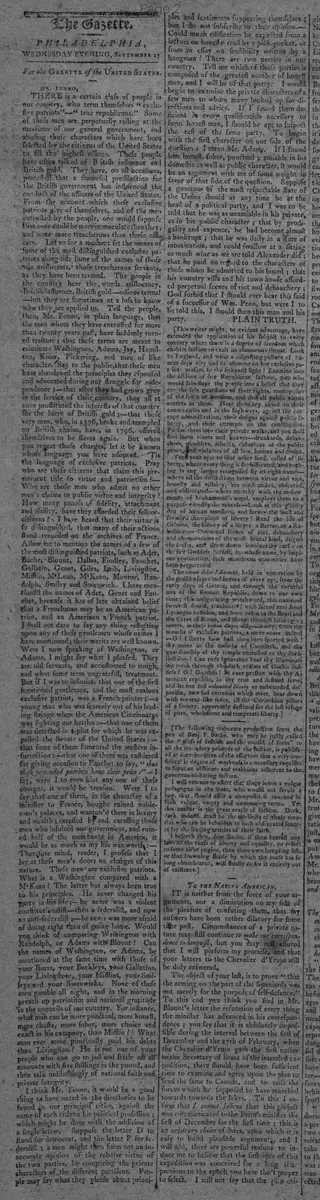
To the citizens of our country, who term themselves "exclusive patriots" "true republicans."
Some of these men are perpetually railing at the measures of our general government, and abusing those characters which have been selected by the citizens of the United States to fill their highest offices. These people have often talked of British influence and British gold. They have, on all occasions, protested that a shameful predilection for the British government has influenced the conduct of the officers of the United States.
From the account which these exclusive patriots give of themselves, and of the men entrusted by the people, one would suppose that none could be more immaculate than they, and none more treacherous than those officers. Let us for a moment set the names of some of the most distinguished exclusive patriots along side some of the names of those vile aristocrats, 'those treacherous servants,' as they have been termed. The people in the country hear the words aristocracy, British influence, British gold—odious terms!—but they are sometimes at a loss to know who they are applied to. Tell the people, then, Mr. Fenno, in plain language, that the men whom they have entrusted for more than twenty years past, have suddenly turned traitors; that these terms are meant to criminate Washington, Adams, Jay, Hamilton, Knox, Pickering, and men of like character. Say to the public, that these men have abandoned the principles they espoused and advocated during our struggle for independence;—that after they had grown gray in the service of their country, they all at once prostituted the interests of that country for the lucre of British gold;—that those very men, who, in 1776, broke and trampled on British chains, have, in 1796, offered themselves to be slaves again. But when you repeat those charges, let it be known whose language you have adopted. —'Tis the language of exclusive patriots. Pray who are these citizens that claim this pre-eminent title to virtue and patriotism?—Who are those men who admit no other men's claims to public virtue and integrity? How many proofs of fidelity, attachment and ability, have they afforded their fellow-citizens? I have heard that their virtue is so distinguished, that many of their actions stand recorded on the archives of France. Allow me to mention the names of a few of the most distinguished patriots, such as Adet, Bache, Blount, Dallas, Findley, Fauchet, Gallatin, Genet, Giles, Leib, Livingston, Mifflin, M'Lean, M'Kean, Monroe, Randolph, Smilie and Swanwick. I have mentioned the names of Adet, Genet and Fauchet, because it has of late obtained belief that a Frenchman may be an American patriot, and an American a French patriot.
I shall not dare to say any thing reflecting upon any of these gentlemen whose names I have mentioned; their merits are well known. Were I now speaking of Washington, or Adams, I might say what I pleased. They are old servants, and accustomed to rough, and what some term ungrateful, treatment. But if I was to insinuate that one of the first mentioned gentlemen, and the most zealous exclusive patriot, was a French printer; a young man who was scarcely out of his leading strings when the American Cincinnatus was fighting our battles:—that one of them was detected in a plot for which he was expelled the Senate of the United States:—that some of them fomented the western insurrection:—that one of them was cashiered for giving occasion to Fauchet to say, "thus these pretended patriots have their price:"—I say, were I to even hint any one of these charges, it would be treason. Were I to say that one of them, in the character of a minister to France, bought ruined noblemen's palaces, and wantoned there in luxury and wealth; caressed by and caressing those men who insulted our government, and ruined half of the merchants in America, it would be as much as my life was worth:—Therefore mind, reader, I profess that I lay at these men's doors no charges of this nature. These men are exclusive patriots.
What is a Washington compared with a M'Kean? The latter has always been true to his principles. He never changed his party in his life;—he never was a violent constitutionalist—then a federalist, and now an anti-federalist;—he never was more afraid of doing right than of going home. Would you think of comparing Washington with Randolph, or Adams with Blount? Can the names of Washington, or Adams, be mentioned at the same time with those of your Burrs, your Beckleys, your Gallatins, your Livingstons, your Mifflins, your Smilies and your Swanwicks. None of these men gamble all night, and in the morning preach up patriotism and national gratitude in the councils of our country. For instance, what man can be more punctual, more honest, more chaste, more sober, more choice and exact in his company, than Mifflin? What man ever more punctually paid his debts than Livingston? He is not one of your people who can go to jail and settle off all accounts with five shillings in the pound, and then talk unblushingly of national faith and private integrity.
I think Mr. Fenno, it would be a good thing to have noted in the directories to be found in our principal cities, against the name of each citizen his political profession; which might be done with the addition of a single letter. Suppose the letter D to stand for democrat, and the letter F for federalist; a man might then form not an inaccurate opinion of the relative virtue of the two parties, by comparing the private characters of the different partisans. People may say what they please about principles and sentiments supporting themselves; but I do not subscribe to their opinion.—Could such edification be expected from a lecture on honesty read by a pick-pocket, or from an essay on sensibility written by a hangman? There are two parties in our country. Tell me which of those parties is composed of the greatest number of honest men, and I will be of that party. I would begin to examine the private characters of a few men to whom many looked up for directions and advice. If I found them deficient in every qualification necessary to form honest men, I should be apt to suspect the rest of the same party. To begin with the first character on one side of the question: I mean Mr. Adams. If I found him honest, sober, punctual; amiable in his domestic as well as public character, it would be an argument with me of some weight in favor of that side of the question. Suppose a governor of the most respectable state of the Union should at any time be at the head of a political party, and I was to be told that he was as unamiable in his private, as in his public character; that by prodigality and expense, he had become almost a bankrupt; that he was daily in a state of intoxication, and could wallow at a sitting as much wine as we are told Alexander did; that he paid no regard to the characters of those whom he admitted to his board; that his country villa and his town house afforded perpetual scenes of riot and debauchery; God forbid that I should ever hear this said of a successor of Wm. Penn, but were I to be told this, I should shun this man and his party.
PLAIN TRUTH.
This writer might, to evident advantage, have extended the application of his subject to every country where there is a degree of freedom which enables faction to exalt its clamorous throat. Look to England, and what a disgusting picture of human depravity and debasement do her exclusive patriots present to the sickened sight! Examine into the actions of her Republican faction, men who would fain dupe the people into a belief that they are the sole guardians of their rights, monopolies of the spirit of freedom, and that all public virtue centers in them. Hear them cry aloud in their conventicles and in the highways, against the corrupt administration, their designs against public liberty, and their attempts on the constitution. Pursue them into their private walks, and you shall find them rioters and knaves—drunkards, debauchees, gamblers, atheists, disturbers of the public peace, and violators of all law, human and divine. Turn your eyes to that other land, called of liberty, where every thing is sophisticated, and nothing is any longer recognized by its right name—where all the distinctions between virtue and vice, honesty and villainy, are confounded, obscured, and obliterated—where anarchy with the endowments of Mohammed's angel, employs them to a purpose directly the reverse—Look at this ghastly den of human monsters, and survey the foul and forward champions of liberty! Read the life of Orleans, the history of a Sieyes, a Barras, or a Robespierre—Continual scenes of riot, debauchery and abominations of the most brutal kind, disgust the senses, and draw down involuntary curse on the fair Goddess herself, in whose name, by impious profanation, such monstrous enormities have been perpetrated.
The nomen dulce Libertatis, held in veneration by the godlike sages and heroes of every age, from the early days of Greece, and through the eventful aera of the Roman Republic, down to our own time; this invigorating watchword, this name of sweetest sound, transmitted with sacred zeal from Lycurgus to Solon, and from Solon to the Bruti and the Catos of Rome, and thence through later ages; comes, in these latter days, disgraced—utterly, from the mouths of exclusive patriots, a mere nomen inceed—O! Liberty how hast thou been tortured with! thy name in the mouths of Cannibals, and the guardianship of thy temple entrusted to thy deadliest foes! Can rude Ignorance hear thy illuminating torch through the dark realms of Gothic dullness? O! Goddess! be ever present with thy American republic, in thy true and defined form—and let not unbounded liberty or unbounded despotism, two bad extremes which meet, bear down with torrent-like force, all the Corinthian pillars of a society, apparently destined for the last refuge of pure, wholesome and temperate liberty.
The following elaborate production from the pen of Benj. F. Bache, who may be justly called the "glass of fashion and the mould of form" to all the sycophant printers of the faction, is published as corroborative of the assertion that a very considerable degree of weakness is a necessary requisite to form an obstinate and malicious adherent to the government-hating faction.
I will venture to assert that there is not a vulgar pedagogue in the State, who would not ferule a boy, that should offer a composition couched in such vulgar, empty and unmeaning terms. Yet this author is the great oracle of faction. Dark, dark, indeed, must be the intellects of those votaries who can be beholden to such obfuscated sources for the leading articles of their faith.
I beseech thee, dear Bache, if thou bearest any love to the cause of liberty and equality, to resort to some abler engine, than thine own bungling fist, or that frowning shade by which thy cause has so long obumbrated, will finally darken it entirely out of existence.
Some of these men are perpetually railing at the measures of our general government, and abusing those characters which have been selected by the citizens of the United States to fill their highest offices. These people have often talked of British influence and British gold. They have, on all occasions, protested that a shameful predilection for the British government has influenced the conduct of the officers of the United States.
From the account which these exclusive patriots give of themselves, and of the men entrusted by the people, one would suppose that none could be more immaculate than they, and none more treacherous than those officers. Let us for a moment set the names of some of the most distinguished exclusive patriots along side some of the names of those vile aristocrats, 'those treacherous servants,' as they have been termed. The people in the country hear the words aristocracy, British influence, British gold—odious terms!—but they are sometimes at a loss to know who they are applied to. Tell the people, then, Mr. Fenno, in plain language, that the men whom they have entrusted for more than twenty years past, have suddenly turned traitors; that these terms are meant to criminate Washington, Adams, Jay, Hamilton, Knox, Pickering, and men of like character. Say to the public, that these men have abandoned the principles they espoused and advocated during our struggle for independence;—that after they had grown gray in the service of their country, they all at once prostituted the interests of that country for the lucre of British gold;—that those very men, who, in 1776, broke and trampled on British chains, have, in 1796, offered themselves to be slaves again. But when you repeat those charges, let it be known whose language you have adopted. —'Tis the language of exclusive patriots. Pray who are these citizens that claim this pre-eminent title to virtue and patriotism?—Who are those men who admit no other men's claims to public virtue and integrity? How many proofs of fidelity, attachment and ability, have they afforded their fellow-citizens? I have heard that their virtue is so distinguished, that many of their actions stand recorded on the archives of France. Allow me to mention the names of a few of the most distinguished patriots, such as Adet, Bache, Blount, Dallas, Findley, Fauchet, Gallatin, Genet, Giles, Leib, Livingston, Mifflin, M'Lean, M'Kean, Monroe, Randolph, Smilie and Swanwick. I have mentioned the names of Adet, Genet and Fauchet, because it has of late obtained belief that a Frenchman may be an American patriot, and an American a French patriot.
I shall not dare to say any thing reflecting upon any of these gentlemen whose names I have mentioned; their merits are well known. Were I now speaking of Washington, or Adams, I might say what I pleased. They are old servants, and accustomed to rough, and what some term ungrateful, treatment. But if I was to insinuate that one of the first mentioned gentlemen, and the most zealous exclusive patriot, was a French printer; a young man who was scarcely out of his leading strings when the American Cincinnatus was fighting our battles:—that one of them was detected in a plot for which he was expelled the Senate of the United States:—that some of them fomented the western insurrection:—that one of them was cashiered for giving occasion to Fauchet to say, "thus these pretended patriots have their price:"—I say, were I to even hint any one of these charges, it would be treason. Were I to say that one of them, in the character of a minister to France, bought ruined noblemen's palaces, and wantoned there in luxury and wealth; caressed by and caressing those men who insulted our government, and ruined half of the merchants in America, it would be as much as my life was worth:—Therefore mind, reader, I profess that I lay at these men's doors no charges of this nature. These men are exclusive patriots.
What is a Washington compared with a M'Kean? The latter has always been true to his principles. He never changed his party in his life;—he never was a violent constitutionalist—then a federalist, and now an anti-federalist;—he never was more afraid of doing right than of going home. Would you think of comparing Washington with Randolph, or Adams with Blount? Can the names of Washington, or Adams, be mentioned at the same time with those of your Burrs, your Beckleys, your Gallatins, your Livingstons, your Mifflins, your Smilies and your Swanwicks. None of these men gamble all night, and in the morning preach up patriotism and national gratitude in the councils of our country. For instance, what man can be more punctual, more honest, more chaste, more sober, more choice and exact in his company, than Mifflin? What man ever more punctually paid his debts than Livingston? He is not one of your people who can go to jail and settle off all accounts with five shillings in the pound, and then talk unblushingly of national faith and private integrity.
I think Mr. Fenno, it would be a good thing to have noted in the directories to be found in our principal cities, against the name of each citizen his political profession; which might be done with the addition of a single letter. Suppose the letter D to stand for democrat, and the letter F for federalist; a man might then form not an inaccurate opinion of the relative virtue of the two parties, by comparing the private characters of the different partisans. People may say what they please about principles and sentiments supporting themselves; but I do not subscribe to their opinion.—Could such edification be expected from a lecture on honesty read by a pick-pocket, or from an essay on sensibility written by a hangman? There are two parties in our country. Tell me which of those parties is composed of the greatest number of honest men, and I will be of that party. I would begin to examine the private characters of a few men to whom many looked up for directions and advice. If I found them deficient in every qualification necessary to form honest men, I should be apt to suspect the rest of the same party. To begin with the first character on one side of the question: I mean Mr. Adams. If I found him honest, sober, punctual; amiable in his domestic as well as public character, it would be an argument with me of some weight in favor of that side of the question. Suppose a governor of the most respectable state of the Union should at any time be at the head of a political party, and I was to be told that he was as unamiable in his private, as in his public character; that by prodigality and expense, he had become almost a bankrupt; that he was daily in a state of intoxication, and could wallow at a sitting as much wine as we are told Alexander did; that he paid no regard to the characters of those whom he admitted to his board; that his country villa and his town house afforded perpetual scenes of riot and debauchery; God forbid that I should ever hear this said of a successor of Wm. Penn, but were I to be told this, I should shun this man and his party.
PLAIN TRUTH.
This writer might, to evident advantage, have extended the application of his subject to every country where there is a degree of freedom which enables faction to exalt its clamorous throat. Look to England, and what a disgusting picture of human depravity and debasement do her exclusive patriots present to the sickened sight! Examine into the actions of her Republican faction, men who would fain dupe the people into a belief that they are the sole guardians of their rights, monopolies of the spirit of freedom, and that all public virtue centers in them. Hear them cry aloud in their conventicles and in the highways, against the corrupt administration, their designs against public liberty, and their attempts on the constitution. Pursue them into their private walks, and you shall find them rioters and knaves—drunkards, debauchees, gamblers, atheists, disturbers of the public peace, and violators of all law, human and divine. Turn your eyes to that other land, called of liberty, where every thing is sophisticated, and nothing is any longer recognized by its right name—where all the distinctions between virtue and vice, honesty and villainy, are confounded, obscured, and obliterated—where anarchy with the endowments of Mohammed's angel, employs them to a purpose directly the reverse—Look at this ghastly den of human monsters, and survey the foul and forward champions of liberty! Read the life of Orleans, the history of a Sieyes, a Barras, or a Robespierre—Continual scenes of riot, debauchery and abominations of the most brutal kind, disgust the senses, and draw down involuntary curse on the fair Goddess herself, in whose name, by impious profanation, such monstrous enormities have been perpetrated.
The nomen dulce Libertatis, held in veneration by the godlike sages and heroes of every age, from the early days of Greece, and through the eventful aera of the Roman Republic, down to our own time; this invigorating watchword, this name of sweetest sound, transmitted with sacred zeal from Lycurgus to Solon, and from Solon to the Bruti and the Catos of Rome, and thence through later ages; comes, in these latter days, disgraced—utterly, from the mouths of exclusive patriots, a mere nomen inceed—O! Liberty how hast thou been tortured with! thy name in the mouths of Cannibals, and the guardianship of thy temple entrusted to thy deadliest foes! Can rude Ignorance hear thy illuminating torch through the dark realms of Gothic dullness? O! Goddess! be ever present with thy American republic, in thy true and defined form—and let not unbounded liberty or unbounded despotism, two bad extremes which meet, bear down with torrent-like force, all the Corinthian pillars of a society, apparently destined for the last refuge of pure, wholesome and temperate liberty.
The following elaborate production from the pen of Benj. F. Bache, who may be justly called the "glass of fashion and the mould of form" to all the sycophant printers of the faction, is published as corroborative of the assertion that a very considerable degree of weakness is a necessary requisite to form an obstinate and malicious adherent to the government-hating faction.
I will venture to assert that there is not a vulgar pedagogue in the State, who would not ferule a boy, that should offer a composition couched in such vulgar, empty and unmeaning terms. Yet this author is the great oracle of faction. Dark, dark, indeed, must be the intellects of those votaries who can be beholden to such obfuscated sources for the leading articles of their faith.
I beseech thee, dear Bache, if thou bearest any love to the cause of liberty and equality, to resort to some abler engine, than thine own bungling fist, or that frowning shade by which thy cause has so long obumbrated, will finally darken it entirely out of existence.
What sub-type of article is it?
Partisan Politics
Satire
Moral Or Religious
What keywords are associated?
Exclusive Patriots
British Influence
French Influence
Federalists
Democratic Republicans
Political Virtue
Partisan Hypocrisy
Benjamin Bache
What entities or persons were involved?
Washington
Adams
Jay
Hamilton
Knox
Pickering
Adet
Bache
Blount
Dallas
Findley
Fauchet
Gallatin
Genet
Giles
Leib
Livingston
Mifflin
M'lean
M'kean
Monroe
Randolph
Smilie
Swanwick
Burr
Beckley
Editorial Details
Primary Topic
Defense Of Federalist Leaders Against Democratic Republican Critics
Stance / Tone
Strongly Pro Federalist, Satirical Attack On Opponents' Character
Key Figures
Washington
Adams
Jay
Hamilton
Knox
Pickering
Adet
Bache
Blount
Dallas
Findley
Fauchet
Gallatin
Genet
Giles
Leib
Livingston
Mifflin
M'lean
M'kean
Monroe
Randolph
Smilie
Swanwick
Burr
Beckley
Key Arguments
Critics Rail Against Federal Government And Its Officers As Influenced By British Gold
Federalist Leaders Like Washington And Adams Are Accused Of Betraying Independence Principles
Opponents Like Bache And Others Are Tied To French Influence And Personal Vices
True Patriotism Is Questioned By Examining Private Characters Of Political Figures
Democratic Republicans Exhibit Hypocrisy In Virtue Claims While Engaging In Debauchery
Federalists Demonstrate Consistent Integrity And Service
Partisan Labels Should Reflect Personal Honesty
Examples From England And France Show Depravity Of Exclusive Patriots
Bache's Writing Exemplifies Weakness In The Opposition Faction