Thank you for visiting SNEWPapers!
Sign up free
Literary
October 2, 1885
West Virginia Argus
Kingwood, Preston County, West Virginia
What is this article about?
An essay advising on personal styles in stationery for letter writing, advocating simple, consistent choices in paper, envelopes, and sealing wax, while decrying fads and shams. Emphasizes elegance in plain linen or smooth papers and proper sealing techniques. From Boston Herald.
Clipping
OCR Quality
98%
Excellent
Full Text
STATIONERY.
The Styles That Obtain in Epistolary Writing.
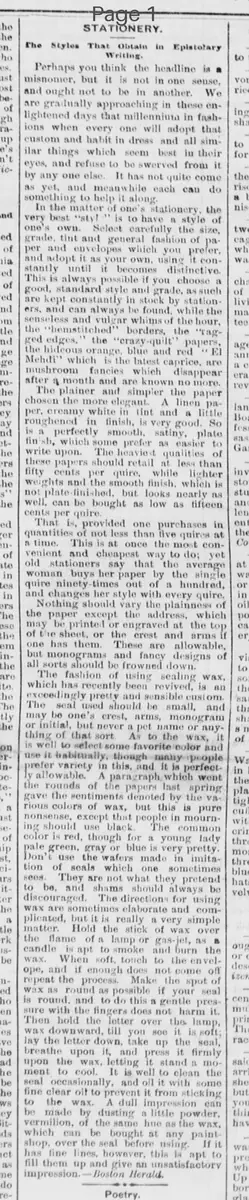
Perhaps you think the headline is a misnomer, but it is not in one sense, and ought not to be in another. We are gradually approaching in these enlightened days that millennium in fashions when every one will adopt that custom and habit in dress and all similar things which seem best in their eyes, and refuse to be swerved from it by any one else. It has not quite come as yet, and meanwhile each can do something to help it along. In the matter of one's stationery, the very best "style" is to have a style of one's own. Select carefully the size, grade, tint and general fashion of paper and envelopes which you prefer, and adopt it as your own, using it constantly until it becomes distinctive. This is always possible if you choose a good, standard style and grade, as such are kept constantly in stock by stationers, and can always be found, while the senseless and vulgar whims of the hour, the "hemstitched" borders, the "ragged edges," the "crazy-quilt" papers, the hideous orange, blue and red "El Mehdi" which is the latest caprice, are mushroom fancies which disappear after a month and are known no more. The plainer and simpler the paper chosen the more elegant. A linen paper, creamy white in tint and a little roughened in finish, is very good. So is a perfectly smooth, satiny, plate finish, which some prefer as easier to write upon. The heaviest qualities of these papers should retail at less than fifty cents per quire, while lighter weights and the smooth finish, which is not plate finished, but looks nearly as well, can be bought as low as fifteen cents per quire. That is, provided one purchases in quantities of not less than five quires at a time. This is at once the most convenient and cheapest way to do; yet old stationers say that the average woman buys her paper by the single quire ninety-times out of a hundred, and changes her style with every quire. Nothing should vary the plainness of the paper except the address, which may be printed or engraved at the top of the sheet, or the crest and arms if one has them. These are allowable, but monograms and fancy designs of all sorts should be frowned down. The fashion of using sealing wax, which has recently been revived, is an exceedingly pretty and sensible custom. The seal used should be small, and may be one's crest, arms, monogram or initial, but never a pet name or anything of that sort. As to the wax, it is well to select some favorite color and use it habitually, though many people prefer variety in this, and it is perfectly allowable. A paragraph which went the rounds of the papers last spring gave the sentiments denoted by the various colors of wax, but this is pure nonsense, except that people in mourning should use black. The common color is red, though for a young lady pale green, gray or blue is very pretty. Don't use the wafers made in imitation of seals which one sometimes sees. They are not what they pretend to be, and shams should always be discouraged. The directions for using wax are sometimes elaborate and complicated, but it is really a very simple matter. Hold the stick of wax over the flame of a lamp or gas-jet, as a candle is apt to smoke and burn the wax. When soft, touch to the envelope, and if enough does not come off repeat the process. Make the spot of wax as round as possible if your seal is round, and to do this a gentle pressure with the fingers does not harm it. Then hold the letter over the lamp, wax downward, till you see it is soft, lay the letter down, take up the seal, breathe upon it, and press it firmly upon the wax, letting it stand a moment to cool. It is well to clean the seal occasionally, and oil it with some fine clear oil to prevent it from sticking to the wax. A dull impression can be made by dusting a little powder, vermilion, of the same hue as the wax, which can be bought at any paint shop, over the seal before using. If it has fine lines, however, this is apt to fill them up and give an unsatisfactory impression.—Boston Herald.
The Styles That Obtain in Epistolary Writing.
Perhaps you think the headline is a misnomer, but it is not in one sense, and ought not to be in another. We are gradually approaching in these enlightened days that millennium in fashions when every one will adopt that custom and habit in dress and all similar things which seem best in their eyes, and refuse to be swerved from it by any one else. It has not quite come as yet, and meanwhile each can do something to help it along. In the matter of one's stationery, the very best "style" is to have a style of one's own. Select carefully the size, grade, tint and general fashion of paper and envelopes which you prefer, and adopt it as your own, using it constantly until it becomes distinctive. This is always possible if you choose a good, standard style and grade, as such are kept constantly in stock by stationers, and can always be found, while the senseless and vulgar whims of the hour, the "hemstitched" borders, the "ragged edges," the "crazy-quilt" papers, the hideous orange, blue and red "El Mehdi" which is the latest caprice, are mushroom fancies which disappear after a month and are known no more. The plainer and simpler the paper chosen the more elegant. A linen paper, creamy white in tint and a little roughened in finish, is very good. So is a perfectly smooth, satiny, plate finish, which some prefer as easier to write upon. The heaviest qualities of these papers should retail at less than fifty cents per quire, while lighter weights and the smooth finish, which is not plate finished, but looks nearly as well, can be bought as low as fifteen cents per quire. That is, provided one purchases in quantities of not less than five quires at a time. This is at once the most convenient and cheapest way to do; yet old stationers say that the average woman buys her paper by the single quire ninety-times out of a hundred, and changes her style with every quire. Nothing should vary the plainness of the paper except the address, which may be printed or engraved at the top of the sheet, or the crest and arms if one has them. These are allowable, but monograms and fancy designs of all sorts should be frowned down. The fashion of using sealing wax, which has recently been revived, is an exceedingly pretty and sensible custom. The seal used should be small, and may be one's crest, arms, monogram or initial, but never a pet name or anything of that sort. As to the wax, it is well to select some favorite color and use it habitually, though many people prefer variety in this, and it is perfectly allowable. A paragraph which went the rounds of the papers last spring gave the sentiments denoted by the various colors of wax, but this is pure nonsense, except that people in mourning should use black. The common color is red, though for a young lady pale green, gray or blue is very pretty. Don't use the wafers made in imitation of seals which one sometimes sees. They are not what they pretend to be, and shams should always be discouraged. The directions for using wax are sometimes elaborate and complicated, but it is really a very simple matter. Hold the stick of wax over the flame of a lamp or gas-jet, as a candle is apt to smoke and burn the wax. When soft, touch to the envelope, and if enough does not come off repeat the process. Make the spot of wax as round as possible if your seal is round, and to do this a gentle pressure with the fingers does not harm it. Then hold the letter over the lamp, wax downward, till you see it is soft, lay the letter down, take up the seal, breathe upon it, and press it firmly upon the wax, letting it stand a moment to cool. It is well to clean the seal occasionally, and oil it with some fine clear oil to prevent it from sticking to the wax. A dull impression can be made by dusting a little powder, vermilion, of the same hue as the wax, which can be bought at any paint shop, over the seal before using. If it has fine lines, however, this is apt to fill them up and give an unsatisfactory impression.—Boston Herald.
What sub-type of article is it?
Essay
What themes does it cover?
Social Manners
What keywords are associated?
Stationery
Epistolary Writing
Letter Paper
Sealing Wax
Etiquette
Social Customs
Fashion Advice
What entities or persons were involved?
Boston Herald
Literary Details
Title
Stationery. The Styles That Obtain In Epistolary Writing.
Author
Boston Herald
Subject
Advice On Stationery And Epistolary Customs
Key Lines
In The Matter Of One's Stationery, The Very Best "Style" Is To Have A Style Of One's Own.
The Plainer And Simpler The Paper Chosen The More Elegant.
The Fashion Of Using Sealing Wax, Which Has Recently Been Revived, Is An Exceedingly Pretty And Sensible Custom.
Don't Use The Wafers Made In Imitation Of Seals Which One Sometimes Sees. They Are Not What They Pretend To Be, And Shams Should Always Be Discouraged.