Thank you for visiting SNEWPapers!
Sign up free
The Ladies' Garland
Harpers Ferry, Jefferson County, West Virginia
What is this article about?
In an early Massachusetts settlement, the Fletcher family joyfully awaits Mr. Fletcher and Hope Leslie's return. Their anticipation turns to horror as Magawisca's father Mononotto and Indian warriors attack, killing Mrs. Fletcher and others. Children are captured or saved amid heroic pleas.
Merged-components note: Continuation of the literary excerpt from 'Hope Leslie' across pages 1 and 2, as the text flows directly from one component to the next.
Clippings
1 of 2
OCR Quality
Full Text
NOTICE OF HOPE LESLIE,
Or Early Times in the Massachusetts.
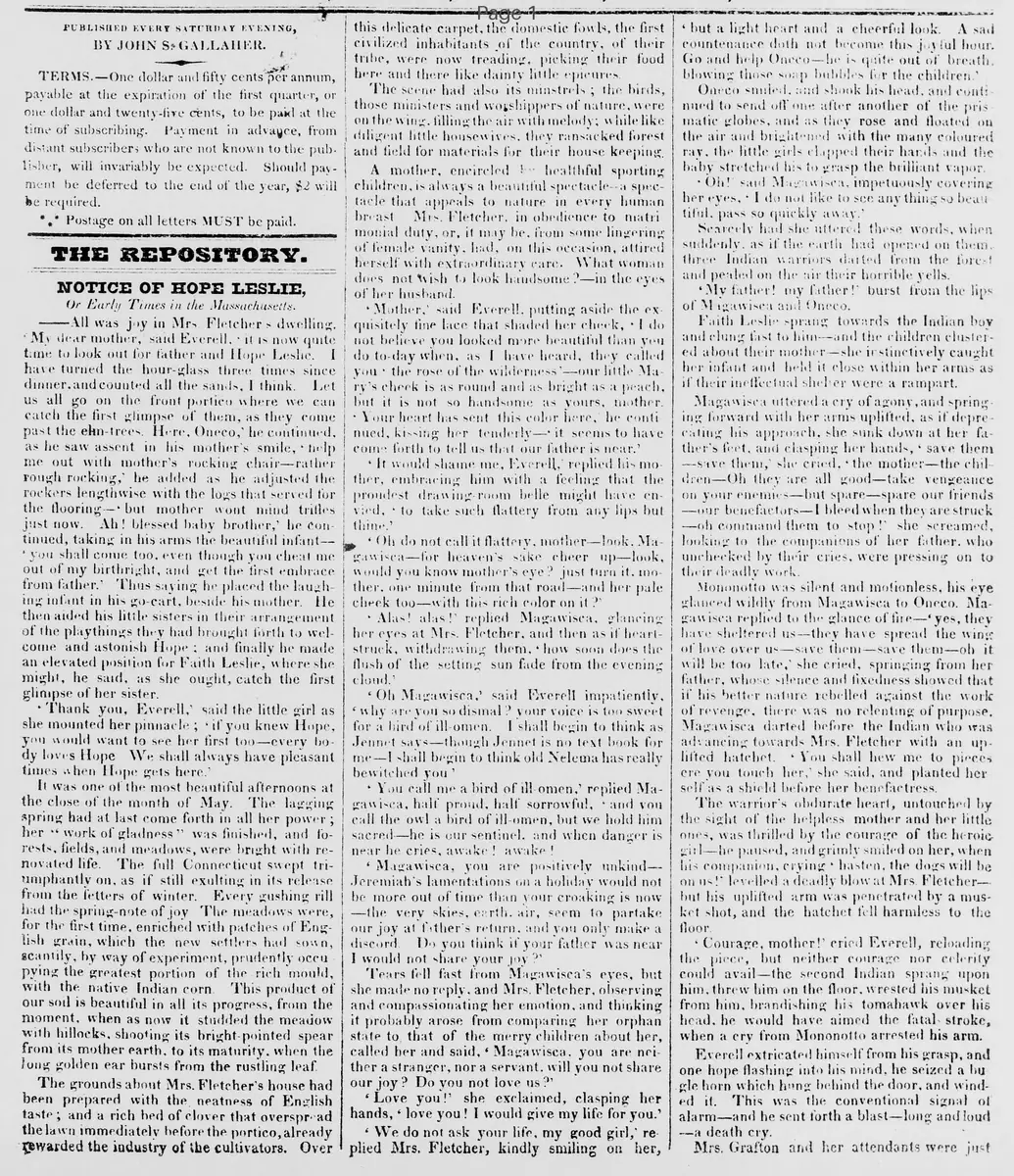
--All was joy in Mr. Fletcher’s dwelling.
My dear mother, said Everell. — it is now quite
time to look out for father and Hope Leslie. I
have turned the hour-glass three times since
dinner, and counted all the sands, I think. Let
us all go on the front portico where we can
catch the first glimpse of them, as they come
past the elm-trees. Here, Oneco, he continued,
as he saw assent in his mother’s smile, help
me out with mother’s rocking chair—rather
rough rocking,’ he added as he adjusted the
rockers lengthwise with the logs that served for
the flooring— but mother won’t mind trifles
just now. Ah! blessed baby brother,’ he continued,
taking in his arms the beautiful infant—
you shall come too, even though you cheat me
out of my birthright, and get the first embrace
from father.’ Thus saying he placed the laughing
infant in his go-cart, beside his mother. He
then aided his little sisters in their arrangement
of the playthings they had brought forth to welcome
and astonish Hope : and finally he made
an elevated position for Faith Leslie, where she
might, he said, as she ought, catch the first
glimpse of her sister.
Thank you, Everell,” said the little girl
as she mounted her pinnacle ; ‘if you knew Hope,
you would want to see her first too—every body
loves Hope We shall always have pleasant
times when Hope gets here.
It was one of the most beautiful afternoons at
the close of the month of May. The lagging
spring had at last come forth in all her power ;
her “ work of gladness” was finished, and forests,
fields, and meadows, were bright with renovated
life. The full Connecticut swept triumphantly
on, as if still exulting in its release
from the fetters of winter. Every gushing rill
had the spring-note of joy The meadows were,
for the first time, enriched with patches of English
grain, which the new settlers had sown,
scantily, by way of experiment, prudently occupying
the greatest portion of the rich mould,
with the native Indian corn. This product of
our soil is beautiful in all its progress, from the
moment, when as now it studded the meadow
with hillocks, shooting its bright-pointed spear
from its mother earth, to its maturity. when the
long golden ear bursts from the rustling leaf.
The grounds about Mrs. Fletcher’s house had
been prepared with the neatness of English
taste; and a rich bed of clover that overspread
the lawn immediately before the portico, already
rewarded the industry of the cultivators. Over
this delicate carpet, the domestic fowls, the first
civilized inhabitants of the country, of their
tribe, were now treading, picking their food
here and there like dainty little epicures.
The scene had also its minstrels ; the birds,
those ministers and worshippers of nature, were
on the wing, filling the air with melody; while like
diligent little housewives. they ransacked forest
and field for materials for their housekeeping.
A mother, encircled by healthful sporting
children,is always a beautiful spectacle—a spectacle
that appeals to nature in every human
breast Mrs. Fletcher, in obedience to matrimonial
duty, or, it may be, from some lingering
of female vanity. had, on this occasion, attired
herself with extraordinary care. What woman
does not wish to look handsome ?—in the eyes
of her husband.
Mother,’ said Everell. putting aside the exquisitely
fine lace that shaded her cheek, I do
not believe you looked more beautiful than you
do to-day when, as I have heard, they called
you the rose of the wilderness —our little Mary’s
cheek is as round and as bright as a peach,
but it is not so handsome as yours. Mother.
— Your heart has sent this color here, he continued,
kissing her tenderly— it seems to have
come forth to tell us that our father is near.’
It would shame me, Everell, replied his mother,
embracing him with a feeling that the
proudest drawing-room belle might have envied,
— to take such flattery from any lips but
thine.?
Oh do not call it flattery, mother—look. Magawisca—for
heaven’s sake cheer up—look,
would you know mother’s eye? just turn it, mother,
one minute from that road—and her pale
cheek too—with this rich color on it?
Alas! alas!’ replied Magawisca. glancing
her eyes at Mrs. Fletcher, and then as if heart-struck,
withdrawing them, how soon does the
flush of the setting sun fade from the evening
cloud.”
Oh Magawisca.’ said Everell impatiently,
“why are you so dismal? your voice is too sweet
for a bird of ill-omen. I shall begin to think as
Jennet says—though Jennet is no text book for
me—I shall begin to think old Nelema has really
bewitched you
. You call me a bird of ill-omen.’ replied Magawisca,
half proud, half sorrowful, and you
call the owl a bird of ill-omen, but we hold him
sacred—he is our sentinel. and when danger is
near he cries, awake ! awake !
— Magawisca, you are positively unkind—
Jeremiah’s lamentations on a holiday would not
be more out of time than your croaking is now
—the very skies. earth. air, seem to partake
our joy at father’s return. and you only make a
discord. Do you think if your father was near
I would not share your joy ?’
Tears fell fast from Magawisca’s eyes, but
she made no reply. and Mrs. Fletcher, observing
and compassionating her emotion, and thinking
it probably arose from comparing her orphan
state to. that of the merry children about her,
called her and said, ‘ Magawisca, you are neither
a stranger, nor a servant. will you not share
our joy? Do you not love us ?
‘Love you!’ she exclaimed, clasping her
hands, love you! I would give my life for you.’
We do not ask your life, my good girl,’ replied
Mrs. Fletcher, kindly smiling on her,
but a light heart and a cheerful look. A sad
countenance doth not become this joyful hour.
Go and help Oneco—he is quite out of breath.
blowing those soap bubbles for the children.
Oneco smiled, and shook his head, and continued
to send off one after another of the prismatic
globes, and as they rose and floated on
the air and brightened with the many coloured
ray, the little girls clapped their hands and the
baby stretched his to grasp the brilliant vapor.
Oh! said Magawisca, impetuously covering
her eyes, : I do not like to see any thing so beautiful,
pass so quickly away.
Scarcely had she uttered these words, when
suddenly, as if the earth had opened on them.
three Indian warriors darted from the forest
and pealed on the air their horrible yells.
My father! my father!” burst from the lips
of Magawisca and Oneco.
Faith Leslie sprang towards the Indian boy
and clung fast to him—and the children clustered
about their mother—she instinctively caught
her infant and held it close within her arms as
if their ineffectual shelter were a rampart.
Magawisca uttered a cry of agony,and springing
forward with her arms uplifted, as if deprecating
his approach, she sunk down at her father’s
feet, and clasping her hands, ‘ save them
—save them,’ she cried, ‘the mother—the children—Oh
they are all good—take vengeance
on your enemies—but spare—spare our friends
—our benefactors—I bleed when they are struck
—oh command them to stop!’ she screamed,
looking to the companions of her father. who
unchecked by their cries, were pressing on to
their deadly work,
Mononotto was silent and motionless, his eye
glanced wildly from Magawisca to Oneco. Magawisca
replied to the glance of fire—‘yes, they
have sheltered us—they have spread the wing
of love over us—save them—save them—oh it
will be too late,’ she cried, springing from her
father, whose silence and fixedness showed that
if his better nature rebelled against the work
of revenge. there was no relenting of purpose.
Magawisca darted before the Indian who was
advancing towards Mrs. Fletcher with an uplifted
hatchet. — You shall hew me to pieces
ere you touch her,’ she said, and planted herself
as a shield before her benefactress.
The warrior’s obdurate heart, untouched by
the sight of the helpless mother and her little
ones, was thrilled by the courage of the heroic
girl—he paused, and grimly smiled on her, when
his companion, crying ‘ hasten, the dogs will be
on us!” levelled a deadly blow at Mrs. Fletcher—
but his uplifted arm was penetrated by a musket
shot, and the hatchet fell harmless to the
floor.
Courage, mother!’ cried Everell, reloading
the piece, but neither courage nor celerity
could avail—the second Indian sprang upon
him, threw him on the floor, wrested his musket
from him, brandishing his tomahawk over his
head. he would have aimed the fatal stroke,
when a cry from Mononotto arrested his arm.
Everell extricated himself from his grasp, and
one hope flashing into his mind, he seized a bugle
horn which hung behind the door, and wound
it. This was the conventional signal of
alarm—and he sent forth a blast—long and loud
—a death cry.
Mrs. Grafton and her attendants were just
mounting their horses to return home. Digby listened for a moment--then exclaiming, it comes from our master's dwelling! ride for your life. Hutton! he tossed away a bandbox that encumbered him, and spurred his horse to its utmost speed.
The alarm was spread through the village. and in a brief space Mr. Pynchon with six armed men was pressing toward the fatal scene.
In the mean time the tragedy was proceeding at Bethel. Mrs. Fletcher's senses had been stunned with terror. She had neither spoken nor moved after she grasped her infant. Leslie's gallant interposition, restored a momentary consciousness;
---she screamed to him--
Fly, Everell, my son, fly; for your father's sake.fly.
'Never,' he replied, springing to his mother's side.
The savages, always rapid in their movements, were now aware that their safety depended on despatch. 'Finish your work, warriors,' cried Mononotto. Obedient to the command, and infuriated by his bleeding wound, the Indian, who on receiving the shot, had staggered back, and leaned against the wall. now sprang forward. and tore the infant from its mother's breast--
She shrieked, and in that shriek passed the agony of death. She was unconscious that her son, putting forth strength beyond nature, for a moment kept the Indian at bay; she neither saw nor felt the knife struck at her own heart.--
She felt not the arms of her defenders, Everell and Magawisca, as they met around her neck.
She fainted and fell to the floor, dragging her impotent protectors with her.
The savage, in his struggle with Everell, had tossed the infant boy to the ground : he fell quite unharmed on the turf at Mononotto's feet.
There raising his head, and looking up into the chieftain's face. he probably perceived a gleam of mercy, for with the quick instinct of infancy, that with unerring sagacity directs its appeal, he clasped the naked leg of the savage with one arm, and stretched the other towards him with a piteous supplication, that no words could have expressed.
Mononotto's heart melted within him ; he stooped to raise the sweet suppliant, when one of the Mohawks fiercely seized him, tossed him wildly around his head, and dashed him on the door stone. But the silent prayer, perhaps the celestial inspiration of the innocent creature was not lost. 'We have had blood enough,' cried Mononotto, 'you have well avenged me, brothers.'
Then looking at Oneco, who had remained in one corner of the portico, clasping Faith Leslie in his arms. he commanded him to follow him with the child. Everell was torn from the lifeless bodies of his mother and sisters, and dragged into the forest. Magawisca uttered one cry of despair, as she looked for the last time on the bloody scene, and then followed her father.
As they passed the boundary of the cleared ground, Mononotto tore from Oneco his English dress. and casting it from him-- 'Thus perish. he said. 'every mark of the captivity of my children Thou shalt return to our forests,' he continued, wrapping a skin around him, 'with the badge of thy people.'
What sub-type of article is it?
What themes does it cover?
What keywords are associated?
Literary Details
Title
Notice Of Hope Leslie, Or Early Times In The Massachusetts.
Subject
Indian Attack On Settler Family
Form / Style
Dramatic Narrative Prose
Key Lines