Thank you for visiting SNEWPapers!
Sign up free
Lynchburg Virginian
Lynchburg, Virginia
What is this article about?
Correspondent's observations in Charleston, S.C. (March 30-April 3): synagogue and church services; talks of wealthy planter Hampton and skilled farmer Calhoun; military parade of 500 volunteers for nullification; small bank bills; praise for local hospitality, chivalry, and notable Union figures like Hayne, Poinsett amid political tensions.
Clipping
OCR Quality
Full Text
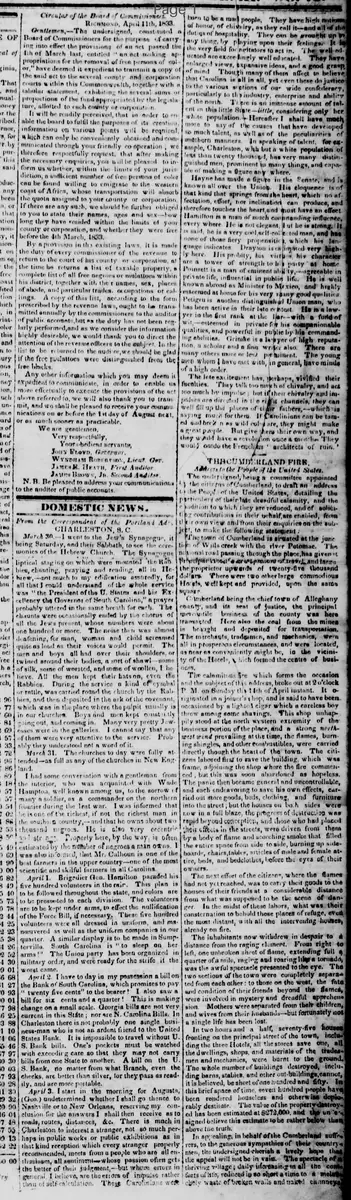
From the Correspondent of the Portland Advertiser.
CHARLESTON, S.C.
March 30. I went to the Jew's Synagogue, it being Saturday, and their Sabbath, to see the ceremonies of the Hebrew Church. The Synagogue elliptical staging on which were mounted the Rabbis, chanting, praying and reading, all in Hebrew,—put much to my edification assuredly, for all that I could understand of the whole service was "the President of the U. States and his Excellency the Governor of South Carolina," a prayer probably offered in the same breath for each. The chaunts were occasionally ended by the chorus of all the Jews present, whose numbers were about one hundred or more. The noise then was almost deafening, for man, woman and child screamed quite as loud as their voices would permit. The men and boys all had over their shoulders, or twined around their bodies, a sort of shawl—some of silk, some of worsted, and some of woollen, I believe. All the men kept their hats on, even the Rabbis. During the service a kind of cymbal or rattle, was carried round the church by the Rabbis, and then deposited in the ark of the covenant, which was in the place where the pulpit usually is in our churches. Boys and men kept constantly going out, and coming in. Many very pretty Jewesses were in the galleries. I cannot say that any of them were very attentive to the service. Probably they understood not a word of it.
March 31. The churches to day were fully attended—as full as any of the churches in New England.
I had some conversation with a gentleman from the interior, who was acquainted with Wade Hampton, well known among us, to the sorrow of many a soldier, as a commander on the northern frontier during the last war. I was informed that he is one of the richest, if not the richest man in the southern country,—and that he owns about two thousand negroes. He is also very eccentric and strange. Property here, by the way, is often estimated by the number of negroes a man owns. I was also informed, that Mr. Calhoun is one of the best farmers in the upper country—one of the most scientific and skilful farmers in all Carolina.
April 1. Brigadier Gen. Hamilton paraded his five hundred volunteers in the rain. This plan is to be followed throughout the state, and colors are to be presented to each division. The volunteers are to be kept under arms, to effect the nullification of the Force Bill, if necessary. These five hundred volunteers were all dressed in uniform, and manoeuvred as well as the uniform companies in our quarter. A similar display is to be made in Sumterville. South Carolina is "to sleep on her arms!" The Union party has been organized in military order, and were ready for the strife if the worst came.
April 2. I have to day in my possession a bill on the Bank of South Carolina, which promises to pay "twenty five cents" to the bearer! I also saw a bill for six cents and a quarter! This is making change on a small scale. Georgia bills are not very current in this State; nor are N. Carolina Bills. In Charleston there is not probably one single business-man who is not an ardent friend to the United States Bank. It is impossible to travel without U. S. Bank bills. One's pockets must be watched with exceeding care so that they may not carry bills from one State to another. A bill on the U. S. Bank, no matter from what Branch, even the checks, are better than silver, for they pass as readily, and are more portable.
April 3. I start in the morning for Augusta, (Geo.) undetermined whether I shall go thence to Nashville or to New Orleans, reserving my conclusion on the answers I shall then receive as to roads, routes, distances, &c. There is much in Charleston to interest a stranger, not so much perhaps in public works or public exhibitions as in that kind reception which every stranger properly recommended, meets from a people who are all enthusiasm, all sentiment—whose passion often gets the better of their judgment,—but whose errors in general I believe, are the errors of impulse rather than of deliberate calculation. These Carolinians were born to be a mad people. They have high notions of honor, of chivalry, as they call it—and all of the duties of hospitality. They can be brought up any thing, by playing upon their feelings. It is the very soil for demagogues to act in. The well-educated are exceedingly well educated. They have enlarged views, expansive ideas, and a good grasp of mind. Though many of them affect to believe that Carolina is all in all, yet even these do justice to the various sections of our wide confederacy, particularly to the industry, enterprise and ability of the north. There is an immense amount of intelligence in this little State—little, considering only her white population. Hereafter I shall have much more to say of the causes that have developed so much talent, as well as of the peculiarities of southern manners. In speaking of talent, for example, Charleston, with but a white population of less than twenty thousand, has very many distinguished men, prominent in many things, and capable of making a figure any where.
Hayne has made a figure in the Senate, and is known all over the Union. His eloquence is of that kind that springs from the heart, which no affectation, effort, nor inclination can produce, and therefore touches the heart, and must have an effect.
Hamilton is a man of much commanding influence, every where. He is not elegant, but he is strong. It is said, he is a very cool, self-collected man, and has none of those fiery propensities, which his language indicates. Drayton is estimated very highly here. His probity, his virtues, his character are a tower of strength to his party at home.
Poinsett is a man of eminent ability,—agreeable in private life, influential in public life. He is well known abroad as Minister to Mexico, and highly esteemed at home for his very many good qualities.
Petigru is another distinguished Union man, who has been active in their late contest. He is a lawyer in the first rank at the bar—with fund of wit,—esteemed in private for his companionable qualities, and powerful in public by his commanding abilities.
Grimke is a lawyer of high reputation, a scholar and a fine writer also. There are many others more or less prominent. The young men whom I have met with, in general, have minds of a high order.
The late excitement has, perhaps, vivified their faculties. They talk too much of chivalry, and act too much by impulse; but if their chivalry and impulses are directed in the right channels, they can well fill up the places of their fathers,—which is saying much for them. If Carolinians can be tamed and broken as wild colts are, they might make a great people. But give them their own way, and they would have a revolution once a month. They would outdo the French as architects of ruin.
What sub-type of article is it?
What keywords are associated?
What entities or persons were involved?
Where did it happen?
Domestic News Details
Primary Location
Charleston, S.C.
Event Date
March 30 To April 3
Key Persons
Event Details
Correspondent describes visiting the Jew's Synagogue on March 30, observing Hebrew service; notes full church attendance on March 31; converses about Wade Hampton's wealth and eccentricity, Calhoun's farming skills; on April 1, observes Brigadier Gen. Hamilton parading 500 volunteers in rain amid nullification preparations; on April 2, comments on small denomination bills and preference for U.S. Bank bills; on April 3, plans travel to Augusta, reflects on Charleston's hospitality, chivalry, demagoguery, intelligence, and profiles notable figures like Hayne, Hamilton, Drayton, Poinsett, Petigru, Grimke.