Thank you for visiting SNEWPapers!
Sign up free
Editorial
February 5, 1936
The Bismarck Tribune
Bismarck, Mandan, Burleigh County, Morton County, North Dakota
What is this article about?
North Dakota editorial encourages farmers and businessmen to secure good seed for spring planting, highlighting cooperative efforts including reduced railroad freight rates, advice from the state agricultural college on varieties and practices, and affordable government-held seed wheat.
Clipping
OCR Quality
98%
Excellent
Full Text
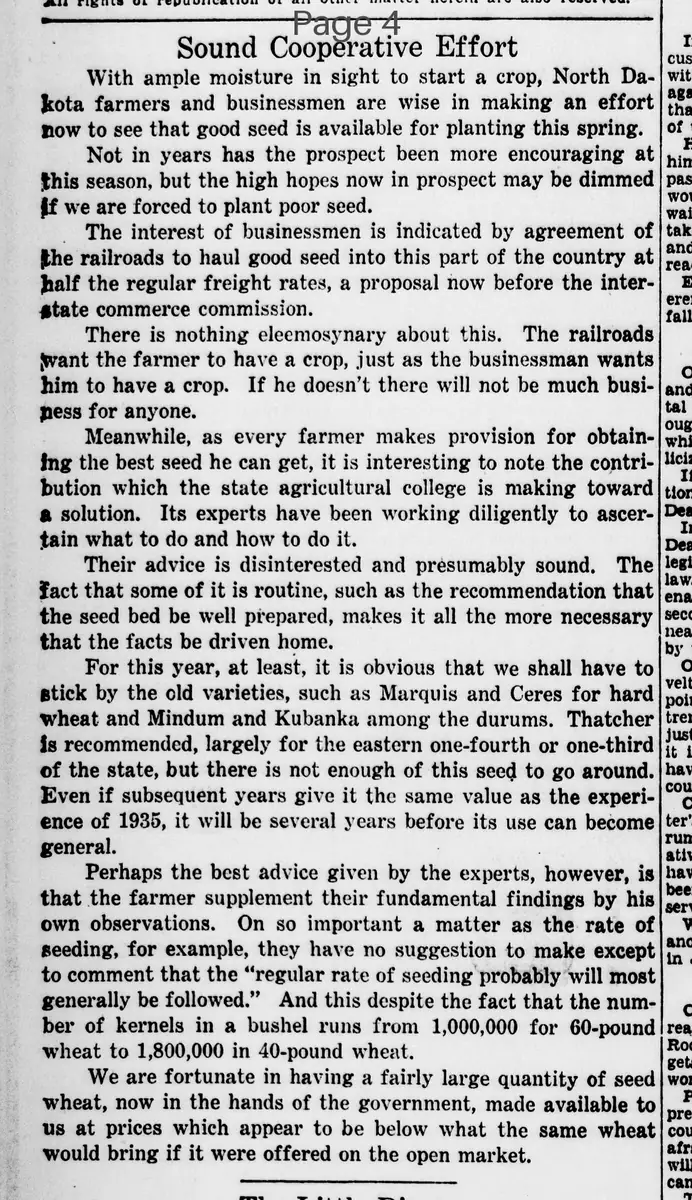
Sound Cooperative Effort
With ample moisture in sight to start a crop, North Dakota farmers and businessmen are wise in making an effort now to see that good seed is available for planting this spring.
Not in years has the prospect been more encouraging at this season, but the high hopes now in prospect may be dimmed if we are forced to plant poor seed.
The interest of businessmen is indicated by agreement of the railroads to haul good seed into this part of the country at half the regular freight rates, a proposal now before the interstate commerce commission.
There is nothing eleemosynary about this. The railroads want the farmer to have a crop, just as the businessman wants him to have a crop. If he doesn't there will not be much business for anyone.
Meanwhile, as every farmer makes provision for obtaining the best seed he can get, it is interesting to note the contribution which the state agricultural college is making toward solution. Its experts have been working diligently to ascertain what to do and how to do it.
Their advice is disinterested and presumably sound. The fact that some of it is routine, such as the recommendation that the seed bed be well prepared, makes it all the more necessary that the facts be driven home.
For this year, at least, it is obvious that we shall have to stick by the old varieties, such as Marquis and Ceres for hard wheat and Mindum and Kubanka among the durums. Thatcher is recommended, largely for the eastern one-fourth or one-third of the state, but there is not enough of this seed to go around.
Even if subsequent years give it the same value as the experience of 1935, it will be several years before its use can become general.
Perhaps the best advice given by the experts, however, is that the farmer supplement their fundamental findings by his own observations. On so important a matter as the rate of seeding, for example, they have no suggestion to make except to comment that the "regular rate of seeding probably will most generally be followed." And this despite the fact that the number of kernels in a bushel runs from 1,000,000 for 60-pound wheat to 1,800,000 in 40-pound wheat.
We are fortunate in having a fairly large quantity of seed wheat, now in the hands of the government, made available to us at prices which appear to be below what the same wheat would bring if it were offered on the open market.
With ample moisture in sight to start a crop, North Dakota farmers and businessmen are wise in making an effort now to see that good seed is available for planting this spring.
Not in years has the prospect been more encouraging at this season, but the high hopes now in prospect may be dimmed if we are forced to plant poor seed.
The interest of businessmen is indicated by agreement of the railroads to haul good seed into this part of the country at half the regular freight rates, a proposal now before the interstate commerce commission.
There is nothing eleemosynary about this. The railroads want the farmer to have a crop, just as the businessman wants him to have a crop. If he doesn't there will not be much business for anyone.
Meanwhile, as every farmer makes provision for obtaining the best seed he can get, it is interesting to note the contribution which the state agricultural college is making toward solution. Its experts have been working diligently to ascertain what to do and how to do it.
Their advice is disinterested and presumably sound. The fact that some of it is routine, such as the recommendation that the seed bed be well prepared, makes it all the more necessary that the facts be driven home.
For this year, at least, it is obvious that we shall have to stick by the old varieties, such as Marquis and Ceres for hard wheat and Mindum and Kubanka among the durums. Thatcher is recommended, largely for the eastern one-fourth or one-third of the state, but there is not enough of this seed to go around.
Even if subsequent years give it the same value as the experience of 1935, it will be several years before its use can become general.
Perhaps the best advice given by the experts, however, is that the farmer supplement their fundamental findings by his own observations. On so important a matter as the rate of seeding, for example, they have no suggestion to make except to comment that the "regular rate of seeding probably will most generally be followed." And this despite the fact that the number of kernels in a bushel runs from 1,000,000 for 60-pound wheat to 1,800,000 in 40-pound wheat.
We are fortunate in having a fairly large quantity of seed wheat, now in the hands of the government, made available to us at prices which appear to be below what the same wheat would bring if it were offered on the open market.
What sub-type of article is it?
Agriculture
Economic Policy
What keywords are associated?
North Dakota Agriculture
Seed Quality
Cooperative Effort
Railroad Freight Rates
Wheat Varieties
Agricultural College Advice
Government Seed Wheat
What entities or persons were involved?
North Dakota Farmers
Businessmen
Railroads
State Agricultural College
Government
Editorial Details
Primary Topic
Cooperative Efforts For Good Seed Availability In North Dakota
Stance / Tone
Supportive And Encouraging Of Cooperative Agricultural Initiatives
Key Figures
North Dakota Farmers
Businessmen
Railroads
State Agricultural College
Government
Key Arguments
Good Seed Is Essential To Capitalize On Promising Crop Prospects
Railroads Agree To Half Freight Rates For Seed To Support Farmers
State Agricultural College Provides Sound Advice On Seed Varieties And Preparation
Stick To Established Wheat Varieties Like Marquis, Ceres, Mindum, Kubanka; Thatcher Limited
Farmers Should Supplement Expert Advice With Personal Observations
Government Seed Wheat Available At Below Market Prices