Thank you for visiting SNEWPapers!
Sign up free
Massachusetts Spy And Worcester Advertiser
Worcester, Worcester County, Massachusetts
What is this article about?
An essay in the Massachusetts Spy urges aspiring lawyers to combine innate genius with rigorous, indefatigable study and professional fidelity, warning against indolence, pleasures, and reliance on ancestry. It draws on classical authors like Horace, Virgil, and Cicero, and legal figures like Coke and Blackstone to emphasize that diligent application leads to eminence in law.
Clipping
OCR Quality
Full Text
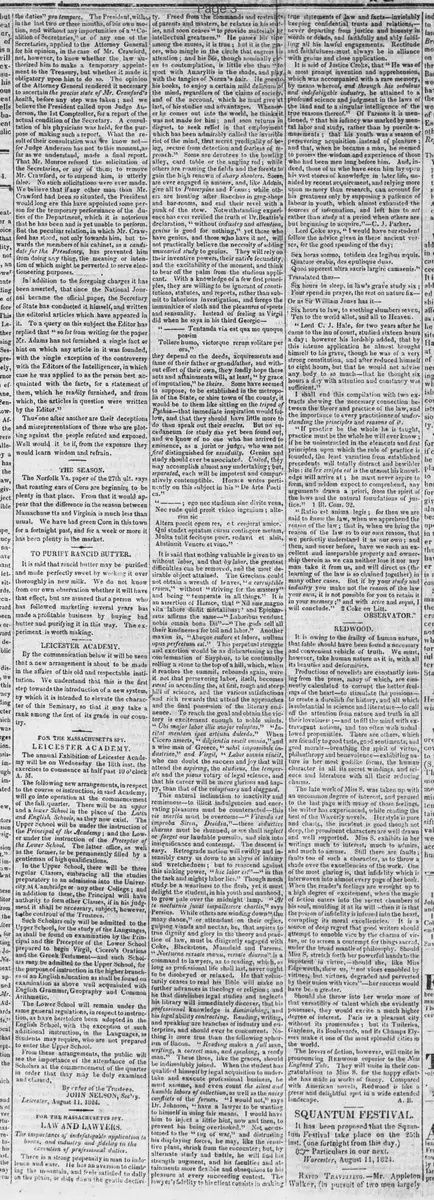
LAW AND LAWYERS.
The importance of indefatigable application to books, and industry and fidelity in the execution of professional duties.
There is a strong propensity in man to indolence and ease. He has an aversion to climbing the mountain, and feels satisfied to dally on the plain, or slide down the gentle declivity. Freed from the commands and restraints of parents and masters, he relaxes in his studies, and soon ceases "to provide materials for intellectual greatness." He passes his time among the muses, it is true; but it is the graces, who mingle in the circle that engross his attention; and his life, though nominally given to contemplation, is little else than to sport with Amaryllis in the shade, and play with the tangles of Neera's hair. He goes to his books, to enjoy a certain mild delirium of the mind, regardless of the claims of society, and of the account, which he must give at last, of his studies and advantages. Whenever he comes out into the world, he thinks it was not made for him; and soon returns in disgust, to seek relief in that employment which has been admirably called the invisible riot of the mind, that secret prodigality of being, secure from detection and fearless of reproach." Some are devotees to the bowling alley, card table or the angling rod; while others are roaming the fields and the forests to gain the high renown of sharp shooters. Some are ever engaged in amours, and, like Adonis, give all to Proserpine and Venus; while others are hunting after Bacchus in grog-shops and bar-rooms, and end their revel with a prank of the stew. Notwithstanding experience has ever verified the truth of Dr. Beattie's declaration, "without industry and attention, genius is good for nothing," yet those who have genius, and those who have it not, will not practically believe the necessity of adding unwearied study to genius. They will rely on their inventive powers, their native fecundity and the excitability of the moment, and think to bear off the palm from the studious applicant. With a knowledge of a few first principles, they are willing to be ignorant of constitutions, statutes, and reports, rather than submit to laborious investigation, and forego the immunities of sloth and the pleasures of sports and sensuality. Instead of feeling as Virgil did when he says in his third Georgic—
"Tentanda via est qua me quoque possim
Tollere humo, victorque rerum volitare per ora,"
they depend on the deeds, acquirements and fame of their father or grandfather, and without effort of their own, they fondly hope these acts and attainments will, at least, "by grace of imputation." be theirs.' Some have seemed to suppose, to be established in the metropolis of the State, or shire town of the county, it would be to them like sitting on the tripod of Pythia—that immediate inspiration would follow, and that they should have little more to do than speak out their oracles. But no succedaneum for study has yet been found out. and we know of no one who has arrived to eminence, as a jurist or judge, who was not first distinguished for assiduity. Genius and study should ever be associated. United, they may accomplish almost any undertaking; but, separated, each will be impotent and comparatively contemptible. Horace writes pertinently on this subject in his "De Arte Poetica."
"—ego nec studium sine divite vena,
Nec rude quid prosit video ingenium; alterius sic
Altera poscit opem res, et conjurat amice:
Qui studet optatam cursu contingere metam,
Multa tulit fecitque puer, sudavit et alsit,
Abstinuit Venere et vino."
It is said that nothing valuable is given to us without labor, and that by labor, the greatest difficulties can be removed, and the most desirable object attained. The Grecians could not obtain a wreath of leaves. ":a corruptible crown," without "striving for the mastery" and being "temperate in all things." It is an assertion of Horace, that "Nil sine magno vita labore dedit mortalibus;' and Epicharmus affirms the same—"Laboribus vendunt nobis omnia bona Dii"—The gods sell all their kindnesses for toil and labor." Another maxim is, "Absque sudore et labore, nullum opus perfectum est." This perpetual struggle and exertion would be as disheartening as the condemnation of Sisyphus, to be continually rolling a stone to the top of a hill, which, when it reaches the summit, rebounds again, were it not that persevering labor, itself, becomes sweet in ascending the, at first, rough and steep hill of science, and the various satisfactions and rich rewards that attend the approaches and the final possession of the literary eminence. To reach the goal and obtain the victory is excitement enough to noble minds. "Ubi major labor illic major voluptas." "Incitat mentem ipsa artium dulcedo." When Cicero asserts, "diligentia vincit omnia," and a wise man of Greece," nihil impossibile industriae," and Virgil, "Labor omnia vincit. who can doubt the success and joy that will attend the aspiring, the studious, the temperate and the pious votary of legal science, and that his career will be more glorious and happy, than that of the voluptuary and sluggard. This natural inclination to inactivity and remissness—to illicit indulgencies and enervating pleasures must be counteracted—this vis inertiæ must be overcome—"Vitanda est improba Siren, Desidia," these seductive charms must be shunned, or we shall neglect or forget our laudable pursuits, and sink into insignificance and contempt. The descent is easy. Retrograde motion will swiftly and insensibly carry us down to an abyss of infamy and wretchedness; but to reascend against this sinking power, "hic labor est"—"in this the task and mighty labor lies." Though much study be a weariness to the flesh, yet it must delight the student, in his youth and manhood. to grow pale over the midnight lamp. "Ai te nocturnis juvat impallescere chartis," says Persius. While others are winding down "the mazy dance," or attendant on their orgies, gulping viands and nectar, he, that aspires to true dignity and glory in the theory and practice of law, must be diligently engaged with Coke, Blackstone, Mansfield and Parsons. "Nocturna versate manu, versate diurna" is a command to lawyers, as to reading, which, as long as professional life shall last, never ought to be disobeyed or relaxed. He that voluntarily ceases to read his Bible will make no further advances in theology or religion; and he that disrelishes legal studies and neglects his library will immediately discover, that his professional knowledge is diminishing, and his legal ability contracting. Reading, writing, and speaking are branches of industry and enterprise, and should ever be concurrent. Nothing is more true than the following aphorism of Bacon. "Reading makes a full man, writing, a correct man, and speaking, a ready man." These three, like the graces, should be indissolubly joined. When the student has qualified himself by legal acquisition to undertake and execute professional business, he must assume, and even court the silent and humble labors of collection, as well as the noisy conflicts of the forum. "I would not," says Dr. Johnson, "have a lawyer to be wanting to himself in using fair means. I would have him to inject a little hint, now and then, to prevent his being overlooked." Not accustomed to the "tug of war," and distrusting his displaying forces, he may, like the sensitive plant, shrink from the encounter; but, by alternate study and battle. he will find his strength augment, and his faculties and attainments more flexible and obsequious to his pleasure at every succeeding contest. The lawyer's fidelity to his client consists in making true statements of law and facts—invioably keeping confidential trusts and relations, never departing from justice and honesty in words or deeds, and faithfully and ably fulfilling all his lawful engagements. Rectitude and faithfulness must always be in alliance with genius and close application. It is said of Justice Croke. that "He was of a most prompt invention and apprehension, which was accompanied with a rare memory, by means whereof, and through his sedulous and indefatigable industry, he attained to a profound science and judgment in the laws of the land and to a singular intelligence of the true reasons thereof." Of Parsons it is mentioned, "that his infancy was marked by mental labor and study, rather than by puerile amusements ; that his youth was a season of persevering acquisition instead of pleasure; and that, when he became a man, he seemed to possess the wisdom and experience of those who had been men long before him. And, indeed, those of us who have seen him lay open his vast stores of knowledge in later life, unaided by recent acquirement, and relying more upon memory than research, can account for his greatness only by supposing a patience of labour in youth, which almost exhausted the sources of information, and left him to act rather than study at a period when others are but beginning to acquire." -C. J. Parker.
Lord Coke says, "I would have our student follow the advice given in these ancient verses, for the good spending of the day;
Sex horas somno, totidem des legibus æquis.
Quatuor orabis, des epulisque duas.
Quod superest ultra sacris largire camænis."
Translated thus—
Six hours in sleep, in law's grave study six ;
Four spend in prayer, the rest on nature fix—
Or as Sir William Jones has it—
Six hours to law, to soothing slumbers seven.
Ten to the world allot, and all to Heaven.
"Lord C. J. Hale, for two years after he came to the inn of court, studied sixteen hours a day: however his lordship added, that by this intense application he almost brought himself to his grave, though he was of a very strong constitution, and after reduced himself to eight hours, but that he would not advise any body to so much—that he thought six hours a day with attention and constancy was sufficient."
I shall end this compilation with two extracts shewing the necessary connection between the theory and practice of the law, and the importance to every practitioner of understanding the principles and reasons of it.
"If practice be the whole he is taught, practice must be the whole he will ever know ; if he be uninstructed in the elements and first principles upon which the rule of practice is founded, the least variation from established precedents will totally distract and bewilder him: ila lex scripta est is the utmost his knowledge will arrive at; he must never aspire to form, and seldom expect to comprehend, any arguments drawn a priori, from the spirit of the laws and the natural foundations of justice." 1 Bl. Com. 32.
"Ratio est anima legis : for then we are said to know the law, when we apprehend the reason of the law; that is, when we bring the reason of the law so to our own reason, that we perfectly understand it as our own; and then, and never before, have we such an excellent and inseparable property and ownership therein as we can neither lose it nor any man take it from us, and will direct us (the learning of the law is so chained together) in many other cases. But if by your study and industry you make not the reason of the law your own, it is not possible for you to retain it in your memory;" and with scire et sequi, I will conclude." Coke on Litt.
OBSERVATOR.
What sub-type of article is it?
What themes does it cover?
What keywords are associated?
What entities or persons were involved?
Letter to Editor Details
Author
Observator.
Recipient
Massachusetts Spy
Main Argument
lawyers must pair genius with indefatigable study, industry, and fidelity to professional duties to achieve eminence, as indolence and reliance on unearned advantages lead to failure; classical and legal authorities underscore that diligent application overcomes all obstacles in legal science.
Notable Details