Thank you for visiting SNEWPapers!
Sign up free
The New Hampshire Gazette
Portsmouth, Rockingham County, New Hampshire
What is this article about?
Report by U.S. Secretary of State Timothy Pickering to Congress on February 27, 1797, detailing American citizens' claims against France for spoliations, captures by French vessels, embargoes, and non-payments since 1793, amid ongoing diplomatic efforts and unstable French decrees violating treaties.
Clipping
OCR Quality
Full Text
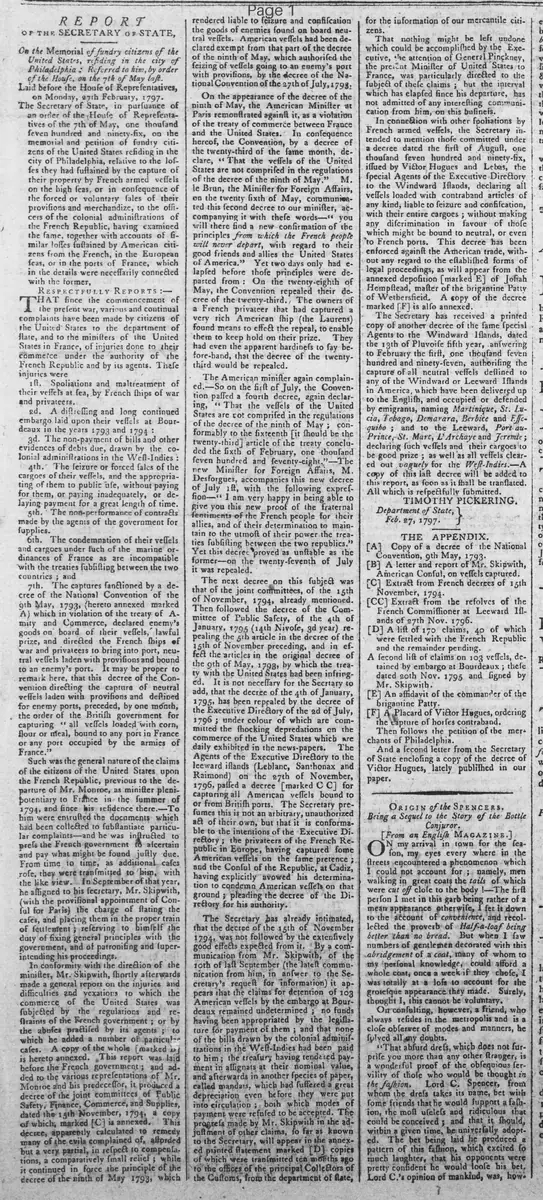
OF THE SECRETARY OF STATE.
On the Memorial of sundry citizens of the United States, residing in the city of Philadelphia: Referred to him, by order of the House, on the 7th of May last.
Laid before the House of Representatives, on Monday, 27th February, 1797.
The Secretary of State, in pursuance of an order of the House of Representatives of the 7th of May, one thousand seven hundred and ninety-six, on the memorial and petition of sundry citizens of the United States residing in the city of Philadelphia, relative to the losses they had sustained by the capture of their property by French armed vessels on the high seas, or in consequence of the forced or voluntary sales of their provisions and merchandize, to the officers of the colonial administrations of the French Republic, having examined the same, together with accounts of similar losses sustained by American citizens from the French, in the European seas, or in the ports of France, which in the details were necessarily connected with the former,
Respectfully Reports:
THAT since the commencement of the present war, various and continual complaints have been made by citizens of the United States to the department of state, and to the ministers of the United States in France, of injuries done to their commerce under the authority of the French Republic and by its agents. These injuries were
1st. Spoliations and maltreatment of their vessels at sea, by French ships of war and privateers.
2d. A distressing and long continued embargo laid upon their vessels at Bordeaux in the years 1793 and 1794:
3d. The non-payment of bills and other evidences of debts due, drawn by the colonial administrations in the West-Indies:
4th. The seizure or forced sales of the cargoes of their vessels, and the appropriating of them to public use, without paying for them, or paying inadequately, or delaying payment for a great length of time.
5th. The non-performance of contracts made by the agents of the government for supplies.
6th. The condemnation of their vessels and cargoes under such of the marine ordinances of France as are incompatible with the treaties subsisting between the two countries; and
7th. The captures sanctioned by a decree of the National Convention of the 9th May, 1793, (hereto annexed marked A) which in violation of the treaty of Amity and Commerce, declared enemy's goods on board of their vessels, lawful prize, and directed the French ships of war and privateers to bring into port, neutral vessels laden with provisions and bound to an enemy's port. It may be proper to remark here, that this decree of the Convention directing the capture of neutral vessels laden with provisions and destined for enemy ports, preceded, by one month, the order of the British government for capturing "all vessels loaded with corn, flour or meal, bound to any port in France or any port occupied by the armies of France."
Such was the general nature of the claims of the citizens of the United States upon the French Republic, previous to the departure of Mr. Monroe, as minister plenipotentiary to France in the summer of 1794, and since his residence there. To him were entrusted the documents which had been collected to substantiate particular complaints—and he was instructed to press the French government to ascertain and pay what might be found justly due. From time to time, as additional cases arose, they were transmitted to him, with the like view. In September of that year, he assigned to his secretary, Mr. Skipwith, (with the provisional appointment of Consul for Paris) the charge of stating the cases, and placing them in the proper train of settlement; reserving to himself the duty of fixing general principles with the government, and of patronizing and superintending his proceedings.
In conformity with the direction of the minister, Mr. Skipwith, shortly afterwards made a general report on the injuries and difficulties and vexations to which the commerce of the United States was subjected by the regulations and restraints of the French government; or by the abuses practiced by its agents; to which he added a number of particular cases. A copy of the whole marked B is hereto annexed. This report was laid before the French government; and added to the various representations of Mr. Monroe and his predecessor, it produced a decree of the joint committees of Public Safety, Finance, Commerce, and Supplies, dated the 15th November, 1794, a copy of which, marked [C] is annexed. This decree, apparently calculated to remedy many of the evils complained of, afforded but a very partial, in respect to compensations, a comparatively small relief; while it continued in force the principle of the decree of the ninth of May 1793, which rendered liable to seizure and confiscation the goods of enemies found on board neutral vessels. American vessels had been declared exempt from that part of the decree of the ninth of May, which authorized the seizing of vessels going to an enemy's port with provisions, by the decree of the National Convention of the 27th of July, 1793.
On the appearance of the decree of the ninth of May, the American Minister at Paris remonstrated against it, as a violation of the treaty of commerce between France and the United States. In consequence hereof, the Convention, by a decree of the twenty-third of the same month, declared, "That the vessels of the United States are not comprised in the regulations of the decree of the ninth of May." M. le Brun, the Minister for Foreign Affairs, on the twenty sixth of May, communicated this second decree to our minister, accompanying it with these words—“you will there find a new confirmation of the principles from which the French people will never depart, with regard to their good friends and allies the United States of America." Yet two days only had elapsed before those principles were departed from: On the twenty-eighth of May, the Convention repealed their decree of the twenty-third. The owners of a French privateer that had captured a very rich American ship (the Laurens) found means to effect the repeal, to enable them to keep hold on their prize. They had even the apparent hardiness to say before-hand, that the decree of the twenty-third would be repealed.
The American minister again complained. So on the first of July, the Convention passed a fourth decree, again declaring, "That the vessels of the United States are not comprised in the regulations of the decree of the ninth of May; conformably to the sixteenth [it should be the twenty-third] article of the treaty concluded the sixth of February, one thousand seven hundred and seventy-eight." The new Minister for Foreign Affairs, M. Deforgues, accompanies this new decree of July 1st, with the following expression —"I am very happy in being able to give you this new proof of the fraternal sentiments of the French people for their allies, and of their determination to maintain to the utmost of their power the treaties subsisting between the two republics."
Yet this decree proved as unstable as the former—on the twenty-seventh of July it was repealed.
The next decree on this subject was that of the joint committees, of the 15th of November, 1794, already mentioned.
Then followed the decree of the Committee of Public Safety, of the 4th of January, 1795 (14th Nivose, 3d year) repealing the 8th article in the decree of the 15th of November preceding, and in effect the articles in the original decree of the 9th of May, 1793, by which the treaty with the United States had been infringed. It is not necessary for the Secretary to add, that the decree of the 4th of January, 1795, has been repealed by the decree of the Executive Directory of the 2d of July, 1796; under colour of which are committed the shocking depredations on the commerce of the United States which are daily exhibited in the news-papers. The Agents of the Executive Directory to the leeward islands (Leblanc, Santhonax and Raimond) on the 27th of November, 1796, passed a decree marked [CC] for capturing all American vessels bound to or from British ports. The Secretary presumes this is not an arbitrary, unauthorized act of their own, but that it is conformable to the intentions of the Executive Directory: the privateers of the French Republic in Europe, having captured some American vessels on the same pretence; and the Consul of the Republic, at Cadiz, having explicitly avowed his determination to condemn American vessels on that ground; pleading the decree of the Directory for his authority.
The Secretary has already intimated that the decree of the 15th of November 1794, was not followed by the extensively good effects expected from it. By a communication from Mr. Skipwith, of the 10th of last September (the latest communication from him, in answer to the Secretary's request for information) it appears that the claims for detention of 103 American vessels by the embargo at Bordeaux remained undetermined; no funds having been appropriated by the legislature for payment of them; and that none of the bills drawn by the colonial administrations in the West-Indies had been paid to him; the treasury having tendered payment in assignats at their nominal value, and afterwards in another species of paper, called mandats, which had suffered a great depreciation even before they were put into circulation; both which modes of payment were refused to be accepted. The progress made by Mr. Skipwith in the adjustment of other claims, so far as known to the Secretary, will appear in the annexed printed statement marked [D] copies of which were transmitted ten months ago to the offices of the principal Collectors of the Customs, from the department of state, for the information of our mercantile citizens.
That nothing might be left undone which could be accomplished by the Executive, the attention of General Pinckney, the present Minister of United States to France, was particularly directed to the subject of these claims: but the interval which has elapsed since his departure, has not admitted of any interesting communication from him, on this business.
In connection with other spoliations by French armed vessels, the Secretary intended to mention those committed under a decree dated the first of August, one thousand seven hundred and ninety-six, issued by Victor Hugues and Lebas, the special Agents of the Executive Directory to the Windward Islands, declaring all vessels loaded with contraband articles of any kind, liable to seizure and confiscation, with their entire cargoes; without making any discrimination in favour of those which might be bound to neutral, or even to French ports. This decree has been enforced against the American trade, without any regard to the established forms of legal proceedings, as will appear from the annexed deposition marked [E] of Josiah Hempstead, master of the brigantine Patty of Wethersfield. A copy of the decree marked [F] is also annexed.
The Secretary has received a printed copy of another decree of the same special Agents to the Windward Islands, dated the 13th of Pluviose fifth year, answering to February the first, one thousand seven hundred and ninety-seven, authorizing the capture of all neutral vessels destined to any of the Windward or Leeward Islands in America, which have been delivered up to the English, and occupied or defended by emigrants, naming Martinique, St. Lucia, Tobago, Demarara, Berbice and Essequibo; and to the Leeward, Port-au-Prince, St. Mart, L'Archaye and Jeremie; declaring such vessels and their cargoes to be good prize; as well as all vessels cleared out vaguely for the West-Indies. A copy of this last decree will be added to this report, as soon as it shall be translated.
All which is respectfully submitted.
TIMOTHY PICKERING
Department of State,
Feb. 27, 1797.
THE APPENDIX.
[A] Copy of a decree of the National Convention, 9th May, 1793
[B] A letter and report of Mr. Skipwith, American Consul, on vessels captured,
[C] Extract from French decrees of 15th November, 1794.
[CC] Extract from the resolves of the French Commissioner at Leeward Islands of 27th Nov. 1796.
[D] A list of 170 claims, 40 of which were settled with the French Republic and the remainder pending.
A second list of claims on 103 vessels, detained by embargo at Bordeaux; these dated 20th Nov. 1795 and signed by Mr. Skipwith.
[E] An affidavit of the commander of the brigantine Patty.
[F] A Placard of Victor Hugues, ordering the capture of horses contraband.
Then follows the petition of the merchants of Philadelphia.
And a second letter from the Secretary of State enclosing a copy of the decree of Victor Hugues, lately published in our paper.
What sub-type of article is it?
What keywords are associated?
What entities or persons were involved?
Where did it happen?
Foreign News Details
Primary Location
France
Event Date
Since The Commencement Of The Present War (1793) To February 1797
Key Persons
Outcome
claims pending for 170 cases (40 settled); 103 vessels detained at bordeaux undetermined; non-payment of west indies bills; ongoing captures under french decrees; diplomatic efforts yielded partial relief but unstable decrees led to continued depredations.
Event Details
U.S. Secretary of State reports on American citizens' losses from French spoliations including vessel captures by warships and privateers, embargo at Bordeaux (1793-1794), non-payment of debts, forced sales of cargoes, contract non-performance, condemnations under incompatible ordinances, and captures under May 9, 1793 decree violating 1778 treaty. Details diplomatic remonstrations, unstable French decrees (exemptions repealed repeatedly), efforts by U.S. ministers Monroe, Skipwith, and Pinckney; recent decrees by agents in West Indies authorizing captures of neutral vessels.