Thank you for visiting SNEWPapers!
Sign up free
Gazette Of The United States
New York, New York County, New York
What is this article about?
An anonymous letter signed 'SCOURGE' criticizes Aristides for ineptly defending Thomas Jefferson against charges of opposing the U.S. Constitution and establishing the National Gazette to attack Alexander Hamilton's policies, accusing Jefferson of promoting schism and ambition-driven discord.
Merged-components note: This is a single continuous letter to the editor addressed to Aristides, signed SCOURGE; the second component is the direct continuation of the first, as indicated by the abrupt ending of the first and sequential reading order across pages.
Clippings
1 of 2
OCR Quality
Full Text
TO ARISTIDES.
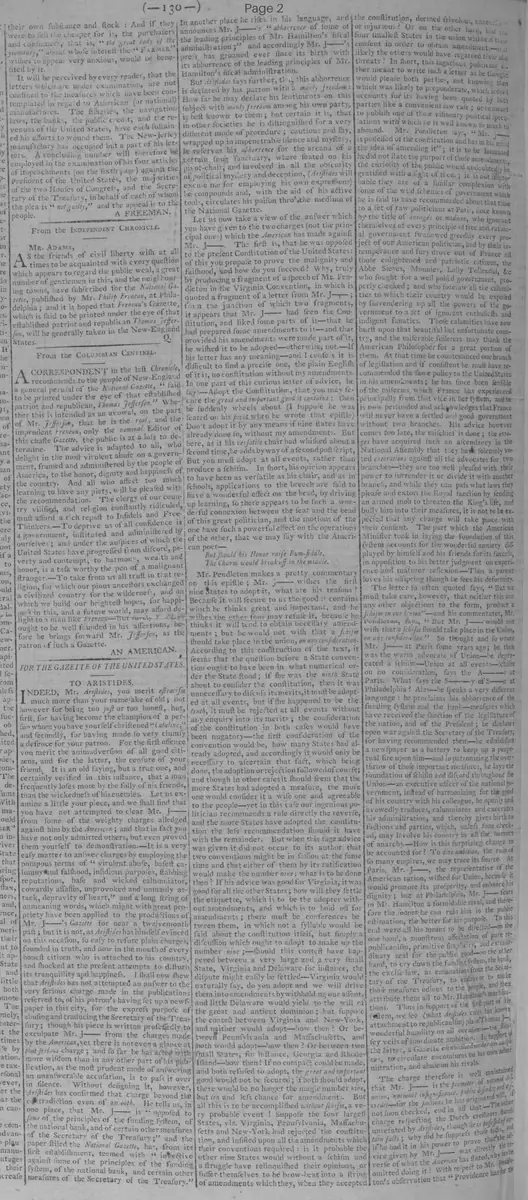
INDEED, Mr. Aristides, you merit ostracism much more than your name sake of old; not however for being too just or too honest, but, first, for having become the champion of a person whom you have yourself christened "Cataline;" and secondly, for having made so very clumsy a defence for your patron. For the first offence you merit the animadversion of all good citizens, and for the latter, the censure of your friend. It is an old saying, but a true one, and certainly verified in this instance, that a man frequently loses more by the folly of his friends, than the wickedness of his enemies. Let us examine a little your piece, and we shall find that you have not attempted to clear Mr. J- from some of the weighty charges alledged against him by the American; and that in fact you have not only admitted others, but even proved them yourself to demonstration. It is a very easy matter to answer charges by employing the pompous terms of "virulent abuse, base calumny and falsehood, insidious purposes, stabbing reputations, base and wicked calumniator, cowardly assassin, unprovoked and unmanly attack, depravity of heart," and a long string of unmeaning words, which might with great propriety have been applied to the productions of Mr. J--'s Gazette for near a twelvemonth past; but it is not, as Aristides has himself evinced on this occasion, so easy to refute plain charges, founded in truth, and now in the mouth of every honest citizen who is attached to his country, and shocked at the present attempts to disturb its tranquillity and happiness. I shall now show that Aristides has not attempted an answer to the very serious charge made in the publications referred to, of his patron's having set up a news-paper in this city, for the express purpose of abusing and traducing the Secretary of the Treasury; though his piece is written professedly to exculpate Mr. J- from the charges made by the American, yet there is not even a glance at that serious charge; and so far he has acted with more wisdom than in any other part of his publication, as the most prudent mode of answering an unanswerable accusation, is to pass it over in silence. Without deigning it, however, Aristides has confirmed that charge beyond the contradiction even of an oath. He tells us, in one place, that Mr. J- is "opposed to some of the principles of the funding system, of the national bank, and of certain other measures of the Secretary of the Treasury;" and that the paper titled the National Gazette, has, from its first establishment, teemed with "invectives against some of the principles of the funding system, of the national bank, and certain other measures of the Secretary of the Treasury."
In another place he rises in his language, and announces Mr. J's "abhorrence of some of the leading principles of Mr. Hamilton's fiscal administration;" and accordingly Mr. J--'s press has groaned ever since its birth with its abhorrence of the leading principles of Mr. Hamilton's fiscal administration. But Aristides says further, that this abhorrence is declared by his patron with a manly freedom: How far he may declare his sentiments on this subject with manly freedom among his own party, is best known to them; but certain it is, that in other societies he is distinguished for a very different mode of procedure; cautious and shy, wrapped up in impenetrable silence and mystery, he reserves his abhorrence for the arcana of a certain snug sanctuary, where seated on his pivot-chair, and involved in all the obscurity of political mystery and deception, (Aristides will excuse me for employing his own expressions) he compounds and, with the aid of his active tools, circulates his poison thro' the medium of the National Gazette.
Let us now take a view of the answer which you have given to the two charges (not the principal one) which the American has made against Mr. J-. The first is, that he was opposed to the present Constitution of the United States: of this you propose to prove the malignity and falsehood, and how do you succeed? Why, truly by producing a fragment of a speech of Mr. Pendleton in the Virginia Convention, in which is quoted a fragment of a letter from Mr. J-; from the junction of which two fragments, it appears that Mr. J-- had seen the Constitution, and liked some parts of it—that he had prepared some amendments to it—and that provided his amendments were made part of it, he wished it to be adopted—otherwise, not. If his letter has any meaning—and I confess it is difficult to find a precise one, the plain English of it is, no constitution without my amendments. In one part of this curious letter of advice, he says—Adopt the Constitution, that you may secure the great and important good it contains; then he suddenly wheels about (I suppose he was seated on his pivot when he wrote that epistle) "Don't adopt it by any means if nine states have already done so, without my amendment." But here, as if his ever facile chair had whisked about a second time, he adds by way of a second postscript, "But you must adopt at all events, rather than produce a schism." In short, his opinion appears to have been as versatile as his chair, and as in schools, applications to the breech are said to have a wonderful effect on the head, by driving up learning, so there appears to be such a wonderful connexion between the seat and the head of this great politician, and the motions of the one have such a powerful effect on the operations of the other, that we may say with the American poet—
But should his Honor raise Bum-fiddle,
The Charm would break off in the middle.
Mr. Pendleton makes a pretty commentary on this epistle; Mr. J-- wishes the first nine States to adopt it, what are his reasons? Because it will secure to us the good it contains which he thinks great and important, and he wishes the other four may refuse it, because he thinks it will tend to obtain necessary amendments; but he would not wish that a schism should take place in the union, on any consideration. According to this construction of the text, it seems that the question before a State convention ought to have been in what numerical order the State stood; if she was the ninth State about to consider the constitution, then it was unnecessary to discuss its merits, it must be adopted at all events, but if she happened to be the tenth, it must be rejected at all events without any enquiry into its merits; the consideration of the constitution in both cases would have been nugatory—the first consideration of the convention would be, how many States had already adopted, and accordingly it would only be necessary to ascertain that fact, which being done, the adoption or rejection followed of course; and though in other cases it should seem that the more States had adopted a measure, the more one would consider it a wise one and agreeable to the people—yet in this case our ingenious politician recommends a rule directly the reverse, and the more States have adopted the constitution the less recommendation should it have with the remainder. But when this sage advice was given it did not occur to its author that two conventions might be in session at the same time and that either of them by its ratification would make the number nine: what is to be done then? If his advice was good for Virginia, it was good for all the other States; how will they settle the etiquette, which is to be the adopter without amendments, and which is to hold off for amendments; there must be conferences between them, in which not a syllable would be said about the constitution itself, but simply a discussion which ought to adopt to make up the number nine;—should this contest have happened between a very large and a very small State, Virginia and Delaware for instance, the dispute might easily be settled—Virginia would naturally say, do you adopt and we will drive them into amendments by withholding our assent. and little Delaware would yield to the will of the great and ancient dominion; but suppose the contest between Virginia and New-York, and neither would adopt—how then? Or between Pennsylvania and Massachusetts, and both would adopt—how then? Or between two small States, for instance, Georgia and Rhode Island—how then? If no compact could be made and both refused to adopt, the great and important good would not be secured; if both should adopt there would be no longer the magic number nine but ten and less chance of amendment. But all this is to be accomplished without schism, a very probable event! Suppose the four largest States, viz. Virginia, Pennsylvania, Massachusetts and New-York had rejected the constitution, and insisted upon all the amendments which their conventions required: is it probable that the other nine States would without a schism and a struggle have relinquished their opinions, to suffer themselves to be brow-beat into a trim of amendments which they, when they accepted the constitution, deemed frivolous, unnecessary or injurious? Or on the other hand, had the four smallest States in the union withheld their consent in order to obtain amendment.—is it likely the others would have regarded their rude threats? In short, this sagacious politician either meant to write such a letter as he thought would please both parties, not knowing then which was likely to preponderate, which indeed accounts for its having been quoted by both parties like a convenient law case; or he meant to publish one of those visionary political speculations with which he is well known so much to abound. Mr. Pendleton says, "Mr. J is possessed of the constitution and has in his mind the idea of amending it"; it is to be lamented he did not state the purport of those amendments, the curiosity of the public would undoubtedly be gratified with a sight of them; it is not improbable they are of a similar complexion with some of the wild schemes of government which he is said to have recommended about that time to a set of raw politicians at Paris, since known by the title of brigands or madmen, who ignorant themselves of every principle of free and rational government swallowed greedily every project of our American politician, and by their intemperance and fury drove out of France all those enlightened and patriotic citizens, the Abbe Sieyes, Mounier, Lally Tollendal, &c. who fought for a well poised government, properly checked; and who foresaw all the calamities to which their country would be exposed by surrendering up all the powers of the government to a set of ignorant enthusiasts and indigent fanatics. Those calamities have now burst upon that beautiful but unfortunate country, and the miserable sufferers may thank the American Philosopher for a great portion of them. At that time he countenanced one branch of legislation and if consistent he must have recommended the same policy to the United States in his amendments; he has since been sensible of the miseries which France has experienced principally from that vice in her system, and he is now persuaded and acknowledges that France will never have a settled and good government without two branches. His advice however comes too late, the mischief is done; the brigands have acquired such an ascendancy in the National Assembly that they have solemnly voted execrations against all the advocates for two branches—they are too well pleased with their power to surrender it or divide it with another branch, and while they can pass what laws they please and extort the Royal sanction by sending an armed mob to threaten the King's life, and bully him into their measures, it is not to be expected that any change will take place without their consent. The part which the American Minister took in laying the foundation of this system accounts for the wonderful anxiety displayed by himself and his friends for its success. in opposition to his better judgment on experience and maturer reflection.—Thus a parent loves his offspring though he sees his deformity. The letter so often quoted says, "But we must take care, however, that neither this nor any other objections to the form, produce a schism in our Union"—and his commentator, Mr. Pendleton, says, "But Mr. J would not wish that a schism should take place in the Union, on any consideration." So thought and so wrote Mr. J--at Paris some years ago; he then was the warm advocate of Union—he deprecated a schism—Union at all events—schism on no consideration. says the J-- at Paris. What says the S-y of S-e at Philadelphia? Alas—he speaks a very different language: he proclaims his abhorrence of the funding system and the bank—measures which have received the sanction of the legislature of the nation, and of the President: he declares open war against the Secretary of the Treasury, for having recommended them—he establishes a newspaper as a battery to keep up a perpetual fire upon him—and in patronizing the overthrow of those important measures, he lays the foundation of schism and discord throughout the Union—an executive officer of the national government, instead of harmonizing for the good of his country with his colleague, he openly and avowedly traduces, calumniates and execrates his administration, and thereby gives birth to factions and parties, which, unless soon checked, may involve his country in all the horrors of anarchy.—How is this surprising change to be accounted for? To dire ambition, the ruin of so many empires, we may trace its source. At Paris, Mr. J-, the representative of the American nation, wished for Union, because it would promote its prosperity, and enhance his dignity; but at Philadelphia, Mr. J fears in Mr. Hamilton a formidable rival, and therefore the sooner he can ruin him in the public estimation, the better for his purpose. To this end were all his means to be directed—on the one hand, a monstrous affectation of pure republicanism, primitive simplicity, and extraordinary zeal for the public good—on the other hand, to cry down the funding system, the bank, the excise law, as emanations from the Secretary of the Treasury, to endeavor to make those measures odious to the people, and then attribute them all to Mr. Hamilton's machinations. Thus in support of the first part of his character (what Aristides calls his known and wonderful humility on all occasions—the flimsy veils of inordinate ambition. In support of the latter, a Gazette established under his auspices, to circulate encomiums on his own administration, and abuse on his rivals. But that Mr. J- is the promoter of national discord and division, public disorder and distress, national insignificance, and discreditor the alone he has originated will, if not soon checked, end in all that.—The other charge respecting the Dutch creditors stands unrefuted by Aristides, though he is possessed of circumstances which if he had it in his power to prove that the advice given by Mr. J- was directly the reverse of Pendleton's observation that "Providence has or te omitted doing it? With respect to Mr. Pendleton's observation that "the American has stated why
The good of mankind accompanied Mr. J's abilities with a disposition to make them of use for the good of his fellow citizens. It is to be lamented that he is so much altered now; so certainly the use to which he now applies his abilities, particularly his talent for intrigue and party-work, evince a disposition hostile to the good of his fellow citizens, and destructive of their future welfare. As to his being what Aristides calls him an old meritorious public servant, it is supposed his eminent services in Virginia, at the time of Tarleton's invasion, are alluded to; and as to the crime of An American, in attacking Mr. J--- during his absence, this would not have happened had he been attending his duty where he ought to be.
SCOURGE.
What sub-type of article is it?
What themes does it cover?
What keywords are associated?
What entities or persons were involved?
Letter to Editor Details
Author
Scourge.
Recipient
Aristides.
Main Argument
aristides fails to adequately defend mr. j- against charges of establishing the national gazette to attack hamilton and opposing the constitution without amendments, thereby confirming jefferson's role in promoting schism through ambition and factionalism.
Notable Details