Thank you for visiting SNEWPapers!
Sign up free
Virginia Argus
Richmond, Virginia
What is this article about?
On May 16, 1811, the US frigate President under Commodore Rogers engaged the British sloop Little Belt under Capt. Bingham off Cape Henry, Virginia, after a mistaken identity led to firing. The Little Belt suffered 30 casualties and heavy damage; President had one minor injury. No broader conflict ensued.
Clipping
OCR Quality
Full Text
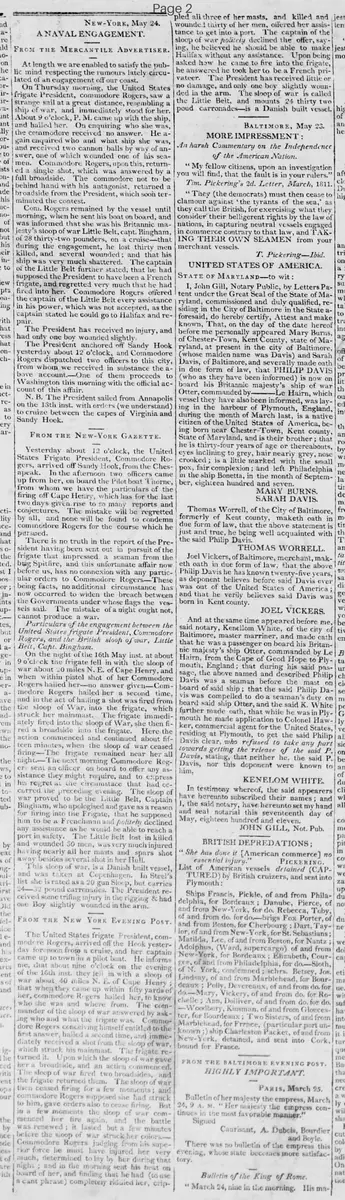
A NAVAL ENGAGEMENT.
FROM THE MERCANTILE ADVERTISER.
At length we are enabled to satisfy the public mind respecting the rumours lately circulated of an engagement off our coast.
On Thursday morning, the United States frigate President, commodore Rogers, saw a strange sail at a great distance, resembling a ship of war, and immediately stood for her. About 9 o'clock, P. M. came up with the ship, and hailed her. On enquiring who she was, the commodore received no answer. He again enquired who and what ship she was, and received two cannon balls by way of answer, one of which wounded one of his seamen. Commodore Rogers, upon this, returned a single shot, which was answered by a full broadside. The commodore not to be behind hand with his antagonist, returned a broadside from the President, which soon terminated the contest.
Com. Rogers remained by the vessel until morning, when he sent his boat on board, and was informed that she was his Britannic majesty's sloop of war Little Belt, capt. Bingham, of 28 thirty-two pounders, on a cruise—that during the engagement, he lost thirty men killed, and several wounded: and that his ship was very much shattered. The captain of the Little Belt further stated, that he had supposed the President to have been a French frigate, and regretted very much that he had fired into her. Commodore Rogers offered the captain of the Little Belt every assistance in his power, which was not accepted, as the captain stated he could go to Halifax and repair.
The President has received no injury, and had only one boy wounded slightly.
The President anchored off Sandy Hook yesterday about 12 o'clock, and Commodore Rogers dispatched two officers to this city, from whom we received in substance the above account.—One of them proceeds to Washington this morning with the official account of this affair.
N. B. The President sailed from Annapolis on the 13th inst. with orders (we understand) to cruize between the capes of Virginia and Sandy Hook.
From the New-York Gazette.
Yesterday about 12 o'clock, the United States Frigate President, Commodore Rogers, arrived off Sandy Hook, from the Chesapeake. In the afternoon two officers came up from her, on board the Pilot boat Thorne, from whom we have the particulars of the firing off Cape Henry, which has for the last two days given rise to so many reports and conjectures. The mistake will be regretted by all, and none will be found to condemn commodore Rogers for the course which he pursued.
There is no truth in the report of the President having been sent out in pursuit of the frigate that impressed a seaman from the brig Spitfire, and this unfortunate affair now before us, has no connexion with any particular orders to Commodore Rogers—These being facts, no additional circumstance has now occurred to widen the breach between the Governments under whose flags the vessels sail. The mistake of a night ought not, cannot produce a war.
Particulars of the engagement between the United States frigate President, Commodore Rogers, and the British sloop of war, Little Belt, Capt. Bingham.
On the night of the 16th May inst. at about 9 o'clock the frigate fell in with the sloop of war about 20 miles N. E. of Cape Henry, and when within pistol shot of her Commodore Rogers hailed her—no answer given—Commodore Rogers hailed her a second time, and in the act of hailing a shot was fired from the sloop of War, into the frigate, which struck her mainmast. The frigate immediately fired into the sloop of War, she then fired a broadside into the frigate. Here the action commenced and continued about fifteen minutes, when the sloop of war ceased firing—The frigate remained near her all night.—The next morning Commodore Rogers sent an officer on board to offer any assistance they might require, and to express his regret at the circumstance that had occurred the preceding evening. The sloop of war proved to be the Little Belt, Captain Bingham, who apologised and gave as a reason for firing into the Frigate, that he supposed him to be a Frenchman and politely declined any assistance as he would be able to reach a port in safety. The Little Belt lost in killed and wounded 30 men, was very much injured having nearly all her masts and spars shot away besides several shot in her Hull.
This sloop of war, is a Danish built vessel, and was taken at Copenhagen. In Steel's list she is rated as a 20 gun Sloop, but carries 24—32 pound carronades. The President received some trifling injury in the rigging & had one boy slightly wounded in the arm.
From the New York Evening Post.
The United States frigate President, commodore Rogers, arrived off the Hook yesterday forenoon from a cruise, and her captain came up to town in a pilot boat. He informs me, that about nine o'clock on the evening of the 16th inst. they fell in with a sloop of war about 40 miles N. E. of Cape Henry; that when they came up within fifty yards of her, commodore Rogers hailed her, to know who she was and where from. The commander of the sloop of war answered by asking who and what the frigate was, Commodore Rogers conceiving himself entitled to the first answer, hailed a second time, and immediately received a shot from the sloop of war, which struck his mainmast. The frigate returned it. Upon which the sloop of war gave her a broadside, and an action commenced. The sloop of war fired two broadsides, and the frigate returned them. The sloop of war then ceased firing for a few moments; and commodore Rogers supposed she had struck to him, gave orders also to cease firing. But in a few moments the sloop of war commenced her fire again, and the battle was renewed; it lasted but a few minutes before the sloop of war struck her colors— Commodore Rogers judging from his superior force he must have injured her very much, determined to lay by her during that night; and in the morning sent his boat on board of her, and finding that he had (to use a cant phrase) completely riddled her, crippled all three of her masts, and killed and wounded thirty of her men, offered her assistance to get into a port. The captain of the sloop of war politely declined the offer, saying, he believed he should be able to make Halifax without any assistance. Upon being asked how he came to fire into the frigate, he answered he took her to be a French privateer. The President has received little or no damage, and only one boy slightly wounded in the arm. The sloop of war is called the Little Belt, and mounts 24 thirty two pound carronades—is a Danish built vessel.
What sub-type of article is it?
What keywords are associated?
What entities or persons were involved?
Where did it happen?
Domestic News Details
Primary Location
Off Cape Henry
Event Date
Night Of The 16th May Inst.
Key Persons
Outcome
little belt: 30 men killed and wounded, ship heavily damaged (masts, spars, hull); president: one boy slightly wounded, minor rigging damage. little belt declined assistance and headed to halifax.
Event Details
US frigate President hailed unknown sloop Little Belt at night; after no response and initial shots from Little Belt, engagement ensued for 15 minutes. Mistaken identity: Bingham thought President was French. President superior force ended fight.