Thank you for visiting SNEWPapers!
Sign up free
Editorial
October 12, 1759
The New Hampshire Gazette
Portsmouth, Rockingham County, New Hampshire
What is this article about?
This editorial continuation satirically criticizes Mr. Pitt for promoting the Militia Act, arguing it is useless, expensive, and a threat to English liberty. It praises the people's rejection of arms as proof of freedom and warns of social and economic disruptions from arming civilians.
Clipping
OCR Quality
98%
Excellent
Full Text
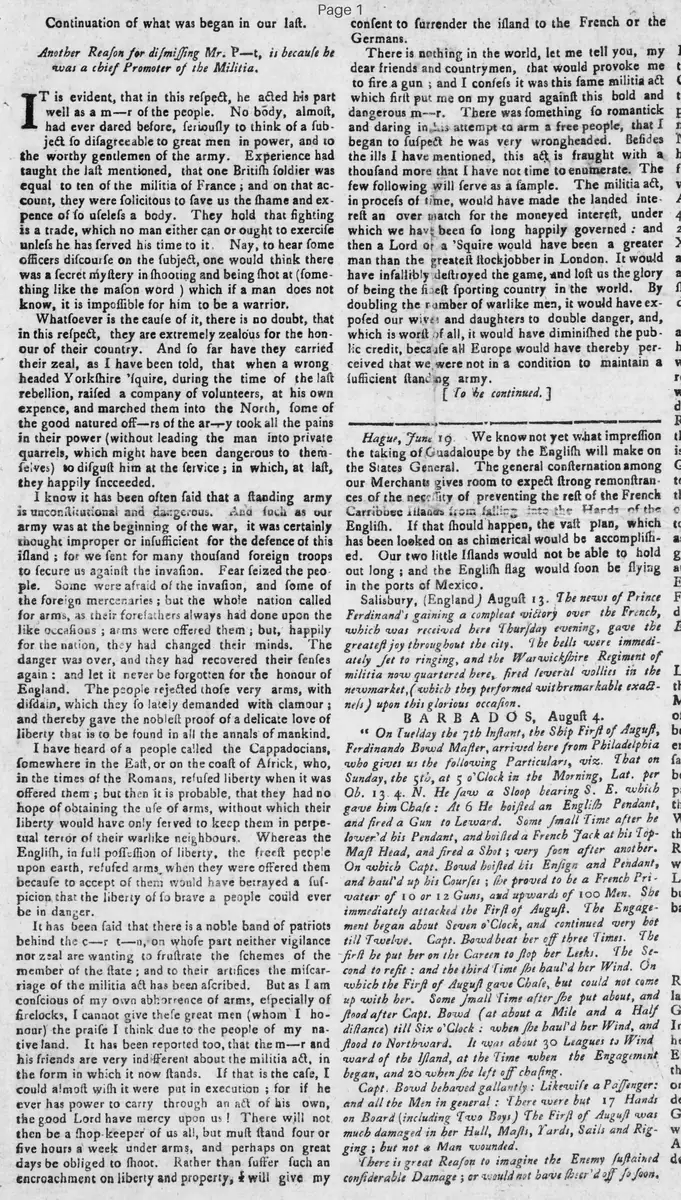
Continuation of what was began in our last.
Another Reason for dismissing Mr. P---t. is because he was a chief Promoter of the Militia. It is evident, that in this respect, he acted his part well as a member of the people. No body, almost, had ever dared before, seriously to think of a subject so disagreeable to great men in power, and to the worthy gentlemen of the army. Experience had taught the last mentioned, that one British soldier was equal to ten of the militia of France ; and on that account, they were solicitous to save us the shame and expense of so useless a body. They hold that fighting is a trade, which no man either can or ought to exercise unless he has served his time to it. Nay, to hear some officers discourse on the subject, one would think there was a secret mystery in shooting and being shot at (something like the mason word) which if a man does not know, it is impossible for him to be a warrior.
Whatsoever is the cause of it, there is no doubt, that in this respect, they are extremely zealous for the honour of their country. And so far have they carried their zeal, as I have been told, that when a wrong headed Yorkshire 'Squire, during the time of the last rebellion, raised a company of volunteers, at his own expense, and marched them into the North, some of the good natured officers of the army took all the pains in their power (without leading the man into private quarrels, which might have been dangerous to themselves) to disgust him at the service; in which, at last, they happily succeeded.
I know it has been often said that a standing army is unconstitutional and dangerous. And such as our army was at the beginning of the war, it was certainly thought improper or insufficient for the defence of this island ; for we sent for many thousand foreign troops to secure us against the invasion. Fear seized the people. Some were afraid of the invasion, and some of the foreign mercenaries ; but the whole nation called for arms, as their forefathers always had done upon the like occasions ; arms were offered them ; but, happily for the nation, they had changed their minds. The danger was over, and they had recovered their senses again : and let it never be forgotten for the honour of England. The people rejected those very arms, with disdain, which they so lately demanded with clamour ; and thereby gave the noblest proof of a delicate love of liberty that is to be found in all the annals of mankind.
I have heard of a people called the Cappadocians, somewhere in the East, or on the coast of Africk, who, in the times of the Romans, refused liberty when it was offered them : but then it is probable, that they had no hope of obtaining the use of arms, without which their liberty would have only served to keep them in perpetual terror of their warlike neighbours. Whereas the English, in full possession of liberty, the freest people upon earth, refused arms when they were offered them because to accept of them would have betrayed a suspicion that the liberty of so brave a people could ever be in danger.
It has been said that there is a noble band of patriots behind the curtain, on whose part neither vigilance nor zeal are wanting to frustrate the schemes of the members of the state : and to their artifices the miscarriage of the militia act has been ascribed. But as I am conscious of my own abhorrence of arms, especially of firelocks, I cannot give these great men (whom I honour) the praise I think due to the people of my native land. It has been reported too, that the minister and his friends are very indifferent about the militia act, in the form in which it now stands. If that is the case, I could almost wish it were put in execution : for if he ever has power to carry through an act of his own, the good Lord have mercy upon us ! There will not then be a shop-keeper of us all, but must stand four or five hours a week under arms, and perhaps on great days be obliged to shoot. Rather than suffer such an encroachment on liberty and property, I will give my consent to surrender the island to the French or the Germans.
There is nothing in the world, let me tell you, my dear friends and countrymen, that would provoke me to fire a gun ; and I confess it was this same militia act which first put me on my guard against this bold and dangerous minister. There was something so romantick and daring in his attempt to arm a free people, that I began to suspect he was very wrongheaded. Besides the ills I have mentioned, this act is fraught with a thousand more that I have not time to enumerate. The few following will serve as a sample. The militia act, in process of time, would have made the landed interest an over match for the moneyed interest, under which we have been so long happily governed : and then a Lord or a 'Squire would have been a greater man than the greatest stockjobber in London. It would have infallibly destroyed the game, and lost us the glory of being the most sporting country in the world. By doubling the number of warlike men, it would have exposed our wives and daughters to double danger, and, which is worst of all, it would have diminished the public credit, because all Europe would have thereby perceived that we were not in a condition to maintain a sufficient standing army.
[To be continued.]
Another Reason for dismissing Mr. P---t. is because he was a chief Promoter of the Militia. It is evident, that in this respect, he acted his part well as a member of the people. No body, almost, had ever dared before, seriously to think of a subject so disagreeable to great men in power, and to the worthy gentlemen of the army. Experience had taught the last mentioned, that one British soldier was equal to ten of the militia of France ; and on that account, they were solicitous to save us the shame and expense of so useless a body. They hold that fighting is a trade, which no man either can or ought to exercise unless he has served his time to it. Nay, to hear some officers discourse on the subject, one would think there was a secret mystery in shooting and being shot at (something like the mason word) which if a man does not know, it is impossible for him to be a warrior.
Whatsoever is the cause of it, there is no doubt, that in this respect, they are extremely zealous for the honour of their country. And so far have they carried their zeal, as I have been told, that when a wrong headed Yorkshire 'Squire, during the time of the last rebellion, raised a company of volunteers, at his own expense, and marched them into the North, some of the good natured officers of the army took all the pains in their power (without leading the man into private quarrels, which might have been dangerous to themselves) to disgust him at the service; in which, at last, they happily succeeded.
I know it has been often said that a standing army is unconstitutional and dangerous. And such as our army was at the beginning of the war, it was certainly thought improper or insufficient for the defence of this island ; for we sent for many thousand foreign troops to secure us against the invasion. Fear seized the people. Some were afraid of the invasion, and some of the foreign mercenaries ; but the whole nation called for arms, as their forefathers always had done upon the like occasions ; arms were offered them ; but, happily for the nation, they had changed their minds. The danger was over, and they had recovered their senses again : and let it never be forgotten for the honour of England. The people rejected those very arms, with disdain, which they so lately demanded with clamour ; and thereby gave the noblest proof of a delicate love of liberty that is to be found in all the annals of mankind.
I have heard of a people called the Cappadocians, somewhere in the East, or on the coast of Africk, who, in the times of the Romans, refused liberty when it was offered them : but then it is probable, that they had no hope of obtaining the use of arms, without which their liberty would have only served to keep them in perpetual terror of their warlike neighbours. Whereas the English, in full possession of liberty, the freest people upon earth, refused arms when they were offered them because to accept of them would have betrayed a suspicion that the liberty of so brave a people could ever be in danger.
It has been said that there is a noble band of patriots behind the curtain, on whose part neither vigilance nor zeal are wanting to frustrate the schemes of the members of the state : and to their artifices the miscarriage of the militia act has been ascribed. But as I am conscious of my own abhorrence of arms, especially of firelocks, I cannot give these great men (whom I honour) the praise I think due to the people of my native land. It has been reported too, that the minister and his friends are very indifferent about the militia act, in the form in which it now stands. If that is the case, I could almost wish it were put in execution : for if he ever has power to carry through an act of his own, the good Lord have mercy upon us ! There will not then be a shop-keeper of us all, but must stand four or five hours a week under arms, and perhaps on great days be obliged to shoot. Rather than suffer such an encroachment on liberty and property, I will give my consent to surrender the island to the French or the Germans.
There is nothing in the world, let me tell you, my dear friends and countrymen, that would provoke me to fire a gun ; and I confess it was this same militia act which first put me on my guard against this bold and dangerous minister. There was something so romantick and daring in his attempt to arm a free people, that I began to suspect he was very wrongheaded. Besides the ills I have mentioned, this act is fraught with a thousand more that I have not time to enumerate. The few following will serve as a sample. The militia act, in process of time, would have made the landed interest an over match for the moneyed interest, under which we have been so long happily governed : and then a Lord or a 'Squire would have been a greater man than the greatest stockjobber in London. It would have infallibly destroyed the game, and lost us the glory of being the most sporting country in the world. By doubling the number of warlike men, it would have exposed our wives and daughters to double danger, and, which is worst of all, it would have diminished the public credit, because all Europe would have thereby perceived that we were not in a condition to maintain a sufficient standing army.
[To be continued.]
What sub-type of article is it?
Military Affairs
Partisan Politics
Constitutional
What keywords are associated?
Militia Act
Standing Army
Liberty
Mr Pitt
Satire
Armed Populace
What entities or persons were involved?
Mr. P T
Minister
Army Officers
People Of England
Editorial Details
Primary Topic
Opposition To The Militia Act And Mr. Pitt's Promotion Of It
Stance / Tone
Satirical Criticism Of Arming The Populace And The Minister
Key Figures
Mr. P T
Minister
Army Officers
People Of England
Key Arguments
Mr. P T Promoted The Useless And Expensive Militia
British Soldiers Superior To Militia
Standing Army Is A Professional Trade
People Rejected Arms To Affirm Liberty
Militia Act Threatens Liberty And Property
Would Empower Landed Interest Over Moneyed
Destroys Game And Exposes Women To Danger
Diminishes Public Credit