Thank you for visiting SNEWPapers!
Sign up free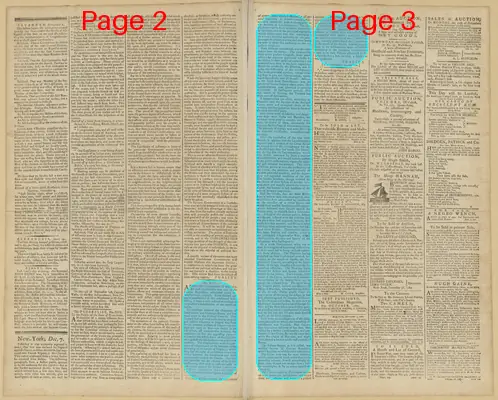
The Daily Advertiser
New York, New York County, New York
What is this article about?
Essay compares the Amphictyonic Council and Achaean league of ancient Greece to the American Confederation, highlighting theoretical powers versus practical weaknesses, domination by powerful states, and the need for a closer union to avoid ruin.
Merged-components note: Merged the two components as they form the complete Federalist No. XVIII essay, which was split during initial parsing. The content is an opinion piece on federalism, fitting the editorial label.
Clippings
1 of 2
OCR Quality
Full Text
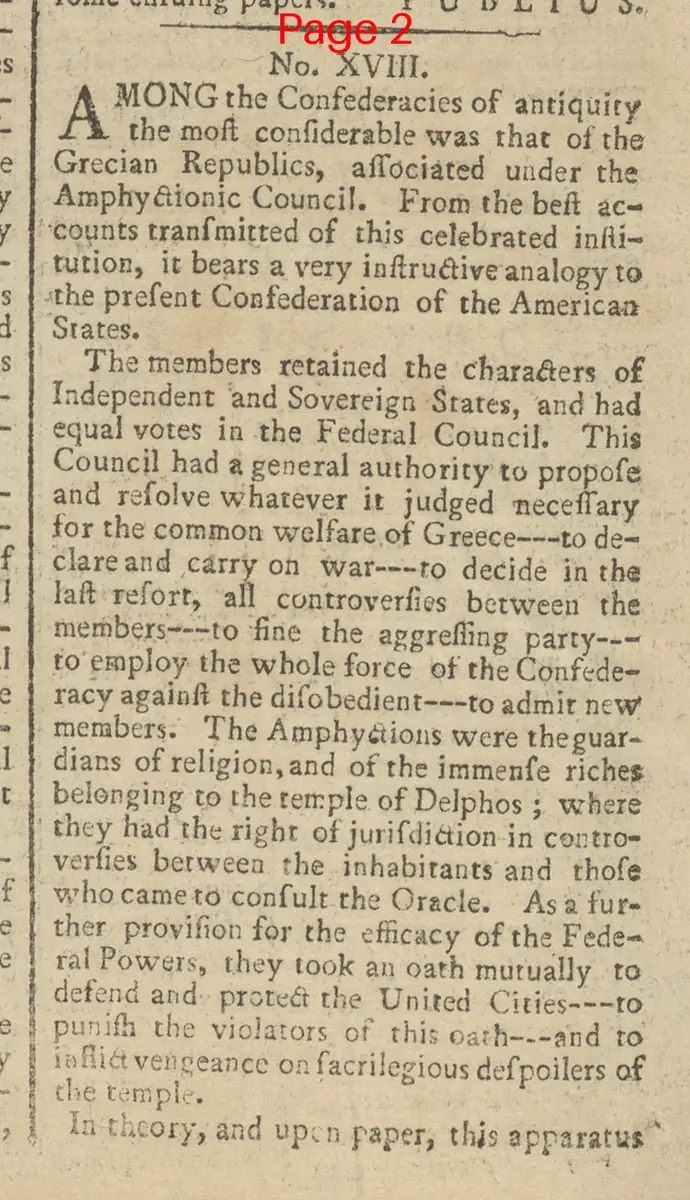
Among the Confederacies of antiquity, the most considerable was that of the Grecian Republics, associated under the Amphictyonic Council. From the best accounts transmitted of this celebrated institution, it bears a very instructive analogy to the present Confederation of the American States.
The members retained the characters of independent and sovereign States, and had equal votes in the Federal Council. This Council had a general authority to propose and resolve whatever it judged necessary for the common welfare of Greece—to declare and carry on war—to decide, in the last resort, all controversies between the members—to fine the aggressing party—to employ the whole force of the Confederacy against the disobedient—to admit new members. The Amphictyons were the guardians of religion, and of the immense riches belonging to the temple of Delphos; where they had the right of jurisdiction in controversies between the inhabitants and those who came to consult the Oracle. As a further provision for the efficacy of the Federal Powers, they took an oath mutually to defend and protect the United Cities—to punish the violators of this oath—and to inflict vengeance on sacrilegious despoilers of the temple.
In theory, and upon paper, this apparatus of powers seems amply sufficient for all general purposes. In several material instances they exceed the powers enumerated in the Articles of Confederation. The Amphictyons had in their hands the superstition of the times, one of the principal engines by which Government was then maintained; they had a declared authority to use coercion against refractory cities, and were bound by oath to exert this authority on the necessary occasions.
Very different nevertheless was the experiment from the theory. The powers, like those of the present Congress, were administered by deputies appointed wholly by the Cities, in their political capacities; and exercised over them in the same capacities. Hence the weakness, the disorders, and finally, the destruction of the Confederacy. The more powerful members, instead of being kept in awe and subordination, tyrannized successively over all the rest. Athens, as we learn from Demosthenes, was the arbiter of Greece seventy-three years. The Lacedemonians next governed it twenty-nine years. At subsequent periods, after the battle of Leuctra, the Thebans had their turn of domination.
It happened but too often, according to Plutarch, that the deputies of the strongest Cities, awed and corrupted those of the weaker, and that judgment went in favor of the most powerful party.
Even in the midst of defensive and dangerous wars with Persia and Macedon, the members never acted in concert, and were, more or fewer of them, alternately the dupes or the hirelings of the common enemy. The intervals of foreign war were filled up by domestic vicissitudes, convulsions and carnage.
After the conclusion of the war with Xerxes, it appears that the Lacedemonians required that a number of the Cities should be turned out of the Confederacy for the unfaithful part they had acted. The Athenians finding that the Lacedemonians would lose fewer partizans by such a measure than themselves, and would become masters of the public deliberations, vigorously opposed and defeated the attempt. This piece of history proves at once the inefficiency of the Union, the ambition and jealousy of its most powerful members, and the dependent and degraded condition of the rest.
The smaller members, though entitled by the theory of their system to revolve in equal pride and majesty around the common center, had become in fact satellites of the orbs of primary magnitude.
Had the Greeks, says the Abbe Milot, been as wise as they were courageous, they would have been admonished by experience of the necessity of a closer Union, and would have availed themselves of the peace, which followed their success against the Persian arms, to establish such a reformation. Instead of this obvious policy, Athens and Sparta, inflated with the victories and the glory they had acquired, became, first rivals and then enemies; and did each other infinitely more mischief than they had suffered from Xerxes. Their mutual jealousies, fears, hatreds and injuries, ended in the celebrated Peloponnesian War; which itself ended in the ruin and slavery of the Athenians, who had begun it.
As a weak Government, when not at war, is ever agitated by internal dissensions, so these never fail to bring on fresh calamities from abroad. The Phocians having ploughed up some consecrated ground, belonging to the temple of Apollo, the Amphictyonic Council, according to the superstition of the age, imposed a fine on the sacrilegious offenders. The Phocians being abetted by Athens and Sparta, refused to submit to the decree. The Thebans, with others of the Cities, undertook to maintain the authority of the Amphictyons, and to avenge the violated God. The latter being the weaker party, invited the assistance of Philip of Macedon, who had secretly fostered the contest. Philip gladly seized the opportunity of executing the designs he had long planned against the liberties of Greece. By his intrigues and bribes, he won over to his interest the popular leaders of several Cities; and by their influence and votes, gained admission into the Amphictyonic Council and by his arts and his arms made himself master of the Confederacy.
Such were the consequences of the fallacious principle on which this interesting establishment was founded. Had Greece, says a judicious observer of her fate, been united by a stricter Confederation, and persevered in her Union, she would never have worn the chains of Macedon, and might have proved a barrier to the vast projects of Rome.
The Achaean league, as it is called, was another society of Grecian Republics, which supplies us with useful and fruitful instructions. The Union here was far more intimate, and its organization much wiser than in the preceding instance. It will accordingly appear, that, though not exempt from a similar catastrophe, it by no means equally deserved it.
The Cities composing this league retained their municipal jurisdictions, appointed their own officers, and enjoyed a perfect equality. The Senate, in which they were represented, had the sole and exclusive right of peace and war; of sending and receiving Ambassadors; of entering into treaties and alliances; of appointing a Chief Magistrate, or Praetor, as he was called, who commanded their armies: and who, with the advice and consent of ten of the Senators, not only administered the Government in the recesses of the Senate, but had a great share in its deliberations when assembled. According to the primitive constitution, there were two Praetors associated in the Administration; but, on trial, a single one was preferred.
PUBLIUS.
[The remainder to-morrow.]
What sub-type of article is it?
What keywords are associated?
What entities or persons were involved?
Editorial Details
Primary Topic
Comparison Of Ancient Greek Confederacies To The American Confederation
Stance / Tone
Critical Of Weak Confederacies, Advocating Stronger Federal Union
Key Figures
Key Arguments