Thank you for visiting SNEWPapers!
Sign up free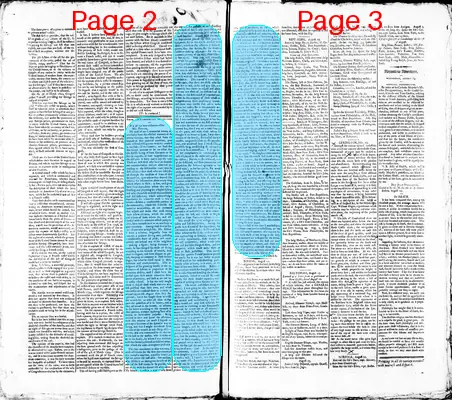
Alexandria Advertiser And Commercial Intelligencer
Alexandria, Virginia
What is this article about?
A letter critiquing the vain, European-influenced fashionable manners in American commercial towns, which foster moral errors like class disdain and neglect of benevolence. The author contrasts this with natural country ways via an anecdote of visiting a wealthy relative's ostentatious family.
Merged-components note: Direct textual continuation of the letter to the editor across pages 2 and 3, with sequential reading orders.
Clippings
1 of 2
OCR Quality
Full Text
Non est tua tuta voluntas—Ovi.
Mr. EDITOR,
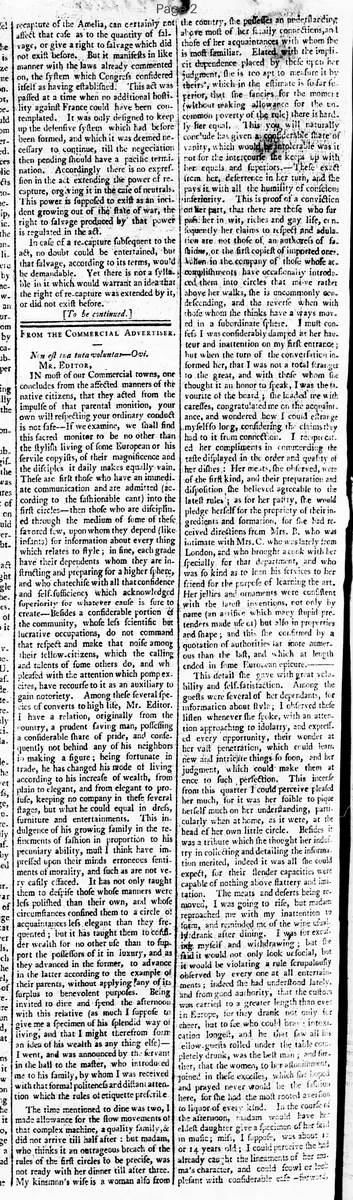
IN most of our Commercial towns, one concludes from the affected manners of the native citizens, that they acted from the impulse of that parental monition, your own will respecting your ordinary conduct is not safe—If we examine, we shall find this sacred monitor to be no other than the stylish living of some European or his servile copyists, of their magnificence and the disciples it daily makes equally vain.
These are first those who have an immediate communication and are admitted (according to the fashionable cant) into the first circles—then those who are disciplined through the medium of some of these favored few, upon whom they depend (like infants) for information about every thing which relates to style; in fine, each grade have their dependents whom they are instructing and preparing for a higher sphere, and who catechise with all that confidence and self-sufficiency which acknowledged superiority for whatever cause is sure to create—Besides a considerable portion of the community, whose less scientific but lucrative occupations, do not command that respect and make that noise among their fellow-citizens, which the calling and talents of some others do, and who pleased with the attention which pomp excites, have recourse to it as an auxiliary to gain notoriety. Among these several species of converts to high life, Mr. Editor, I have a relation, originally from the country, a prudent saving man, possessing a considerable share of pride, and consequently not behind any of his neighbors in making a figure; being fortunate in trade, he has changed his mode of living according to his increase of wealth, from plain to elegant, and from elegant to profuse, keeping no company in these several stages, but what he could equal in dress, furniture and entertainments. This indulgence of his growing family in the refinements of fashion in proportion to his pecuniary ability, must I think have impressed upon their minds erroneous sentiments of morality, and such as are not very easily effaced. It has not only taught them to despise those whose manners were less polished than their own, and whose circumstances confined them to a circle of acquaintances less elegant than they frequent; but it has taught them to consider wealth in no other light than to support the possessors of it in luxury, and as they advanced in the former, to advance in the latter according to the example of their parents, without applying any of its surplus to benevolent purposes. Being invited to dine and spend the afternoon with this relative (as much I suppose to give me a specimen of his splendid way of living, and that I might therefrom form an idea of his wealth as any thing else)—I went, and was announced by the servant in the hall to the master, who introduced me to his family, by whom I was received with that formal politeness and distant attention which the rules of etiquette prescribe. The time mentioned to dine was two, I made allowance for the slow movements of that complex machine, a quality family, & did not arrive till half after: but madam, who thinks it an outrageous breach of the rules of the first circles to be precise, was not ready with her dinner till after three.
My kinsman's wife is a woman also from the country, the possessor an understanding above most of her family connections, and those of her acquaintances with whom she is most familiar. Elated with the implicit dependence placed by these on her judgment, she is too apt to measure it by theirs, wherein the estimate is so far superior, that she fancies, for the moment at least without making allowance for the uncommon poverty of the style) there is hardly her equal. This you will naturally conclude has given a considerable share of vanity, which would be intolerable was it not for the intercourse she keeps up with her equals and superiors.—These exact from her, deference in her turn, and she pays it with all the humility of conscious inferiority. This is proof of a conviction on her part, that there are those who surpass her in wit, riches and gay life, consequently—her claims to respect and adulation are not those of an authoress of fashion, or the first copyist of imported ones. Among in the company of those whose accomplishments have occasionally introduced them into circles that move rather above her walks, she is uncommonly condescending, and the reverse when with those whom she thinks have always moved in a subordinate sphere. I must confess I was considerably dismayed at her hauteur and inattention on my first entrance: but when the turn of the conversation informed her, that I was not a total stranger to the great, and with those whom she thought it an honor to speak, I was the favorite of the board; she loaded me with caresses, congratulated me on the acquaintance, and wondered how I could estrange myself so long, considering the claims they had to it from connection. I reciprocated her compliments in commending the taste displayed in the order and quality of her dishes: Her meats, she observed, were of the first kind, and their preparation and disposition she believed agreeable to the latest rules'; as for her pastry, she would pledge herself for the propriety of their ingredients and formation, for she had received directions from Mrs. B. who was intimate with Mrs. C. who was lately from London, and who brought a cook with her especially for that department, and who was so kind as to lend his services to her friend for the purpose of learning the art.
Her jellies and ornaments were consistent with the latest inventions, not only by name (an artifice which many stupid pretenders made use of) but also in properties and shape; and this she confirmed by a quotation of authorities far more numerous than the last, and which at length ended in some European epicure.
This detail she gave with great volubility and self-satisfaction. Among the guests were several of her dependents, for information about style: I observed these listen whenever she spoke, with an attention approaching to idolatry, and expressed every opportunity, their wonder at her vast penetration, which could learn new and intricate things so soon, and her judgment, which could make them at once to such perfection. This incense from this quarter I could perceive pleased her much, for it was her foible to pique herself much on her understanding, particularly when at home, as it were, at the head of her own little circle. Besides it was a tribute which she thought her industry in collecting and detailing the information merited, indeed it was all she could expect, for their slender capacities were capable of nothing above flattery and imitation. The meats and deserts being removed, I was going to rise, but madam reproached me with my inattention to form, and reminded me of the wine usual hydrank after dining. I was sorry excusing myself and withdrawing: but she said it would not only look unsocial, but it would be violating a rule scrupulously observed by every one at all entertainments; indeed she had understood lately, and from good authority, that the custom was carried to a greater length than ever in Europe, for they drank not only for cheer, but to see who could brave intoxication longest, and he that saw all his fellow-guests rolled under the table completely drunk, was the best man; and further, that the women, to her astonishment, joined in these excesses, which she hoped and prayed never would be the fashion here, for she had the most rooted aversion to liquor of every kind. In the course of the afternoon, madam would have her eldest daughter give a specimen of her skill in music; miss, I suppose, was about 12 or 14 years old; I could perceive she had already caught the lineaments of her mama's character, and could scowl or look pleasant with considerable ease—forward,
pert, and fierceilious, at times, which were thought to be piques of a strong and quick mind—affected and imitative, which it was said was a mark of her having kept good company and manifested a disposition still to do it, and improve farther in manners and knowledge of politeness. One, this young ape (the term is rather harsh, but I know of none more appropriate) could feign reluctance to oblige, and a sweet disposition, which prevented her from executing well; the former was easily overcome by persuasion, and the latter soon removed by a little fulsome praise. While playing, she took occasion to refer, as it were by accident, to certain misses, whose families were notorious in the beau monde. As, that her instrument was like Miss B's; that air she learnt from Miss C. this one of Miss D. altho' she couldn't think she played it half as well (in which she was contradicted by a certain parasite present) all in that easy and familiar way as to suspect to disguise her intention, which was to let the company know with whom she associated, and to give currency to whatever she said, as coming from the fountain of fashion. Towards evening after most of the company had left us, a family ride was suggested, which was resolved upon, and I was to make one of the party. A coach was ordered; here was another ceremony to be observed before we could taste the projected pleasure: the carriage after it had arrived most stand full an hour before we must enter, altho' we were all ready—I could see that the whole family followed this custom right against their inclinations, the children evinced their impatience to be off, by their half cries and urging calls of "come ma, we are ready," the daughter observed that she was sure the coach had stood as long as Mrs. --, did the other afternoon, and if it hadn't it was no matter, for it wasn't worth while to be so particular.— For once I saw this lady's patience in submitting to form fail, she shewed her desire to be gone by frequent recurrences to her watch and running about the house pretending to be busy, and affecting that she couldn't find something she wanted before she started, but it was all to beguile time. At length unable to resist her own uneasiness and the increasing clamours of her children (after waiting about half an hour) she concluded to go, with observing in the way, "what a folly it was to be ruled by the caprice of fashion, as for her part she meant to be independent, and do as she pleased, in defiance of the will of others" —in many other impertinences, Mr. Editor, I see practiced by this family, the detail of which at present, would make this number too long for your paper. The conduct at the time I recollect excited some comparative reflections, on the easy and natural manners of a country family with those of one living in the city. whose minutest act is shaped by the whimsical hand of fashion—the first act more from the impulse of nature, and their own ideas of propriety—the last from the impulse of art and the opinions and wills of others of what is fit to be said or done.
ETHICUS.
What sub-type of article is it?
What themes does it cover?
What keywords are associated?
What entities or persons were involved?
Letter to Editor Details
Author
Ethicus
Recipient
Mr. Editor
Main Argument
the adoption of vain, european-influenced fashionable manners in commercial towns leads to moral errors, such as despising the less affluent and using wealth only for luxury rather than benevolence, as illustrated by the author's relative's family.
Notable Details