Thank you for visiting SNEWPapers!
Sign up free
Virginia Argus
Richmond, Virginia
What is this article about?
This editorial from the American Mercury criticizes Federalists for collaborating with British Minister Erskine to undermine Jefferson's administration and promote union dissolution. It highlights Gallatin's letter defending Jefferson's impartial foreign policy against Federalist and British slanders.
Merged-components note: Continuation of the editorial commentary on federalists, Erskine's letters, and Mr. Gallatin's reply across the page break.
Clippings
1 of 2
OCR Quality
Full Text
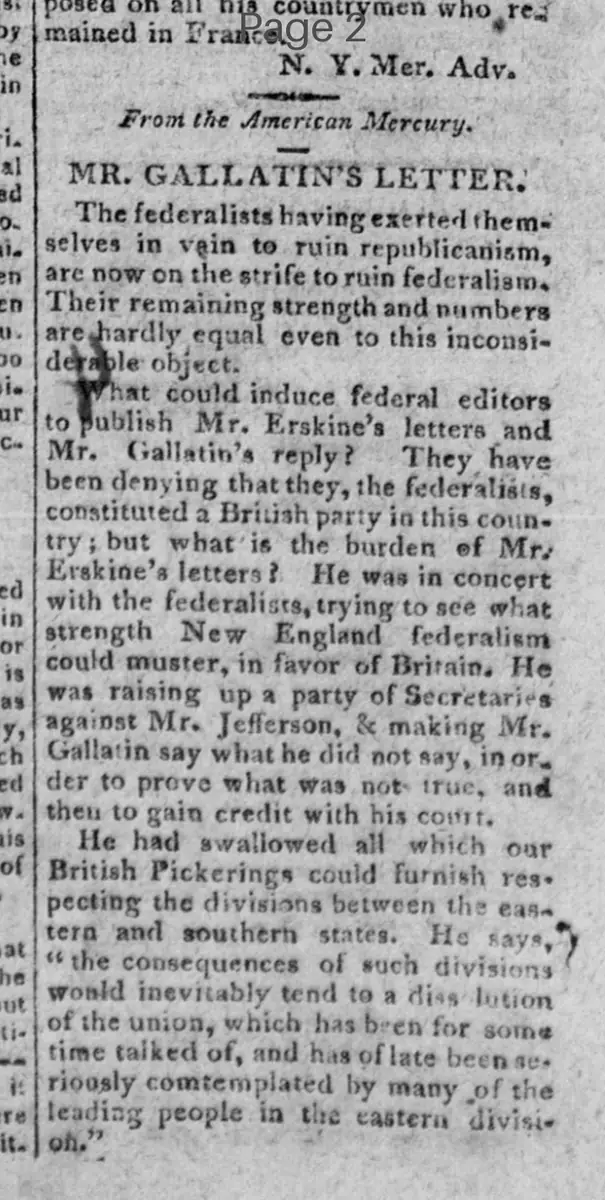
From the American Mercury.
MR. GALLATIN'S LETTER.
The federalists having exerted themselves in vain to ruin republicanism, are now on the strife to ruin federalism. Their remaining strength and numbers are hardly equal even to this inconsiderable object.
What could induce federal editors to publish Mr. Erskine's letters and Mr. Gallatin's reply? They have been denying that they, the federalists, constituted a British party in this country: but what is the burden of Mr. Erskine's letters? He was in concert with the federalists, trying to see what strength New England federalism could muster, in favor of Britain. He was raising up a party of Secretaries against Mr. Jefferson, & making Mr. Gallatin say what he did not say, in order to prove what was not true. and then to gain credit with his court. He had swallowed all which our British Pickerings could furnish respecting the divisions between the eastern and southern states. He says, "the consequences of such divisions would inevitably tend to a dissolution of the union, which has been for some time talked of, and has of late been seriously contemplated by many of the leading people in the eastern division."
Will any doubt whether these leading people are federalists or republicans? No, our Washingtonian Pickerings, Gores, Otises and other Jacksonians are all for dividing the union, whenever things do not go according to their mind. Mr. Pickering told Mr. Erskine all these fine stories, and the letters are so much like Pickering's famous letter, and so much like the rest of federal nonsense about division, that Pickering is probably the author of the letters said to be Erskine's. It is impossible for a Briton to write in such way without help. H- married an American wife, he kept federal company, and would naturally learn some of the language, but he could never write so much in Pickering's style. The letters however bear the name of Erskine, the British minister, who will soon be made earl of Essex, (from his intimacy with the junto) or have some other title for his faithful services in this country. A French minister may travel from end to end of the continent; he will find very few of his nation and language among us, seldom one who takes any interest in politics, and no republican who will fail to reprobate the outrages on our commerce in the ports of France and Naples. Far different is the condition of Erskine. He is hand & glove with Pinkney, as much as Pinkney is with Gore. Travelling the country he sees thousands of British subjects, most of them violent federalists and sets other thousands of federal Washingtonians, who feel, & talk & toast as ardently in favor of Britain as he does, and who would divide the union, if the interests of Britain required it. Who told Mr. Erskine to write to Mr. Canning that the non-intercourse law would, if continued, operate so upon the eastern states that it would not be submitted to long, and that during its continuance his majesty's subjects could run their goods through Canada into the United States. Does any one believe that general Varnum told him to write this? Who told Mr. Erskine to slander Mr. Jefferson on the authority of Mr. Gallatin? The federalist, who did it, made a dreadful mistake; as appears by Mr. Gallatin's reply, in which is the following memorable sentence, "Eight years of the most intimate intercourse, during which not an act, and hardly a thought respecting the foreign relations of America was concealed, enable me confidently to say, that Mr. Jefferson never had in that respect, any other object in view but the protection of the rights of the United States against every foreign aggression or injury, from whatever nation it proceeded, and has in every instance, observed towards all the belligerents, the most strict justice and the most scrupulous impartiality." Erskine had chosen his own witness. In the presence of Mr. Gallatin, to establish an abandoned charge against Mr. Jefferson. Coleman had given dark hints of storms in the cabinet. Dr. Park, Major Russell, and the pestle pounder of the Palladium, were all in the secret. The editors of little bitter federal papers suspected something, and last, and least of all, the Indian doctor and his Ariel knew all about it. His knowledge is most perfect, where there is no subject or fact. The mighty secret of Mr. Gallatin's testimony against Mr. Jefferson was gathered in federalism like the contents of a mighty boil, nourished by inward corruption, till at length it burst from the diplomatic orifice of the British minister, and discharged copiously to the lasting mortification of New-England federalism.
What sub-type of article is it?
What keywords are associated?
What entities or persons were involved?
Editorial Details
Primary Topic
Critique Of Federalist Collaboration With British Interests And Defense Of Jefferson's Foreign Policy
Stance / Tone
Strongly Pro Republican, Anti Federalist, Satirical Mockery Of British Federalist Alliance
Key Figures
Key Arguments