Thank you for visiting SNEWPapers!
Sign up free
New Haven Daily Herald
New Haven, New Haven County, Connecticut
What is this article about?
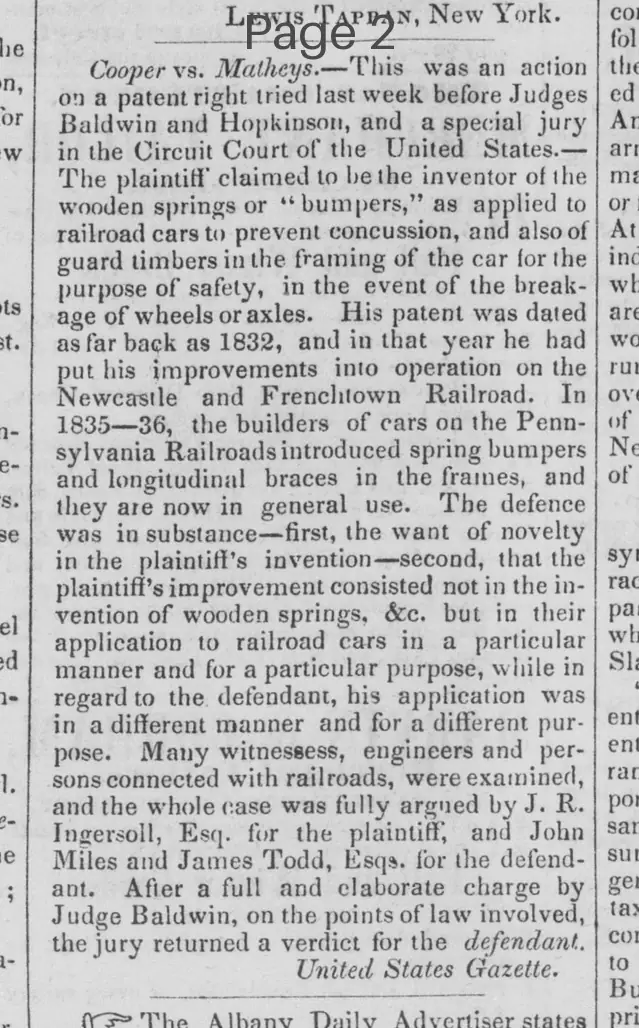
In the US Circuit Court, Cooper sued Matheys over a patent for wooden springs and guard timbers for railroad cars, invented in 1832 and used on the Newcastle and Frenchtown Railroad. The defense argued lack of novelty and different application. After testimony and arguments by J.R. Ingersoll for plaintiff and John Miles and James Todd for defendant, Judge Baldwin charged the jury, who returned a verdict for the defendant.
Clipping
OCR Quality
Full Text
United States Gazette.
What sub-type of article is it?
What keywords are associated?
What entities or persons were involved?
Domestic News Details
Event Date
Last Week
Key Persons
Outcome
the jury returned a verdict for the defendant
Event Details
This was an action on a patent right tried last week before Judges Baldwin and Hopkinson, and a special jury in the Circuit Court of the United States. The plaintiff claimed to be the inventor of the wooden springs or "bumpers," as applied to railroad cars to prevent concussion, and also of guard timbers in the framing of the car for the purpose of safety, in the event of the breakage of wheels or axles. His patent was dated as far back as 1832, and in that year he had put his improvements into operation on the Newcastle and Frenchtown Railroad. In 1835-36, the builders of cars on the Pennsylvania Railroads introduced spring bumpers and longitudinal braces in the frames, and they are now in general use. The defence was in substance—first, the want of novelty in the plaintiff's invention—second, that the plaintiff's improvement consisted not in the invention of wooden springs, &c. but in their application to railroad cars in a particular manner and for a particular purpose, while in regard to the defendant, his application was in a different manner and for a different purpose. Many witnesses, engineers and persons connected with railroads, were examined, and the whole case was fully argued by J. R. Ingersoll, Esq. for the plaintiff, and John Miles and James Todd. Esqs. for the defendant. After a full and elaborate charge by Judge Baldwin, on the points of law involved