Thank you for visiting SNEWPapers!
Sign up free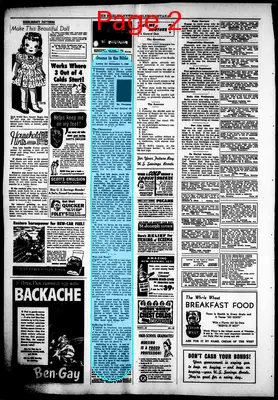
Literary
November 5, 1948
The Harlem News
Harlem, Blaine County, Montana
What is this article about?
This article presents the Book of Job as a dramatic biblical narrative exploring the conflict between faith and suffering. It recounts Job's trials inflicted by Satan with God's permission, his steadfastness, and the debate with friends on why good people suffer, concluding that suffering tests true faith and goodness.
Clipping

OCR Quality
95%
Excellent
Full Text
SCRIPTURE: The Book of Job.
DEVOTIONAL READING: Job 23:8-10.
Drama in the Bible
Lesson for November 7, 1948
THOMAS CARLYLE, dyspeptic but a literary artist of no small skill, was visiting a crusty Christian friend. In the morning at family prayers (so the story goes) his host put into his hands a copy of the Bible and asked him to read a chapter. Carlyle opened at the first chapter of Job; read it—read on to the next and the next and the next - and refused to stop reading till he had finished all 42 chapters.
Job is like that. It is a book you hate to put down. In all the Bible it is the outstanding example of the drama; a drama of conflict in which the opposing forces are not people as much as ideas.
The Characters
THE characters at first are three: God, Satan and a man named Job. Job is a good man, in fact God calls him perfect. He is also prosperous, and thereby hangs the tale.
For one fateful day God and Satan have a conversation about this man. The Lord inquires if Satan has seen him, and how good he is. Oh yes, Satan says airily, he has seen him, but he does not think highly of his "goodness." He is too well paid for it. He has a large and happy family, and has immense wealth; why shouldn't he be good? Take away his prosperity and he will curse you to your face, Satan sneers.
So God lets Satan work his malice on the man. In a terrible series of disasters, one rushing on another's heels everything Job has owned vanishes: His children are killed by storm and fire, and Job is left a childless, penniless man.
But Job does not complain; his faith in God still does not waver.
So when next Satan reports to God, the Almighty asks again: Did you see my servant Job? He holds fast to his integrity. Ah, yes, sneers the unbelieving fiend. Yes, but he still has his health. He can have another family, another fortune. Make life itself so miserable that he will long to die, and then you will see his goodness vanish, then he surely will curse you to your face.
So God let Satan do his worst- Do all you can to him, God says, only leave him alive. And then Job is made horribly and painfully ill, he cannot sleep for the torture of boils covering him from head to foot. Three of his friends come to visit him. For seven days they sit in silence. and then begins a great debate with Job on one side and his friends on the other: Why must such things be?
Why must good people suffer?
Was Job Real?
DON'T ask: Was Job a real character, or a made-up one like Hamlet and Macbeth? It is very likely there was once upon a time some man by that name who suffered in that way, and that he had friends, not too sympathetic, who talked it over with him.
As Hamlet and Macbeth were historical characters, whom Shakespeare used with high art to express profound ideas, so the author of Job may well have used the trials of some man he knew, or knew of, to express truths about a problem as profound and widespread as the human race.
For Job most surely is real: his local name may be Smith or Jones, and he may be living just around the corner from you. Indeed, sooner or later every man's name is Job.
Sooner or later, every thoughtful person has to face the tragedy of human suffering:
Why must such things be?
Suffering Is Test
THERE is, however, one solution which comes out in the course of the drama. It is not a theoretical solution; that is, it does not altogether answer the question, WHY must men suffer? It does tell us WHAT we can do about it.
Suffering is a test: A test of man's faith and real goodness.
“When he hath tried me, I shall come forth as gold,” Job says. (23:10.) The test of a ship is not the quiet waters of the harbor but the rearing open seas the test of a man is not comfort but stress and pain.
To have faith in God only when we are well-fed and softly clad is not faith at its best. Real faith and goodness prove their reality only when they hold together when torn by the nails of a cross.
(Supplied by the
DEVOTIONAL READING: Job 23:8-10.
Drama in the Bible
Lesson for November 7, 1948
THOMAS CARLYLE, dyspeptic but a literary artist of no small skill, was visiting a crusty Christian friend. In the morning at family prayers (so the story goes) his host put into his hands a copy of the Bible and asked him to read a chapter. Carlyle opened at the first chapter of Job; read it—read on to the next and the next and the next - and refused to stop reading till he had finished all 42 chapters.
Job is like that. It is a book you hate to put down. In all the Bible it is the outstanding example of the drama; a drama of conflict in which the opposing forces are not people as much as ideas.
The Characters
THE characters at first are three: God, Satan and a man named Job. Job is a good man, in fact God calls him perfect. He is also prosperous, and thereby hangs the tale.
For one fateful day God and Satan have a conversation about this man. The Lord inquires if Satan has seen him, and how good he is. Oh yes, Satan says airily, he has seen him, but he does not think highly of his "goodness." He is too well paid for it. He has a large and happy family, and has immense wealth; why shouldn't he be good? Take away his prosperity and he will curse you to your face, Satan sneers.
So God lets Satan work his malice on the man. In a terrible series of disasters, one rushing on another's heels everything Job has owned vanishes: His children are killed by storm and fire, and Job is left a childless, penniless man.
But Job does not complain; his faith in God still does not waver.
So when next Satan reports to God, the Almighty asks again: Did you see my servant Job? He holds fast to his integrity. Ah, yes, sneers the unbelieving fiend. Yes, but he still has his health. He can have another family, another fortune. Make life itself so miserable that he will long to die, and then you will see his goodness vanish, then he surely will curse you to your face.
So God let Satan do his worst- Do all you can to him, God says, only leave him alive. And then Job is made horribly and painfully ill, he cannot sleep for the torture of boils covering him from head to foot. Three of his friends come to visit him. For seven days they sit in silence. and then begins a great debate with Job on one side and his friends on the other: Why must such things be?
Why must good people suffer?
Was Job Real?
DON'T ask: Was Job a real character, or a made-up one like Hamlet and Macbeth? It is very likely there was once upon a time some man by that name who suffered in that way, and that he had friends, not too sympathetic, who talked it over with him.
As Hamlet and Macbeth were historical characters, whom Shakespeare used with high art to express profound ideas, so the author of Job may well have used the trials of some man he knew, or knew of, to express truths about a problem as profound and widespread as the human race.
For Job most surely is real: his local name may be Smith or Jones, and he may be living just around the corner from you. Indeed, sooner or later every man's name is Job.
Sooner or later, every thoughtful person has to face the tragedy of human suffering:
Why must such things be?
Suffering Is Test
THERE is, however, one solution which comes out in the course of the drama. It is not a theoretical solution; that is, it does not altogether answer the question, WHY must men suffer? It does tell us WHAT we can do about it.
Suffering is a test: A test of man's faith and real goodness.
“When he hath tried me, I shall come forth as gold,” Job says. (23:10.) The test of a ship is not the quiet waters of the harbor but the rearing open seas the test of a man is not comfort but stress and pain.
To have faith in God only when we are well-fed and softly clad is not faith at its best. Real faith and goodness prove their reality only when they hold together when torn by the nails of a cross.
(Supplied by the
What sub-type of article is it?
Essay
What themes does it cover?
Religious
Moral Virtue
What keywords are associated?
Book Of Job
Biblical Drama
Suffering
Faith Test
God And Satan
Literary Details
Title
Drama In The Bible
Subject
Lesson For November 7, 1948
Key Lines
“When He Hath Tried Me, I Shall Come Forth As Gold,” Job Says. (23:10.)